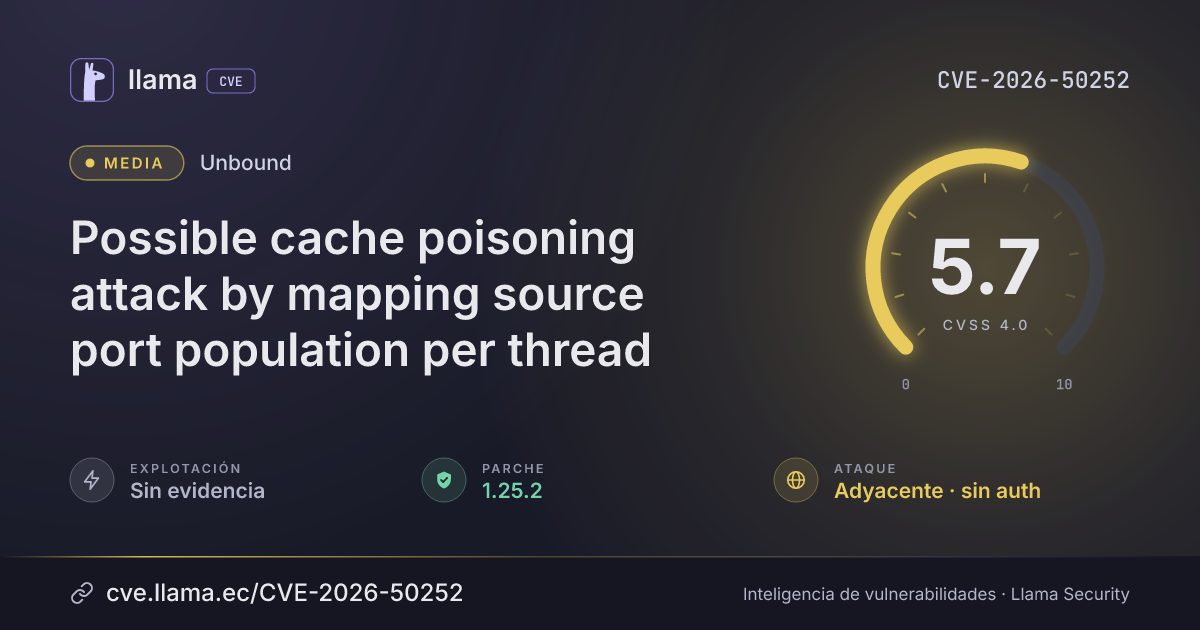
CVE-2026-50252
Possible cache poisoning attack by mapping source port population per thread
CVSS:4.0/AV:A/AC:L/AT:P/PR:N/UI:N/VC:N/VI:H/VA:N/SC:N/SI:H/SA:H/E:P/U:Amber
Fuente: CNA
CVSS:3.1/AV:A/AC:L/PR:N/UI:N/S:C/C:N/I:H/A:HCiclo de vida de la vulnerabilidad
| Fecha | Fase | Evento | Detalle |
|---|---|---|---|
| Divulgación | Publicada | CVE-2026-50252 divulgada · CVSS 5.7 (CNA) | |
| Divulgación | Evaluación SSVC | CISA-ADP · explotación ninguna | |
| Divulgación | Modificada | Última actualización del registro | |
| Monitoreo | Detectada | Ingresó al índice | |
| Monitoreo | Verificada | Última verificación contra las fuentes |
In NLnet Labs Unbound 1.4.22 up to and including 1.25.1, UDP source port is randomized and intended to serve as a secret value that increases the entropy of DNS transactions. When resolver load balancing policies depend on the source port while their outcome is revealed this secrecy is undermined. The vulnerability arises when the load balancing policy is consistent with respect to the incoming source UDP port and IP address while heavily depending on the incoming source UDP port as a randomization source. When the SO_REUSEPORT configuration option is enabled ('so-reuseport: yes') in Unbound (by default), it meets these conditions, making it vulnerable for DNS cache poisoning attacks. Upon startup, Unbound randomly partitions the available UDP source port space into disjoint subsets of (almost) equal size, assigning each subset to a specific worker thread. When an incoming DNS query is received, the kernel’s SO_REUSEPORT load balancing mechanism deterministically assigns the query to a socket associated with a particular thread. All outgoing DNS queries generated during the resolution of that request use source ports selected exclusively from the port subset assigned to the corresponding thread. Since these port subsets are disjoint across threads, the source port observed in a resolver’s outgoing query to an authoritative name server serves as a reliable indicator of the worker thread that processed the original client query. A malicious actor can acquire the mapping between incoming UDP source ports (for a given fixed source IP address) and Unbound worker threads and leverage it to conduct DNS cache poisoning attacks by effectively lowering the random port population per thread.
Desglose de métricas
Rangos afectados
Estado del parche por paquete
| Paquete / producto | Estado | Corregida en | Desde divulgación | Última versión |
|---|---|---|---|---|
Unbound |
Corregida | 1.25.2 | — | — |
1.25.2Arsenal público
Sin exploits, módulos ni PoC públicos conocidos a la fecha de verificación.
https://www.nlnetlabs.nl/downloads/unbound/CVE-2026-50252.txtLas referencias externas se muestran para copiar: cve.llama.ec no lo redirige a otros sitios.