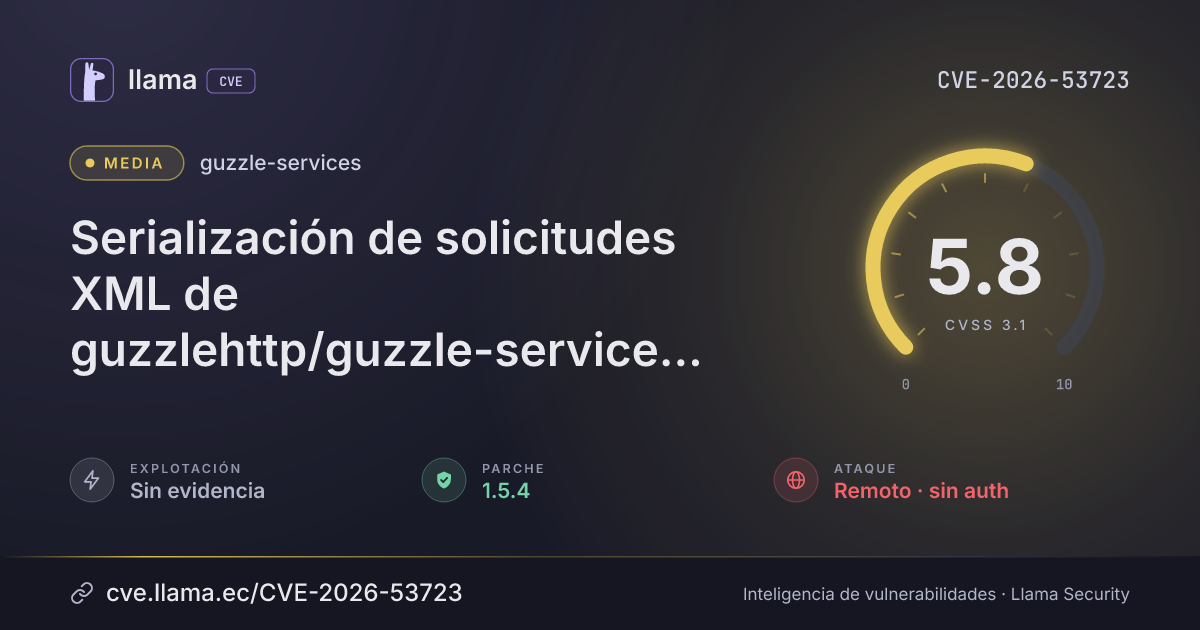
CVE-2026-53723
guzzlehttp/guzzle-services' XML Request Serialization Vulnerable to XML Injection via CDATA Terminator
Texto original en inglés · Ver en español
CVSS:3.1/AV:N/AC:L/PR:N/UI:N/S:C/C:N/I:L/A:N
Fuente: CNA
Ciclo de vida de la vulnerabilidad
| Fecha | Fase | Evento | Detalle |
|---|---|---|---|
| Divulgación | Publicada | CVE-2026-53723 divulgada · CVSS 5.8 (CNA) | |
| Divulgación | Evaluación SSVC | CISA-ADP · explotación ninguna | |
| Divulgación | Modificada | Última actualización del registro | |
| Monitoreo | Detectada | Ingresó al índice |
Guzzle Services provides an implementation of the Guzzle Command library that uses Guzzle service descriptions to describe web services, serialize requests, and parse responses into easy to use model structures. Versions prior ro 1.5.4 do not safely serialize scalar XML element values containing the CDATA terminator `]]>`. The XML request serializer writes values containing `<`, `>`, or `&` with `XMLWriter::writeCData($value)`. If attacker-controlled input contains `]]>`, the CDATA section closes early and the remainder is interpreted as XML markup. This is an outgoing request-body integrity issue, not a response parsing issue. The attacker does not need to control the service description or schema. Users are affected when all of the following are true: the application uses `guzzlehttp/guzzle-services` to serialize outgoing requests; a request parameter or `additionalParameters` schema uses `location: xml`; the value is serialized as XML element text, not an XML attribute; the value can contain attacker-controlled, user-controlled, tenant-controlled, or otherwise untrusted input; the value is not constrained by a safe `enum`, `pattern`, or custom filter that excludes `]]>`; and the downstream service parses the generated XML structurally and may act on unexpected, duplicated, or injected elements. Applications that serialize untrusted input into `location: xml` request parameters can emit XML containing attacker-controlled elements outside the intended text node. Depending on the receiving service, this can alter operation semantics, smuggle privileged fields, bypass modeled parameter boundaries, or create conflicting duplicated elements. Fixed service descriptions are sufficient if they contain an XML element parameter populated from attacker-controlled input. Users are not directly affected if they only use Guzzle Services to deserialize HTTP response bodies. Response XML parsing uses the response XML location visitor and does not invoke the vulnerable request XML serializer. Response bodies matter only in a second-order flow, such as parsing attacker-controlled response XML, storing or forwarding a parsed string value, and later using it as a `location: xml` request parameter. The issue is patched in `1.5.3` and later by safely splitting embedded CDATA terminators before serialization. The fix preserves the original scalar value as XML text and prevents injected nodes. As a workaround, constrain attacker-controlled XML element values with a strict `enum`, `pattern`, or custom filter that excludes `]]>`, or avoid serializing untrusted data into `location: xml` element text until patched. Where appropriate for the service schema, XML attributes are not affected because they are written with XMLWriter attribute APIs rather than CDATA sections. To determine whether action is needed, search service descriptions for request parameters using `location: xml`, including operation `parameters` and `additionalParameters`. Response-only `models` are not directly affected unless parsed values are reused for request serialization. For object and array parameters, review nested scalar properties because leaf element values can still be affected.
Desglose de métricas
Rangos afectados
Estado del parche por paquete
| Paquete / producto | Estado | Corregida en | Desde divulgación | Última versión |
|---|---|---|---|---|
guzzle-services |
Corregida | 1.5.4 | — | — |
1.5.4Arsenal público
Sin exploits, módulos ni PoC públicos conocidos a la fecha de verificación.
https://github.com/guzzle/guzzle-services/security/advisories/GHSA-q8r6-5hfw-5jffLas referencias externas se muestran para copiar: cve.llama.ec no lo redirige a otros sitios.