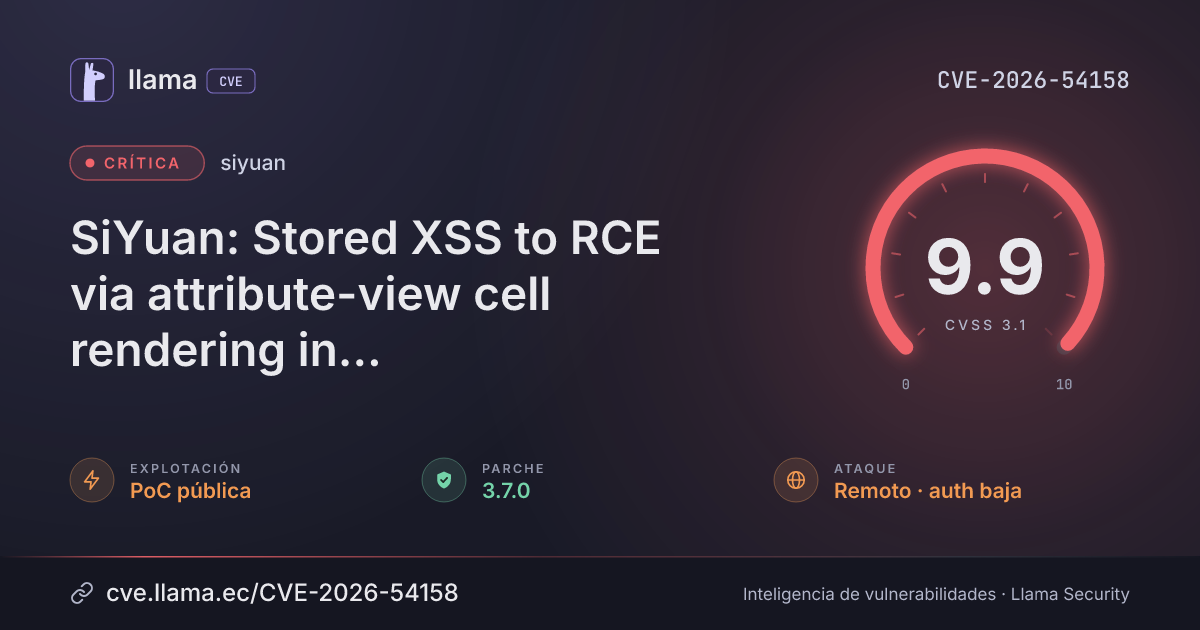
CVE-2026-54158
SiYuan: Stored XSS to RCE via attribute-view cell rendering in genAVValueHTML()
CVSS:3.1/AV:N/AC:L/PR:L/UI:N/S:C/C:H/I:H/A:H
Fuente: CNA
Ciclo de vida de la vulnerabilidad
| Fecha | Fase | Evento | Detalle |
|---|---|---|---|
| Divulgación | Publicada | CVE-2026-54158 divulgada · CVSS 9.9 (CNA) | |
| Divulgación | Evaluación SSVC | CISA-ADP · explotación PoC pública | |
| Divulgación | Modificada | Última actualización del registro | |
| Monitoreo | Detectada | Ingresó al índice |
SiYuan is an open-source personal knowledge management system. Prior to 3.7.0, the attribute-view (database) cell renderer genAVValueHTML interpolates cell content raw in four of its branches: text, url, phone, and mAsset. A cell value like </textarea><img src=x onerror="..."> or "><img src=x onerror="..."> breaks out of its surrounding tag and runs arbitrary JavaScript in the renderer when the victim opens the block-attribute panel. On Electron desktop the renderer runs with nodeIntegration:true, so the XSS chains to host RCE via require('child_process'). AV files live under the workspace and ride normal sync, so an attacker with write access to any synced workspace plants the payload once and it fires on every device that opens a panel containing that row.he kernel doesn't escape on the way in either, so the malicious cell persists byte-for-byte. There's no equivalent of the html.EscapeAttrVal call that protects block IAL attributes at kernel/model/blockial.go:261. This vulnerability is fixed in 3.7.0.
Desglose de métricas
Rangos afectados
Estado del parche por paquete
| Paquete / producto | Estado | Corregida en | Desde divulgación | Última versión |
|---|---|---|---|---|
siyuan |
Corregida | 3.7.0 | — | — |
3.7.0Arsenal público
Sin exploits, módulos ni PoC públicos conocidos a la fecha de verificación.
https://github.com/siyuan-note/siyuan/security/advisories/GHSA-5xfx-xj4h-5p7rLas referencias externas se muestran para copiar: cve.llama.ec no lo redirige a otros sitios.