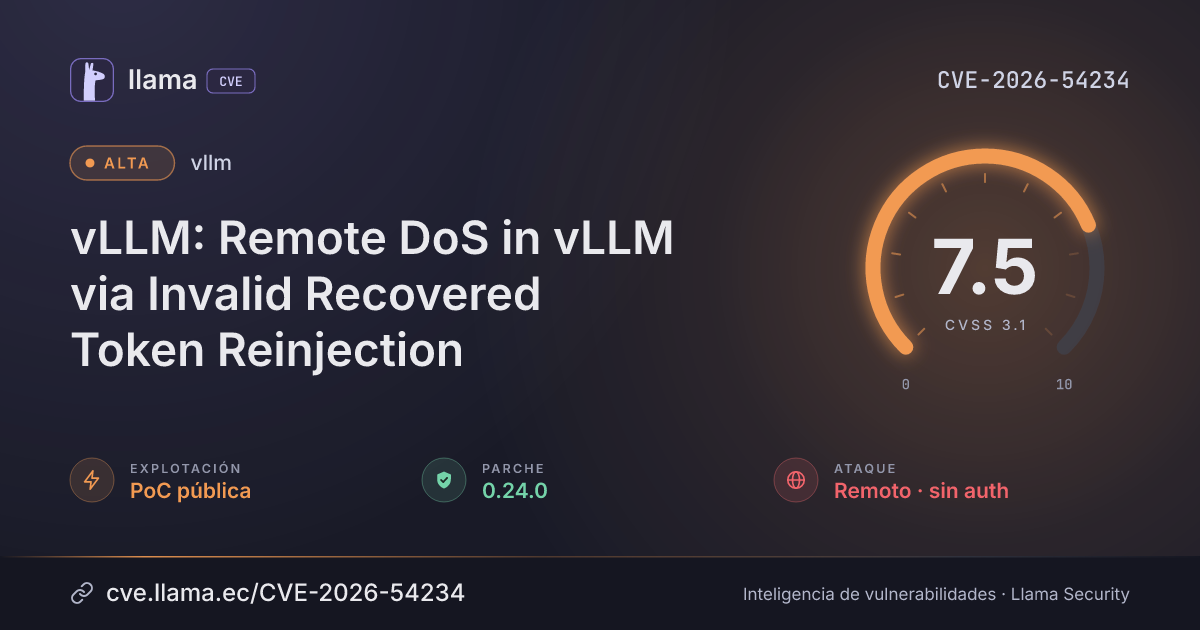
CVE-2026-54234
vLLM: Remote DoS in vLLM via Invalid Recovered Token Reinjection
CVSS:3.1/AV:N/AC:L/PR:N/UI:N/S:U/C:N/I:N/A:H
Fuente: CNA
Ciclo de vida de la vulnerabilidad
| Fecha | Fase | Evento | Detalle |
|---|---|---|---|
| Remediación | Parche 0.24.0 | vllm · -6 d desde divulgación | |
| Divulgación | Publicada | CVE-2026-54234 divulgada · CVSS 7.5 (CNA) | |
| Divulgación | Evaluación SSVC | CISA-ADP · explotación PoC pública | |
| Divulgación | Modificada | Última actualización del registro | |
| Monitoreo | Detectada | Ingresó al índice |
vLLM is a high-throughput and memory-efficient inference and serving engine for LLMs. Prior to 0.24.0, a frontend-legal multi-request speculative decoding workload can cause the rejection sampler to produce a recovered token equal to the model vocabulary size boundary value, which is then converted to negative one when the engine selects the next live token for a request and is written back into the drafter's input ids; that out-of-vocabulary value is later consumed by the model's embedding and attention path and crashes the engine worker with a GPU device-side assertion. The same triggering request sequence is reachable through the public gRPC Generate and Abort endpoints, so a remote client that can send generation requests can crash the shared engine worker, aborting concurrent requests and causing a service-wide denial of service for other clients of the deployment until the worker is restarted. This issue is fixed in version 0.24.0.
Desglose de métricas
Rangos afectados
Estado del parche por paquete
| Paquete / producto | Estado | Corregida en | Desde divulgación | Última versión |
|---|---|---|---|---|
pypivllm |
Corregida | 0.24.0 | -6 d | 0.33.0 no afectada |
0.24.0Arsenal público
Sin exploits, módulos ni PoC públicos conocidos a la fecha de verificación.
https://github.com/vllm-project/vllm/security/advisories/GHSA-8wr5-jm2h-8r4fhttps://github.com/vllm-project/vllm/pull/44744https://github.com/vllm-project/vllm/commit/8a5cf1ccd65e8ac7635c402c1ec0b08988bc26caLas referencias externas se muestran para copiar: cve.llama.ec no lo redirige a otros sitios.