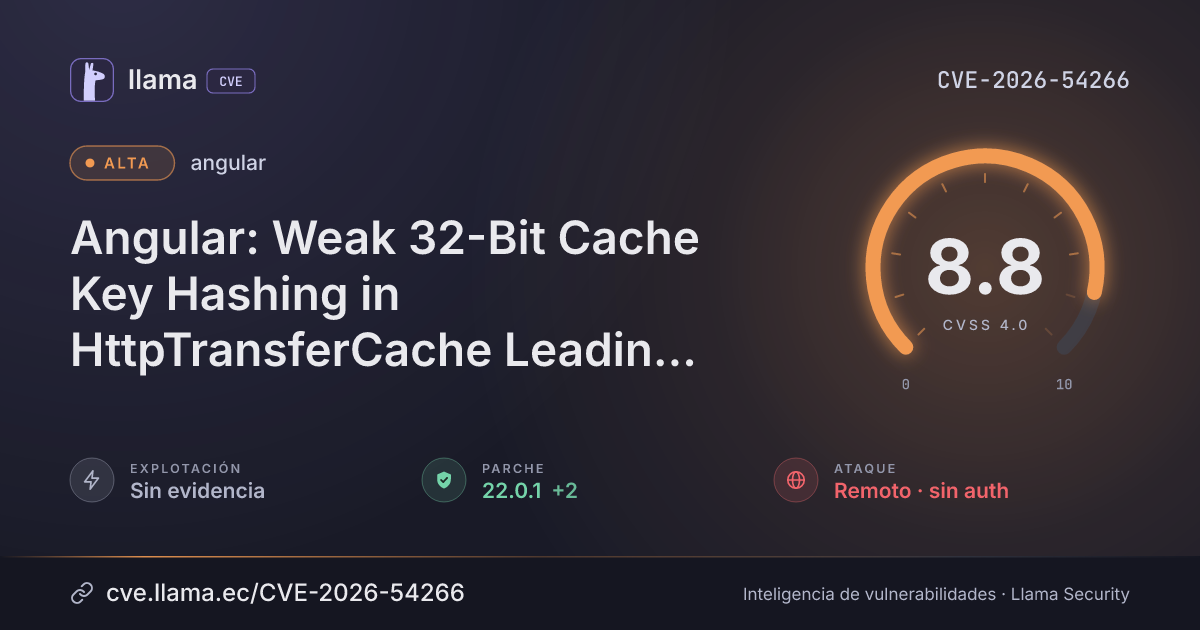
CVE-2026-54266
Angular: Weak 32-Bit Cache Key Hashing in HttpTransferCache Leading to Cross-Request Data Leakage and State Poisoning
CVSS:4.0/AV:N/AC:L/AT:N/PR:N/UI:N/VC:H/VI:L/VA:N/SC:N/SI:N/SA:N
Fuente: CNA
CVSS:3.1/AV:N/AC:L/PR:N/UI:R/S:C/C:L/I:L/A:NCiclo de vida de la vulnerabilidad
| Fecha | Fase | Evento | Detalle |
|---|---|---|---|
| Remediación | Parche 20.3.25 | @angular/common · -12 d desde divulgación | |
| Remediación | Parche 21.2.17 | @angular/common · -12 d desde divulgación | |
| Remediación | Parche 22.0.1 | @angular/common · -12 d desde divulgación | |
| Divulgación | Publicada | CVE-2026-54266 divulgada · CVSS 8.8 (CNA) | |
| Divulgación | Evaluación SSVC | CISA-ADP · explotación ninguna | |
| Divulgación | Modificada | Última actualización del registro | |
| Monitoreo | Detectada | Ingresó al índice | |
| Monitoreo | Verificada | Última verificación contra las fuentes |
Angular is a development platform for building mobile and desktop web applications using TypeScript/JavaScript and other languages. Prior to 22.0.1, 21.2.17, and 20.3.25, Angular's HttpTransferCache caches HTTP requests made during Server-Side Rendering (SSR) so that they can be reused during client-side hydration. This avoids repeating the same HTTP requests on the client. The cached responses are stored in TransferState using a cache key generated by hashing request properties (method, response type, mapped URL, serialized body, and sorted query parameters). The cache keys are generated using a weak 32-bit DJB2-like polynomial rolling hash. The 32-bit hash space is extremely small, allowing attackers to find hash collisions. An attacker can easily find a query parameter string (e.g., q=aaCAZMMM for a search request) that produces the exact same 32-bit hash as a sensitive endpoint (e.g., /api/user/profile). When a victim visits a crafted link containing the colliding parameter, the SSR process executes both the search request and the profile request. Due to the hash collision, the search response overwrites the profile response in the TransferState cache. This vulnerability is fixed in 22.0.1, 21.2.17, and 20.3.25.
Desglose de métricas
Rangos afectados
Estado del parche por paquete
| Paquete / producto | Estado | Corregida en | Desde divulgación | Última versión |
|---|---|---|---|---|
npm@angular/common |
Corregida | 20.3.25, 21.2.17, 22.0.1 | -12 d · -12 d · -12 d | 22.2.6 no afectada |
20.3.2521.2.1722.0.1Arsenal público
Sin exploits, módulos ni PoC públicos conocidos a la fecha de verificación.
https://github.com/angular/angular/security/advisories/GHSA-39pv-4j6c-2g6vhttps://github.com/angular/angular/pull/69153https://github.com/angular/angular/commit/5f36274da3f961430ae72865159afa02a1dd9133Las referencias externas se muestran para copiar: cve.llama.ec no lo redirige a otros sitios.