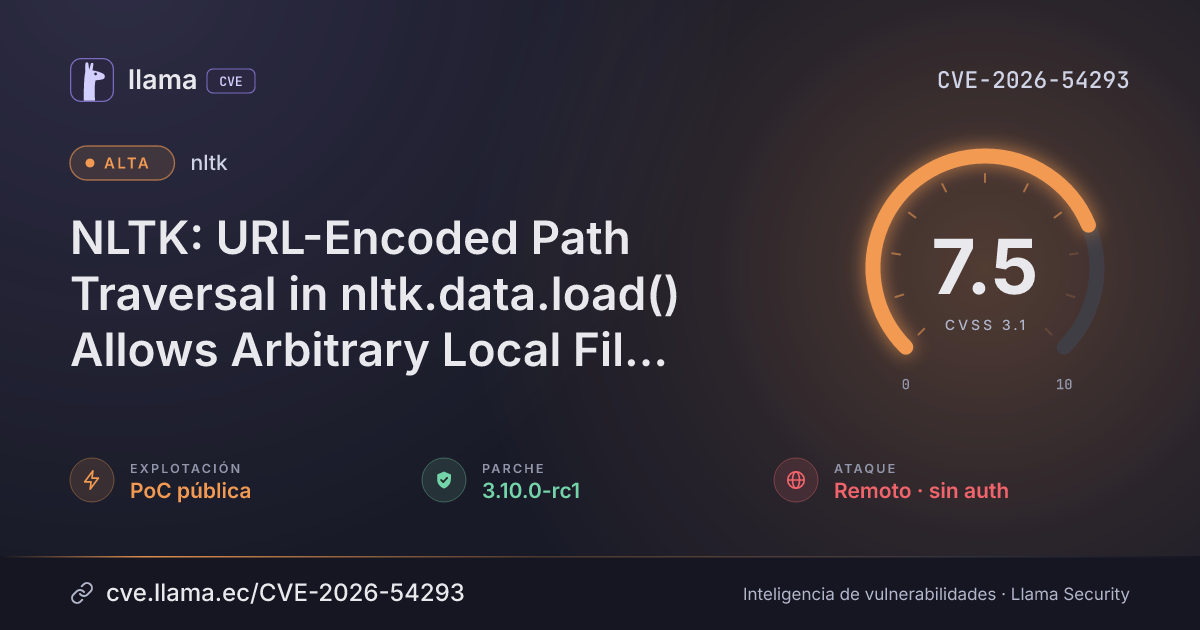
CVE-2026-54293
NLTK: URL-Encoded Path Traversal in nltk.data.load() Allows Arbitrary Local File Read
CVSS:3.1/AV:N/AC:L/PR:N/UI:N/S:U/C:H/I:N/A:N
Fuente: CNA
CVSS:3.1/AV:N/AC:L/PR:N/UI:N/S:U/C:H/I:N/A:NCiclo de vida de la vulnerabilidad
| Fecha | Fase | Evento | Detalle |
|---|---|---|---|
| Divulgación | Publicada | CVE-2026-54293 divulgada · CVSS 7.5 (CNA) | |
| Divulgación | Evaluación SSVC | CISA-ADP · explotación PoC pública | |
| Divulgación | Modificada | Última actualización del registro | |
| Monitoreo | Detectada | Ingresó al índice |
NLTK (Natural Language Toolkit) is a suite of open source Python modules, data sets, and tutorials supporting research and development in Natural Language Processing. Prior to 3.10.0-rc1, nltk.data.load() in NLTK is vulnerable to path traversal via URL-encoded path separators and traversal segments when using the nltk: URL scheme. The unsafe-path regex check is performed before url2pathname() decodes the %xx sequences (a classic decode-after-check / TOCTOU-style flaw), allowing an attacker to bypass the protection documented in NLTK's SECURITY.md and read arbitrary files from the filesystem. While literal traversal strings such as ../../../etc/passwd are correctly blocked, encoded variants such as %2fetc%2fpasswd, %2e%2e%2f..., and ..%2f..%2f slip past the regex and are subsequently decoded into a real filesystem path. This vulnerability is fixed in 3.10.0-rc1.
Desglose de métricas
Rangos afectados
Estado del parche por paquete
| Paquete / producto | Estado | Corregida en | Desde divulgación | Última versión |
|---|---|---|---|---|
nltk |
Corregida | 3.10.0-rc1 | — | — |
3.10.0-rc1Arsenal público
Sin exploits, módulos ni PoC públicos conocidos a la fecha de verificación.
https://access.redhat.com/errata/RHSA-2026:42644https://access.redhat.com/errata/RHSA-2026:65126https://access.redhat.com/errata/RHSA-2026:60520https://github.com/nltk/nltk/security/advisories/GHSA-p4gq-832x-fm9vhttps://bugzilla.redhat.com/show_bug.cgi?id=2491486https://github.com/nltk/nltk/pull/3575https://access.redhat.com/security/cve/CVE-2026-54293https://security.access.redhat.com/data/csaf/v2/vex/2026/cve-2026-54293.jsonLas referencias externas se muestran para copiar: cve.llama.ec no lo redirige a otros sitios.