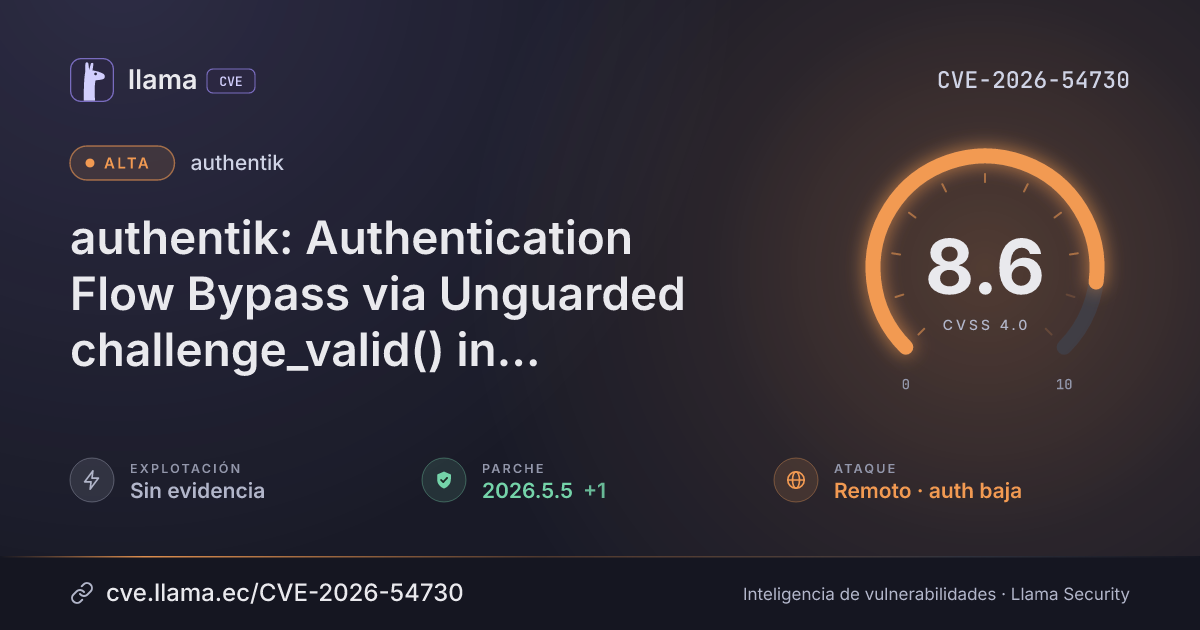
CVE-2026-54730
authentik: Authentication Flow Bypass via Unguarded challenge_valid() in AuthenticatorEndpointGDTCStage and GoogleChromeStageView
CVSS:4.0/AV:N/AC:L/AT:N/PR:L/UI:N/VC:H/VI:H/VA:N/SC:N/SI:N/SA:N
Fuente: CNA
Ciclo de vida de la vulnerabilidad
| Fecha | Fase | Evento | Detalle |
|---|---|---|---|
| Divulgación | Publicada | CVE-2026-54730 divulgada · CVSS 8.6 (CNA) | |
| Divulgación | Evaluación SSVC | CISA-ADP · explotación ninguna | |
| Divulgación | Modificada | Última actualización del registro | |
| Monitoreo | Detectada | Ingresó al índice | |
| Monitoreo | Fuente: OSV | Registro visto por primera vez en OSV | |
| Monitoreo | Verificada | Última verificación contra las fuentes |
authentik is an open-source identity provider. Prior to 2026.2.6 and 2026.5.5, the enterprise Google Chrome device-trust stages advance the flow without confirming that the out-of-band device attestation actually ran. Affected enterprise deployments place either a Google Chrome Endpoint stage with mode set to REQUIRED or the deprecated Google Chrome Device Trust Connector stage in an authentication flow. The device attestation occurs in a verification iframe that calls the Google Verified Access API and records the verified device on success, but the vulnerable stages treat the flow as passed as soon as the stage is submitted. An attacker who can reach such a stage, including after primary username and password authentication, can skip the verification iframe and authenticate from a device that was never verified. Where device trust is the only additional factor, that protection is fully bypassed, while other configured factors remain in force. This issue is fixed in versions 2026.2.6 and 2026.5.5.
Affects authentik before 2026.2.6 and 2026.5.0 to before 2026.5.5, in Enterprise deployments using the Google Chrome Endpoint stage or the deprecated GDTC stage. Fixed in 2026.2.6 and 2026.5.5.
Condiciones y alcance
Desglose de métricas
Rangos afectados
Estado del parche por paquete
| Paquete / producto | Estado | Corregida en | Desde divulgación | Última versión |
|---|---|---|---|---|
authentik |
Corregida | 2026.2.6, 2026.5.5 | — | — |
2026.2.62026.5.5Arsenal público
Sin exploits, módulos ni PoC públicos conocidos a la fecha de verificación.
https://github.com/goauthentik/authentik/security/advisories/GHSA-3v9h-3hrm-29cxhttps://github.com/goauthentik/authentik/pull/24053https://github.com/goauthentik/authentik/pull/24058https://github.com/goauthentik/authentik/commit/27866a94f29d0d7f784b3c462a697a968d3f6b9chttps://github.com/goauthentik/authentik/commit/85adb0bbbd7ad4f2807ec21cf25bb42aee81afbchttps://github.com/goauthentik/authentik/releases/tag/version/2026.2.6https://github.com/goauthentik/authentik/releases/tag/version/2026.5.5Las referencias externas se muestran para copiar: cve.llama.ec no lo redirige a otros sitios.