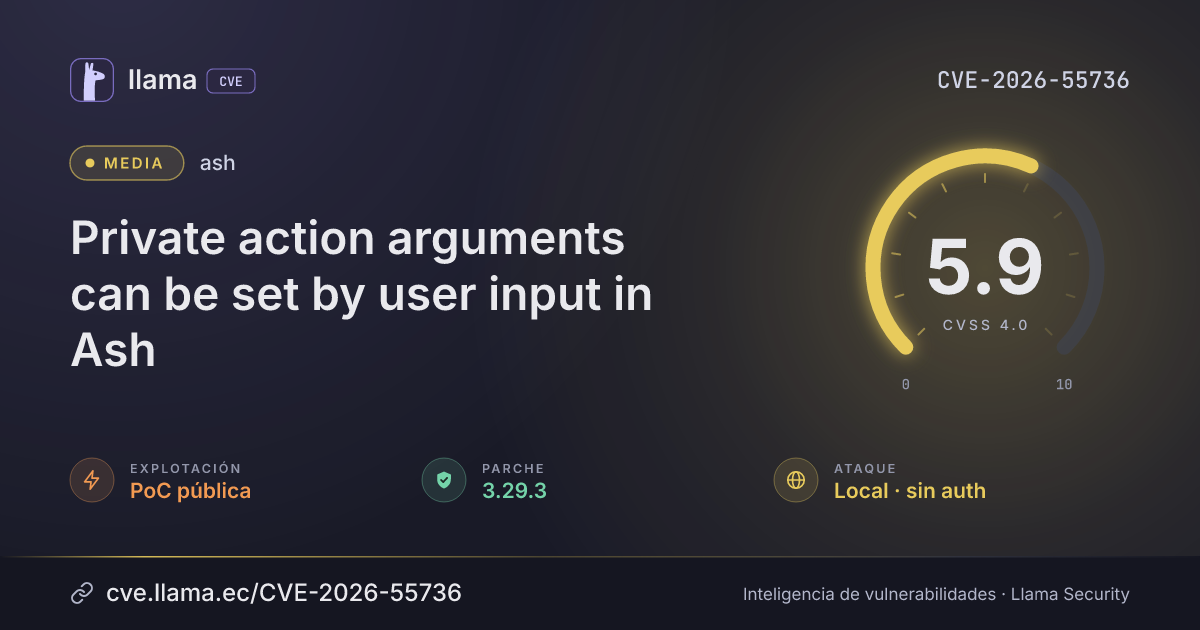
CVE-2026-55736
Private action arguments can be set by user input in Ash
CVSS:4.0/AV:L/AC:L/AT:P/PR:N/UI:N/VC:N/VI:H/VA:N/SC:N/SI:N/SA:N
Fuente: CNA
Ciclo de vida de la vulnerabilidad
| Fecha | Fase | Evento | Detalle |
|---|---|---|---|
| Divulgación | Publicada | CVE-2026-55736 divulgada · CVSS 5.9 (CNA) | |
| Divulgación | Evaluación SSVC | CISA-ADP · explotación PoC pública | |
| Divulgación | Modificada | Última actualización del registro | |
| Monitoreo | Detectada | Ingresó al índice |
Improperly Controlled Modification of Dynamically-Determined Object Attributes vulnerability in ash-project ash allows a user to set the value of a private action argument that is intended to be controlled only by trusted server-side code. Action arguments declared with public?: false are meant to be set internally (for example via Ash.Changeset.set_private_argument/3) and must not be settable from end-user input. When a changeset is built from a parameter map, Ash filters out private arguments, but the filtering is incomplete. In the regular changeset path (for_create, for_update, for_destroy), private arguments are stripped only when the parameter key is an atom. When the key is a binary (string), as is the case for user-supplied parameters, the private argument is kept and the user controls its value. In the atomic path (Ash.Changeset.fully_atomic_changeset/4, also reached through atomic and bulk updates), private arguments are not stripped at all, regardless of whether the key is an atom or a binary. An attacker who can submit parameters to an action that defines a private argument can therefore inject a value for that argument. Depending on how the application uses the argument (for example an acting_user_id driving authorization or record ownership), this can lead to an integrity violation or privilege escalation. This issue affects ash: from 3.0.0 before 3.29.3.
Desglose de métricas
Rangos afectados
Estado del parche por paquete
| Paquete / producto | Estado | Corregida en | Desde divulgación | Última versión |
|---|---|---|---|---|
ash |
Corregida | 3.29.3 | — | — |
3.29.3Arsenal público
Sin exploits, módulos ni PoC públicos conocidos a la fecha de verificación.
https://github.com/ash-project/ash/security/advisories/GHSA-f4hc-ppw9-4hhwhttps://github.com/ash-project/ash/commit/d9b3100219b3ea86d73202bf7368c03a7688efeahttps://cna.erlef.org/cves/CVE-2026-55736.htmlhttps://osv.dev/vulnerability/EEF-CVE-2026-55736Las referencias externas se muestran para copiar: cve.llama.ec no lo redirige a otros sitios.