llamaCVEVulnerability Intelligence
/
OTP

CVE-2026-55951

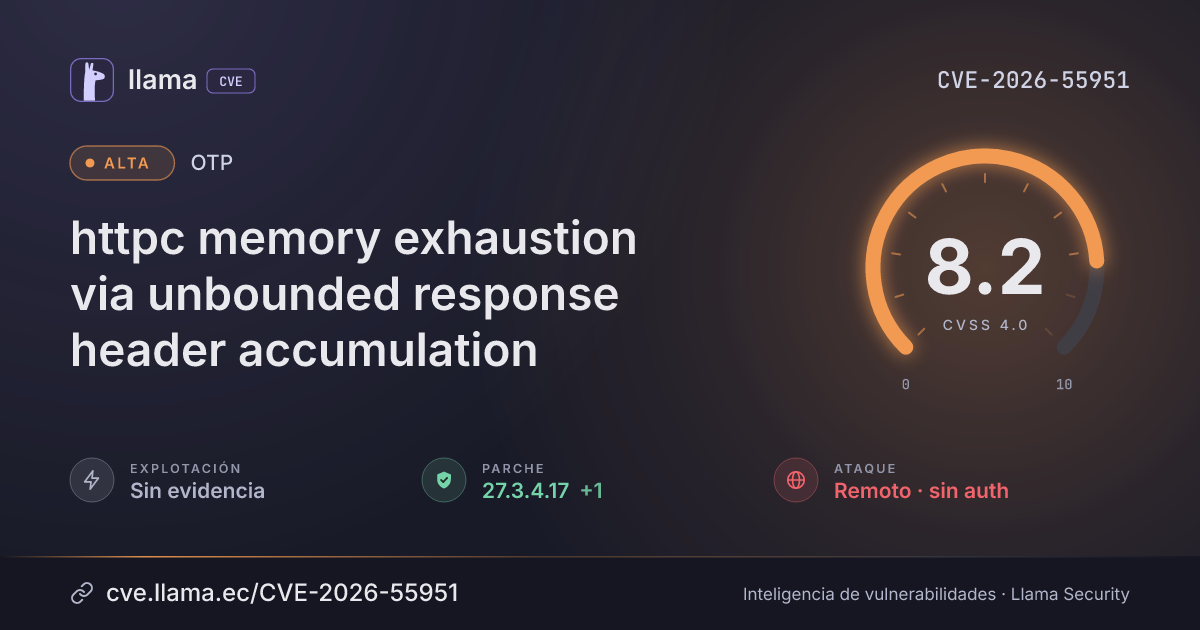
httpc memory exhaustion via unbounded response header accumulation

Default setupsParche disponibledenial of service
Descargar PNG JSON
CVSS 4.0
8.2
Alta
CVSS:4.0/AV:N/AC:L/AT:P/PR:N/UI:N/VC:N/VI:N/VA:H/SC:N/SI:N/SA:N Fuente: CNA
ExplotaciónSin evidenciaSSVC: none · no figura en CISA KEV
Exploits públicos0Ninguno conocido
Parche2 versiones9.3.2.7 · 27.3.4.17
Exposición78 dDesde la divulgación, 1 sept 2026, 9:37 a. m.
Detección62 dDesde la divulgación hasta su ingreso al índice
Decisión SSVCSeguir
Remediar en la ventana regular de mantenimiento
Sin explotación conocida, no automatizable e impacto técnico parcial. Hay versiones corregidas disponibles.
Timeline

Ciclo de vida de la vulnerabilidad

Hoy
Divulgación
Publicada +1
Modificada
Explotación
Remediación
Monitoreo
Detectada
Fuente: OSV
Verificada
1 sept 26
3 nov 26
11 nov 26
17 nov 26
19 nov 26
1 sept 26
21 sept 26
10 oct 26
30 oct 26
19 nov 26
FechaFaseEventoDetalle
Divulgación Publicada CVE-2026-55951 divulgada · CVSS 8.2 (CNA)
Divulgación Evaluación SSVC CISA-ADP · explotación ninguna
Monitoreo Detectada Ingresó al índice
Divulgación Modificada Última actualización del registro
Monitoreo Fuente: OSV Registro visto por primera vez en OSV
Monitoreo Verificada Última verificación contra las fuentes
Resumen

The Erlang/OTP httpc HTTP client does not enforce a limit on the total size of response headers received from a server. The max_header_size option defaults to nolimit, and httpc_response:parse_headers/6 accumulates every header into a list before the length check runs (which only fires after the terminating CRLF CRLF is received). A malicious or compromised HTTP server can send an arbitrarily large number of headers, or headers with very large values, causing the client process to allocate unbounded memory until the system runs out of memory or the BEAM VM crashes. A proof-of-concept server sending 100,000 headers of roughly 4000 bytes each caused the client VM to allocate over 13 GB of memory in under 30 seconds. Any application using httpc:request/4,5 to connect to untrusted servers is affected. No authentication is required: any server the client connects to (including via a redirect or man-in-the-middle) can trigger the exhaustion. This issue affects OTP from OTP 17.0 before OTP 27.3.4.17, OTP 28.5.0.6, and OTP 29.0.6, corresponding to inets from 5.10 before 9.3.2.7, 9.6.2.3, and 9.7.2. Whether OTP before OTP 17.0, corresponding to inets before 5.10, is affected is unknown.

Affects Erlang/OTP from 17.0 before 27.3.4.17 when the httpc client runs with its default unlimited max_header_size. Fixed in 27.3.4.17; the vendor recommends OTP 28.5.0.6 or 29.0.6.

¿Qué significa?The httpc HTTP client keeps accumulating response headers from a server without a size limit. A malicious or compromised server can make the client allocate memory until the system runs out of memory or the BEAM VM crashes, which is a denial of service.
¿Quién está afectado?Erlang/OTP from 17.0 before 27.3.4.17 is listed as affected, and inets from 5.10 before the fixed inets releases. The issue applies when httpc uses the default max_header_size setting, which is unlimited. Check the installed OTP version and whether httpc is called with a max_header_size option.
Contexto

Condiciones y alcance

Condiciones necesarias para que el fallo sea explotable
01
Erlang/OTP versions from OTP 17.0 before the fixed releases (inets from 5.10 before the fixed inets releases)“This issue affects OTP from OTP 17.0 before OTP 27.3.4.17, OTP 28.5.0.6, and OTP 29.0.6”
02
The client uses the httpc HTTP client with the default max_header_size setting, which is unlimited“The max_header_size option defaults to nolimit”
¿Quién debe revisar?Teams running Erlang/OTP httpc (inets) clients that connect to untrusted, user-supplied or redirected servers
MitigaciónRestrict httpc to trusted servers only, apply OS memory limits, or use an alternative HTTP client that enforces a header size limit.
Vector CVSS 4.0

Desglose de métricas

Opción resaltada = valor del vector · izquierda = peor caso · CNA
Vector de ataqueAV:N
RedAdyacenteLocalFísica
ComplejidadAC:L
BajaAlta
Requisitos de ataqueAT:P
NingunoPresentes
PrivilegiosPR:N
NingunoBajosAltos
InteracciónUI:N
NingunaPasivaActiva
Confid. (sistema)VC:N
AltoBajoNinguno
Integridad (sistema)VI:N
AltoBajoNinguno
Disponib. (sistema)VA:H
AltoBajoNinguno
Confid. (posterior)SC:N
AltoBajoNinguno
Integridad (posterior)SI:N
AltoBajoNinguno
Disponib. (posterior)SA:N
AltoBajoNinguno
Versiones

Rangos afectados

Afectada Corregida
inets≥ 5.10 < 9.3.2.7
otp≥ 17.0 < 27.3.4.17
5.10
9.3.2.7
17.0
27.3.4.17
Remediación

Estado del parche por paquete

Paquete / productoEstadoCorregida enDesde divulgaciónÚltima versión
OTP
Corregida 9.3.2.7, 27.3.4.17 — —
Versiones corregidas9.3.2.727.3.4.17
Explotación

Arsenal público

Sin exploits, módulos ni PoC públicos conocidos a la fecha de verificación.

Registro
EscenarioGENERALEEF
Mitigación* Restrict httpc to trusted servers only, and avoid using it to fetch resources from arbitrary or user-supplied URLs. * Apply operating-system memory limits (cgroups,ulimit) to contain the blast radius of a runaway client process. * Use an alternative HTTP client library that enforces a response header size limit.EEF
Referencias
Fabricantehttps://github.com/erlang/otp/security/advisories/GHSA-f9fw-mg7q-4g3x
Fabricantehttps://www.erlang.org/doc/system/versions.html#order-of-versions
Parchehttps://github.com/erlang/otp/commit/aba0fe8c2d700bf4ac94607cf7f00e53bbe4042d
Parchehttps://github.com/erlang/otp/commit/e3be1cfe9f6cedd0cd20d9905e05601dfb31c8aa
Otrahttps://cna.erlef.org/cves/CVE-2026-55951.html
Otrahttps://osv.dev/vulnerability/EEF-CVE-2026-55951

Las referencias externas se muestran para copiar: cve.llama.ec no lo redirige a otros sitios.