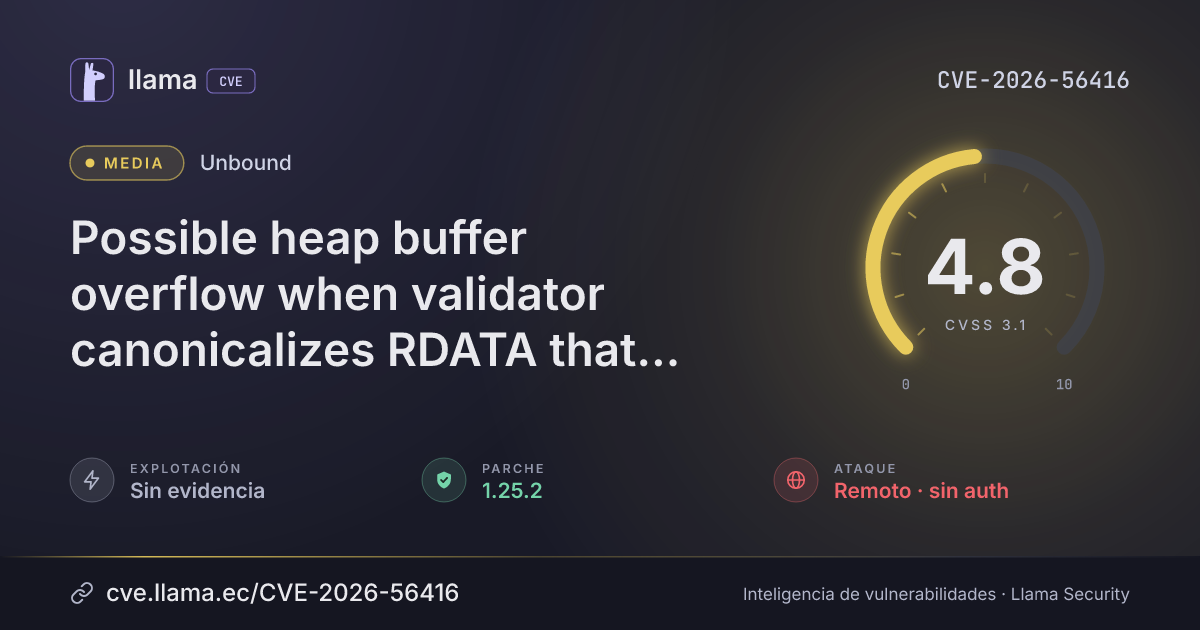
CVE-2026-56416
Possible heap buffer overflow when validator canonicalizes RDATA that contains domain name
CVSS:3.1/AV:N/AC:H/PR:N/UI:N/S:U/C:N/I:L/A:L
Fuente: CNA
Ciclo de vida de la vulnerabilidad
| Fecha | Fase | Evento | Detalle |
|---|---|---|---|
| Divulgación | Publicada | CVE-2026-56416 divulgada · CVSS 4.8 (CNA) | |
| Divulgación | Evaluación SSVC | CISA-ADP · explotación ninguna | |
| Divulgación | Modificada | Última actualización del registro | |
| Monitoreo | Detectada | Ingresó al índice |
In NLnet Labs Unbound up to and including version 1.25.1, when the validator builds the canonical RDATA form for an RRSIG-covered PX/RP/MINFO/SOA RRset, it computes the address of the second embedded domain name as 'datstart + dname_valid(datstart, ...)' and passes it straight to 'query_dname_tolower()' without checking that a second name is actually present in the RDATA. The wire-format parser accepts multi-dname RRs whose RDATA ends after the first name, so an attacker who runs a DNSSEC-signed authoritative server can deliver a record with an absent second domain name (e.g. SOA record) and cause 'query_dname_tolower()' to walk label-by-label through stale bytes in the per-worker 'env->scratch_buffer', past the end of that heap allocation if 'msg-buffer-size' has been lowered from the default. This leads to heap buffer overflow and on a release build the outcome relies heavily on the contents of the buffer tail and the adjacent heap chunk.
Desglose de métricas
Rangos afectados
Estado del parche por paquete
| Paquete / producto | Estado | Corregida en | Desde divulgación | Última versión |
|---|---|---|---|---|
Unbound |
Corregida | 1.25.2 | — | — |
1.25.2Arsenal público
Sin exploits, módulos ni PoC públicos conocidos a la fecha de verificación.
https://www.nlnetlabs.nl/downloads/unbound/CVE-2026-56416.txtLas referencias externas se muestran para copiar: cve.llama.ec no lo redirige a otros sitios.