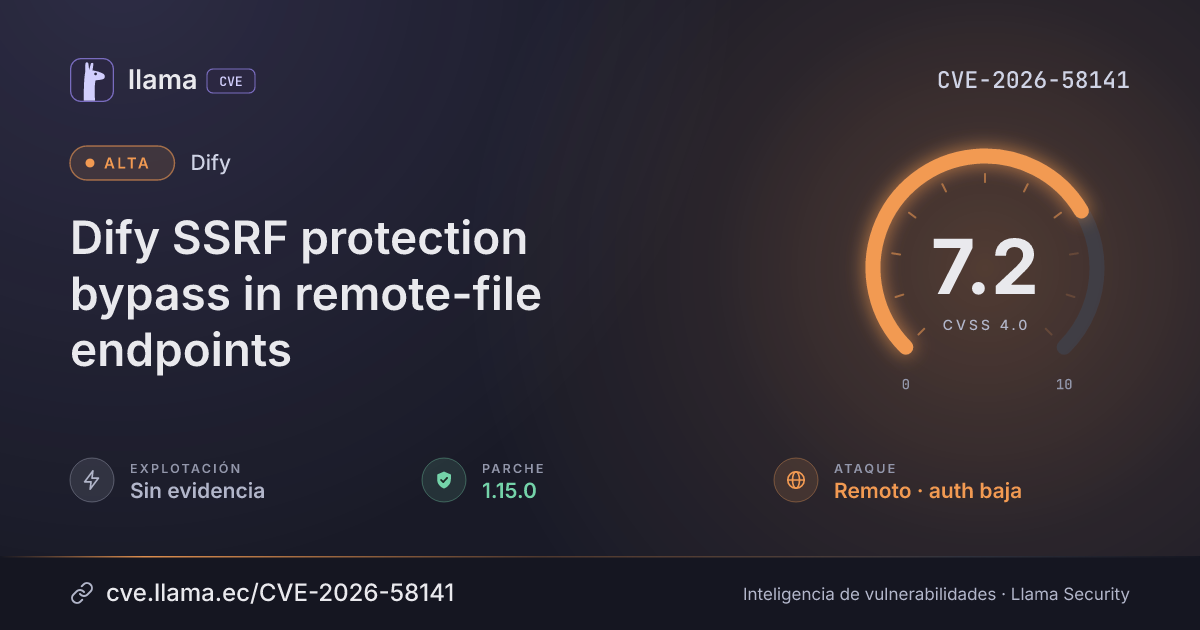
CVE-2026-58141
Dify SSRF protection bypass in remote-file endpoints
A remote attacker with a low-privilege login can make the server reach internal services and cloud metadata.
CVSS:4.0/AV:N/AC:L/AT:N/PR:L/UI:N/VC:H/VI:L/VA:L/SC:N/SI:N/SA:N
Fuente: CNA
Ciclo de vida de la vulnerabilidad
| Fecha | Fase | Evento | Detalle |
|---|---|---|---|
| Divulgación | Publicada | CVE-2026-58141 divulgada · CVSS 7.2 (CNA) | |
| Monitoreo | Detectada | Ingresó al índice | |
| Monitoreo | Fuente: NIST NVD | Registro visto por primera vez en NIST NVD | |
| Divulgación | Evaluación SSVC | CISA-ADP · explotación ninguna | |
| Monitoreo | Fuente: ENISA EUVD | Registro visto por primera vez en ENISA EUVD | |
| Divulgación | Modificada | Última actualización del registro | |
| Monitoreo | Fuente: OSV | Registro visto por primera vez en OSV | |
| Monitoreo | Verificada | Última verificación contra las fuentes |
Dify, an open-source platform for building AI applications, is affected by a server-side request forgery flaw that lets a remote attacker with a low-privilege console login send arbitrary HTTP requests from the server to internal services and cloud metadata endpoints, which can expose internal components such as the sandbox, internal APIs, PostgreSQL, and on AWS, instance IAM credentials. The bug is reached remotely through console endpoints such as the remote-files and HTTP Request workflow features, and the HTTP Request node can also send POST, PUT, and DELETE writes to internal services.
Affects Dify from 0.6.0 before 1.15.0 when the Squid proxy config has only source ACLs and make_request() lacks destination IP checks. Fixed in 1.15.0.
Descripción original del registro (VulnCheck)
Dify before 1.15.0 contains a server-side request forgery vulnerability that allows any authenticated console user to bypass SSRF protections and issue arbitrary HTTP requests to internal services and cloud metadata endpoints due to the Squid proxy configuration only defining source ACLs without destination deny rules and the make_request() helper performing no independent destination IP validation. Attackers can use endpoints such as GET /console/api/remote-files/<url>, POST /console/api/remote-files/upload, the HTTP Request workflow node, website crawl, or document import from URL to reach internal components like the sandbox, internal APIs, and PostgreSQL, and on AWS deployments read IAM credentials from the instance metadata service, with the HTTP Request node further enabling POST, PUT, and DELETE writes to internal services relying on network isolation for authorization.
Condiciones y alcance
Desglose de métricas
Rangos afectados
Estado del parche por paquete
| Paquete / producto | Estado | Corregida en | Desde divulgación | Última versión |
|---|---|---|---|---|
dify |
Corregida | 1.15.0 | — | — |
1.15.0Arsenal público
Sin exploits, módulos ni PoC públicos conocidos a la fecha de verificación.
https://github.com/langgenius/dify/pull/36332https://github.com/langgenius/dify/commit/7bfcf9185c75bb18f0b44335080524e659f087d9https://github.com/langgenius/dify/releases/tag/1.15.0https://www.vulncheck.com/advisories/dify-ssrf-protection-bypass-via-remote-files-endpointsLas referencias externas se muestran para copiar: cve.llama.ec no lo redirige a otros sitios.