llamaCVEVulnerability Intelligence
/
VMware Cloud Foundation

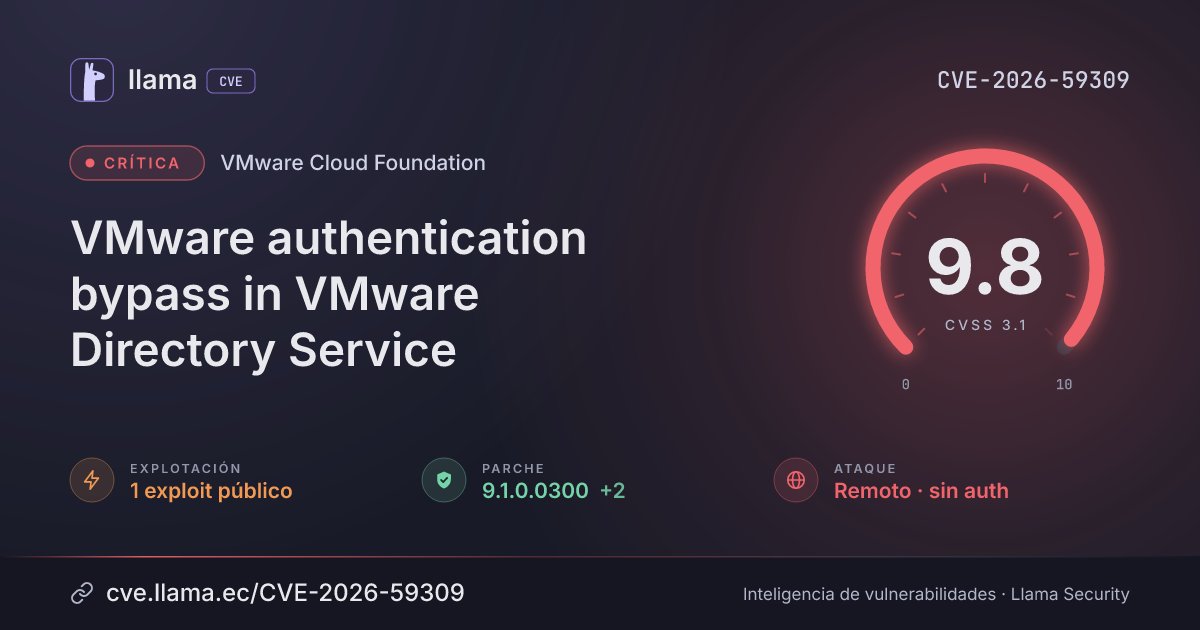
CVE-2026-59309

VMware authentication bypass in VMware Directory Service

A remote attacker with no login can gain unauthorized access to the system over the network.

Crítica · CVSS alto en tecnología listada, EPSS ≥ 10 %UnclearParche disponibleauthentication bypass
Descargar PNG JSON
CVSS 3.1
9.8
Crítica
CVSS:3.1/AV:N/AC:L/PR:N/UI:N/S:U/C:H/I:H/A:H Fuente: CNA
ExplotaciónExploit públicoSSVC: none · no figura en CISA KEV
Exploits públicos11 fuente · 1 confirmado en GitHub
Parche3 versiones8.0 U3k · 9.0.2.0100 · 9.1.0.0300
Exposición112 dDesde la divulgación, 30 jul 2026, 7:19 a. m.
EPSS ≥ 10 %17 nov 2026Fecha en que la probabilidad de explotación superó el umbral
Decisión SSVCAtender
Priorizar en el próximo ciclo de cambios
Sin explotación conocida, automatizable e impacto técnico total. Hay versiones corregidas disponibles.
Timeline

Ciclo de vida de la vulnerabilidad

Hoy
Divulgación
Publicada +2
Explotación
Umbral EPSS +1
Remediación
Monitoreo
Detectada +2
30 jul 26
17 nov 26
19 nov 26
30 jul 26
27 ago 26
24 sept 26
22 oct 26
19 nov 26
FechaFaseEventoDetalle
Divulgación Publicada CVE-2026-59309 divulgada · CVSS 9.8 (CNA)
Divulgación Evaluación SSVC CISA-ADP · explotación ninguna
Divulgación Modificada Última actualización del registro
Explotación Umbral EPSS La probabilidad de explotación supera el 10 %
Monitoreo Detectada Ingresó al índice
Explotación Exploit en GitHub JHenryArcaneCipher/CVE-2026-59309-PoC
Monitoreo Fuente: PoC-in-GitHub Registro visto por primera vez en PoC-in-GitHub
Monitoreo Verificada Última verificación contra las fuentes
Resumen
Resumen generado por IA · CC-BY 4.0 · 17 nov 2026

VMware vCenter, which is also part of products such as Cloud Foundation, vSphere Foundation, Telco Cloud Infrastructure and Telco Cloud Platform, has a flaw in its VMware Directory Service that lets an attacker bypass authentication and gain unauthorized access to the system. The attacker can reach it remotely over the network without logging in, and public exploit code is available.

Affects VMware vCenter with the VMware Directory Service, including vCenter in Cloud Foundation, vSphere Foundation and Telco Cloud products. Fixed in vCenter 9.1.0.0300, 9.0.2.0100 and 8.0 U3k.

¿Qué significa?The VMware Directory Service in vCenter contains an authentication bypass. A malicious actor with network access to vCenter can skip authentication and gain unauthorized access to the system.
¿Quién está afectado?vCenter with the VMware Directory Service is affected, including vCenter shipped in VMware Cloud Foundation, vSphere Foundation, Telco Cloud Infrastructure and Telco Cloud Platform. The listed ranges run from 9.1.x.x (fixed in 9.1.0.0300), 9.0.x.x (fixed in 9.0.2.0100) and 8.0 (fixed in 8.0 U3k). The installed vCenter version and build number can be compared with these fixed versions.
¿Qué hacer?Upgrade vCenter to the fixed version for its release line: 9.1.0.0300, 9.0.2.0100 or 8.0 U3k. The facts list no workaround.
Descripción original del registro (vmware)

VMware vCenter contains an authentication bypass vulnerability in the VMware Directory Service. A malicious actor with network access to vCenter may exploit this issue to bypass authentication and gain unauthorized access to the system.

Contexto

Condiciones y alcance

Condiciones necesarias para que el fallo sea explotable
01
VMware vCenter with the VMware Directory Service is affected, including vCenter in VMware Cloud Foundation, vSphere Foundation and Telco Cloud products“VMware vCenter contains an authentication bypass vulnerability in the VMware Directory Service.”
02
Attacker must have network access to vCenter“A malicious actor with network access to vCenter may exploit this issue to bypass authentication and gain unauthorized access to the system.”
¿Quién debe revisar?Teams running VMware vCenter 7.0, 8.0 or 9.x, including those in VMware Cloud Foundation, vSphere Foundation and Telco Cloud Platform/Infrastructure.
Vector CVSS 3.1

Desglose de métricas

Opción resaltada = valor del vector · izquierda = peor caso · CNA
Vector de ataqueAV:N
RedAdyacenteLocalFísica
ComplejidadAC:L
BajaAlta
PrivilegiosPR:N
NingunoBajosAltos
InteracciónUI:N
NingunaRequerida
AlcanceS:U
CambiadoSin cambio
ConfidencialidadC:H
AltoBajoNinguno
IntegridadI:H
AltoBajoNinguno
DisponibilidadA:H
AltoBajoNinguno
Versiones

Rangos afectados

Afectada Corregida
vCenter≥ 8.0 < 8.0 U3k
vCenter≥ 9.0.x.x < 9.0.2.0100
vCenter≥ 9.1.x.x < 9.1.0.0300
8.0 U3k
8.0
9.0.x.x
9.0.2.0100
9.1.x.x
9.1.0.0300
Remediación

Estado del parche por paquete

Paquete / productoEstadoCorregida enDesde divulgaciónÚltima versión
Cloud Foundation
Corregida 8.0 U3k, 9.0.2.0100, 9.1.0.0300 — —
Versiones corregidas8.0 U3k9.0.2.01009.1.0.0300
Explotación

Arsenal público

Exploit-DB
—
0
Metasploit
—
0
Nuclei
—
0
PoC en GitHub
JHenryArcaneCipher/CVE-2026-59309-PoC
1
Ver los 1 repositorios de GitHub (1 con exploit confirmado)
JHenryArcaneCipher/CVE-2026-59309-PoCexploit

Los repositorios públicos incluyen exploits, escáneres, laboratorios y reglas de detección. No ejecute código de terceros sin revisarlo en un entorno aislado.

Registro
EscenarioGENERALvmware
Referencias
Exploithttps://github.com/JHenryArcaneCipher/CVE-2026-59309-PoC
Otrahttps://support.broadcom.com/web/ecx/support-content-notification/-/external/content/SecurityAdvisories/0/38017

Las referencias externas se muestran para copiar: cve.llama.ec no lo redirige a otros sitios.