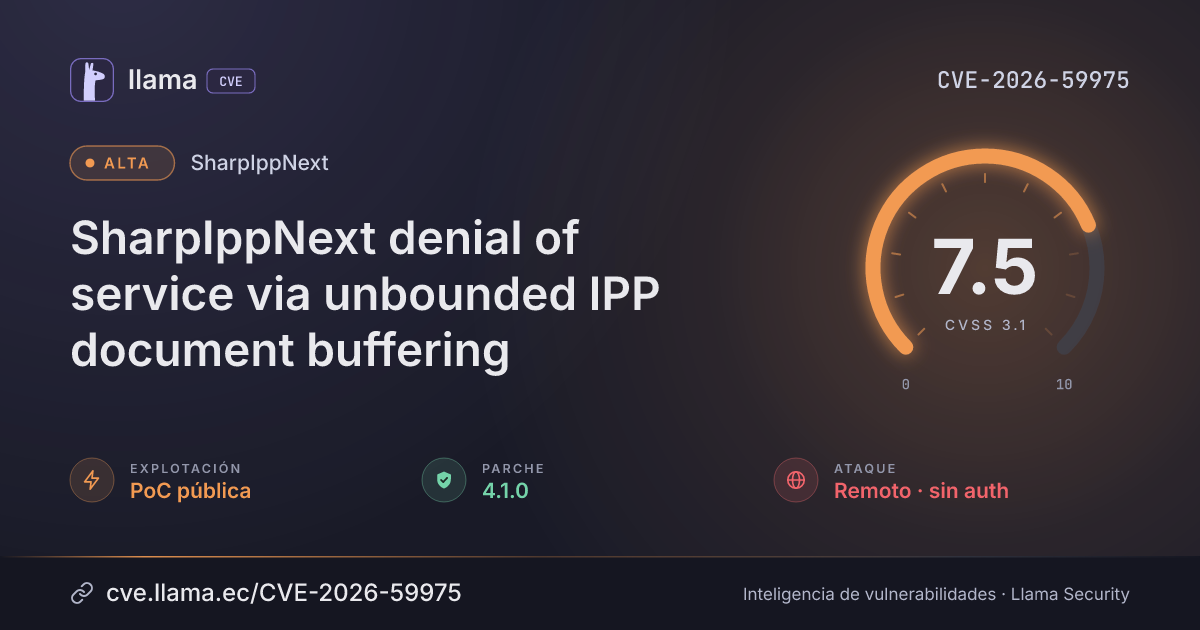
CVE-2026-59975
SharpIppNext denial of service via unbounded IPP document buffering
A remote, unauthenticated attacker can send an oversized document that is buffered without limit, crashing the server.
CVSS:3.1/AV:N/AC:L/PR:N/UI:N/S:U/C:N/I:N/A:H
Fuente: CNA
Ciclo de vida de la vulnerabilidad
| Fecha | Fase | Evento | Detalle |
|---|---|---|---|
| Divulgación | Publicada | CVE-2026-59975 divulgada · CVSS 7.5 (CNA) | |
| Monitoreo | Detectada | Ingresó al índice | |
| Divulgación | Evaluación SSVC | CISA-ADP · explotación PoC pública | |
| Divulgación | Modificada | Última actualización del registro | |
| Monitoreo | Fuente: NIST NVD | Registro visto por primera vez en NIST NVD | |
| Monitoreo | Fuente: ENISA EUVD | Registro visto por primera vez en ENISA EUVD | |
| Monitoreo | Fuente: OSV | Registro visto por primera vez en OSV | |
| Monitoreo | Verificada | Última verificación contra las fuentes |
SharpIppNext, a .NET library for Internet Printing Protocol clients and servers, has a flaw in its server-side code that lets a remote attacker cause a denial of service without logging in. The attacker sends an arbitrarily large document body, which is buffered in memory with no size limit until the process runs out of memory and fails.
Only affects server-side use of SharpIppServer to parse incoming IPP requests with ReadDocumentStream enabled, which is the default. Fixed in 4.1.0.
Descripción original del registro (GitHub_M)
SharpIppNext is a .NET Standard library for building Internet Printing Protocol clients and servers. Prior to 4.1.0, server-side SharpIppNext implementations using SharpIppServer.ReceiveRequestAsync or SharpIppServer.ReceiveRawRequestAsync pass incoming data to IppProtocol.ReadIppRequestAsync in SharpIpp/Protocol/IppProtocol.cs, where ReadDocumentStream is enabled by default and the remaining document body is copied with CopyToAsync into a MemoryStream without a size limit. An unauthenticated remote client can send an arbitrarily large IPP document body, exhausting process memory and causing an out-of-memory failure or service termination. Client-only implementations using SharpIppClient are not affected. This issue is fixed in version 4.1.0.
Condiciones y alcance
Desglose de métricas
Rangos afectados
Estado del parche por paquete
| Paquete / producto | Estado | Corregida en | Desde divulgación | Última versión |
|---|---|---|---|---|
SharpIppNext |
Corregida | 4.1.0 | — | — |
4.1.0Arsenal público
Sin exploits, módulos ni PoC públicos conocidos a la fecha de verificación.
https://github.com/danielklecha/SharpIppNext/security/advisories/GHSA-3h63-w8jq-rrf2https://github.com/danielklecha/SharpIppNext/commit/30e236e35f415d5172e178c75030cafd53d150fehttps://github.com/danielklecha/SharpIppNext/commit/fe161eb3d6d114aaf9b2f1e42dea55b097257281https://github.com/danielklecha/SharpIppNext/releases/tag/v4.1.0Las referencias externas se muestran para copiar: cve.llama.ec no lo redirige a otros sitios.