llamaCVEVulnerability Intelligence
/
Netatalk

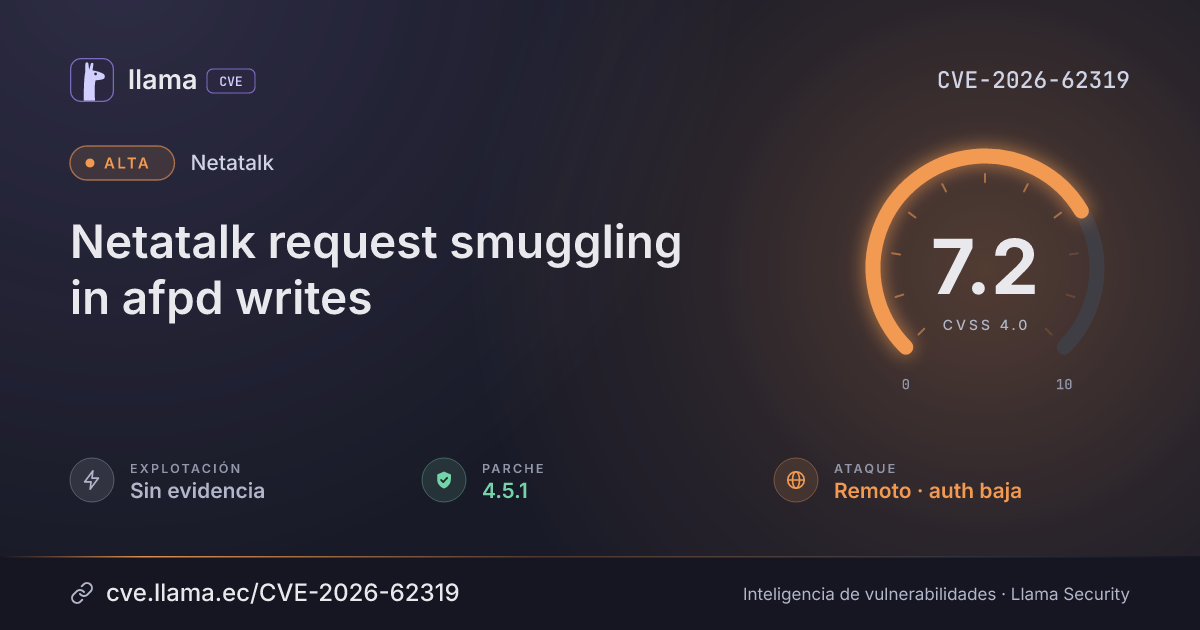
CVE-2026-62319

Netatalk request smuggling in afpd writes

A logged-in attacker can desync a connection and control the next request header and payload the server parses.

Texto original en inglés · Ver en español

Solo en configuraciones específicasParche disponibleimproper input validation
Descargar PNG JSON
CVSS 4.0
7.2
Alta
CVSS:4.0/AV:N/AC:L/AT:N/PR:L/UI:N/VC:L/VI:H/VA:L/SC:N/SI:N/SA:N Fuente: CNA
ExplotaciónSin evidenciaSSVC: ninguna · no figura en CISA KEV
Exploits públicos0Ninguno conocido
Parche1 versión4.5.1
Exposición1 dDesde la divulgación, 20 nov 2026, 12:26 p. m.
Detección6 minDesde la divulgación hasta su ingreso al índice
Decisión SSVCSeguir
Remediar en la ventana regular de mantenimiento
Sin explotación conocida, no automatizable e impacto técnico parcial. Hay versiones corregidas disponibles.
Las PoC crecen rápido, como las llamas bebé.Agéndala y deja de pensar en ella.
Timeline

Ciclo de vida de la vulnerabilidad

Hoy
Divulgación
Publicada
Evaluación SSVC +1
Explotación
Remediación
Monitoreo
Detectada
Fuente: NIST NVD
Verificada
12:26 p. m.
01:22 p. m.
02:02 p. m.
02:22 p. m.
12:26 p. m.
06:55 p. m.
01:24 a. m.
07:53 a. m.
02:22 p. m.
FechaFaseEventoDetalle
Divulgación Publicada CVE-2026-62319 divulgada · CVSS 7.2 (CNA)
Monitoreo Detectada Ingresó al índice
Monitoreo Fuente: NIST NVD Registro visto por primera vez en NIST NVD
Divulgación Evaluación SSVC CISA-ADP · explotación ninguna
Divulgación Modificada Última actualización del registro
Monitoreo Verificada Última verificación contra las fuentes
Resumen
Resumen generado por IA · CC-BY 4.0 · 20 nov 2026

Netatalk's AFP file-sharing daemon (afpd) mishandles certain write requests, letting a logged-in client desynchronize the connection's protocol framing. An attacker with low-privilege login can remotely control the next request header and payload that the server parses on that connection.

Affects Netatalk 1.5.0 through 4.5.0 where authenticated AFP clients send DSIWrite requests to afpd. Fixed in 4.5.1.

¿Qué significa?A DSIWrite frame whose dsi_doff value is greater than its dsi_len value desynchronizes the DSI/TCP stream. This lets the sender control the next DSI header and payload parsed on that connection.
¿Quién está afectado?Netatalk versions 1.5.0 through 4.5.0 are in the affected range, and the advisory did not assess later versions. The bug requires an authenticated AFP client sending DSIWrite requests to afpd. To check, compare the installed Netatalk version against that range.
¿Qué hacer?Upgrade Netatalk to 4.5.1 or later, the fixed version listed for this vulnerability.
Descripción original del registro (GitHub_M)

Netatalk is a Free and Open Source file server suite for Unix-like operating systems. From 1.5.0 until 4.5.1, dsi_stream_receive in libatalk/dsi/dsi_stream.c independently clamps dsi_doff and dsi_len for DSIWrite requests without enforcing that the data offset is no greater than the declared frame length. An authenticated AFP client can send dsi_doff greater than dsi_len, causing the receiver to consume bytes from a queued subsequent frame before libatalk/dsi/dsi_write.c detects the inconsistency. The irreversible stream desynchronization lets the attacker control the next parsed DSI header and payload and corrupts protocol framing for the connection. This issue is fixed in version 4.5.1.

Contexto

Condiciones y alcance

Condiciones necesarias para que el fallo sea explotable
01
Netatalk versions 1.5.0 through 4.5.0 (the advisory did not assess later versions)“Confirmed vulnerable version: Netatalk 4.5.0”
02
The attacker must be an authenticated AFP client sending DSIWrite requests to afpd“If an authenticated AFP client sends a DSIWrite frame with dsi_doff > dsi_len”
¿Quién debe revisar?Teams running Netatalk 1.5.0 through 4.5.0 as an AFP file server (afpd), including any service exposing AFP to authenticated users
No protegeNetwork filtering alone does not fix it.
Vector CVSS 4.0

Desglose de métricas

Opción resaltada = valor del vector · izquierda = peor caso · CNA
Vector de ataqueAV:N
RedAdyacenteLocalFísica
ComplejidadAC:L
BajaAlta
Requisitos de ataqueAT:N
NingunoPresentes
PrivilegiosPR:L
NingunoBajosAltos
InteracciónUI:N
NingunaPasivaActiva
Confid. (sistema)VC:L
AltoBajoNinguno
Integridad (sistema)VI:H
AltoBajoNinguno
Disponib. (sistema)VA:L
AltoBajoNinguno
Confid. (posterior)SC:N
AltoBajoNinguno
Integridad (posterior)SI:N
AltoBajoNinguno
Disponib. (posterior)SA:N
AltoBajoNinguno
Score de explotaciónQué tan fácil y probable es que la exploten
8.3/ 10Alto
Vector 8.3 (muy fácil) · sin evidencia de explotación.
Versiones

Rangos afectados

Afectada Corregida
netatalk≥ 1.5.0 < 4.5.1
1.5.0
4.5.1
Remediación

Estado del parche por paquete

Paquete / productoEstadoCorregida enDesde divulgaciónÚltima versión
netatalk
Corregida 4.5.1 — —
Versiones corregidas4.5.1
Explotación

Arsenal público

Sin exploits, módulos ni PoC públicos conocidos a la fecha de verificación.

Referencias
Fabricantehttps://github.com/Netatalk/netatalk/security/advisories/GHSA-h2jj-64fr-9grq
Otrahttps://github.com/Netatalk/netatalk/commit/2128c2ba3664bdbbe70dd0c92d58328e69e77973
Otrahttps://github.com/Netatalk/netatalk/commit/cc0a9d16d664745379da03f13e5b67cdd8f02733
Otrahttps://github.com/Netatalk/netatalk/releases/tag/netatalk-4-5-1

Las referencias externas se muestran para copiar: cve.llama.ec no lo redirige a otros sitios.