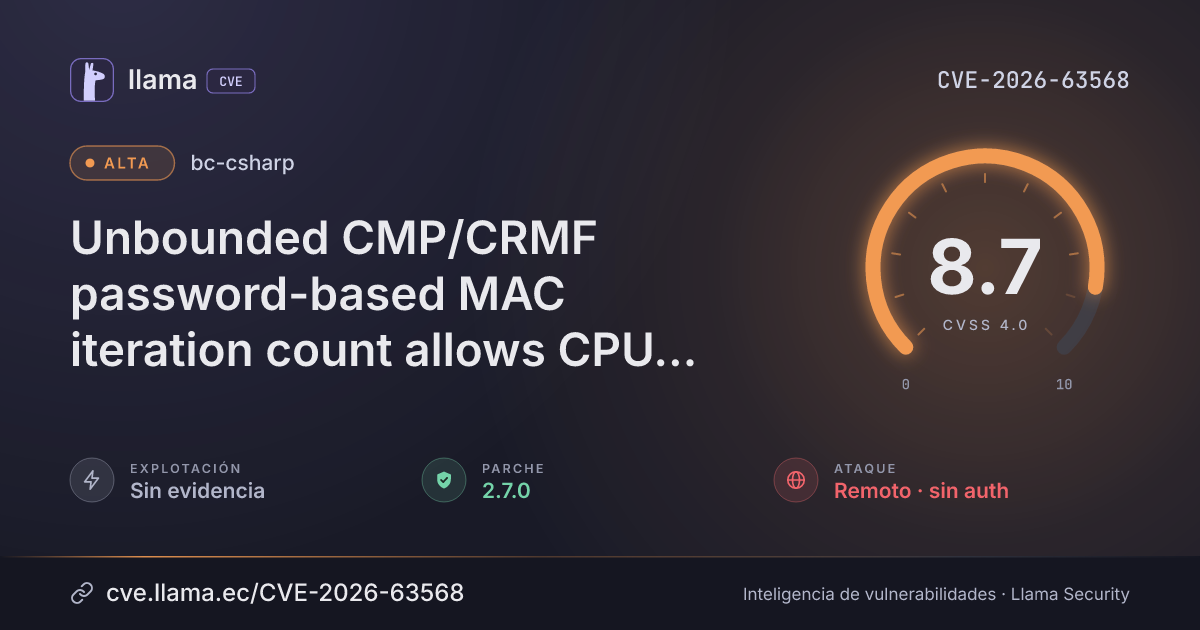
CVE-2026-63568
Unbounded CMP/CRMF password-based MAC iteration count allows CPU exhaustion
CVSS:4.0/AV:N/AC:L/AT:N/PR:N/UI:N/VC:N/VI:N/VA:H/SC:N/SI:N/SA:N
Fuente: CNA
Ciclo de vida de la vulnerabilidad
| Fecha | Fase | Evento | Detalle |
|---|---|---|---|
| Divulgación | Publicada | CVE-2026-63568 divulgada · CVSS 8.7 (CNA) | |
| Divulgación | Evaluación SSVC | CISA-ADP · explotación ninguna | |
| Divulgación | Modificada | Última actualización del registro | |
| Monitoreo | Detectada | Ingresó al índice | |
| Monitoreo | Fuente: OSV | Registro visto por primera vez en OSV | |
| Monitoreo | Fuente: NIST NVD | Registro visto por primera vez en NIST NVD |
Allocation of resources without limits or throttling in the CMP/CRMF password-based MAC verifier (PKMacBuilder) in Legion of the Bouncy Castle Inc. bc-csharp before 2.7.0 allows a remote unauthenticated attacker to cause a denial of service through CPU exhaustion via a CMP message or CRMF certificate request whose PBMParameter declares a very large iteration count, because PKMacBuilder enforced its iteration-count ceiling only when the caller had supplied an explicit maximum through the PKMacBuilder(IPKMacPrimitivesProvider, int) constructor. With any other constructor, ProtectedPkiMessage.Verify and CertificateRequestMessage.IsValidSigningKeyPop performed as many hash iterations as the sender requested, up to about 2^31, before the MAC could be checked.
Desglose de métricas
Rangos afectados
Estado del parche por paquete
| Paquete / producto | Estado | Corregida en | Desde divulgación | Última versión |
|---|---|---|---|---|
bc-csharp |
Corregida | 2.7.0 | — | — |
2.7.0Arsenal público
Sin exploits, módulos ni PoC públicos conocidos a la fecha de verificación.
https://github.com/bcgit/bc-csharp/wiki/CVE-2026-63568https://github.com/bcgit/bc-csharp/commit/10a9862fad04bb0c832a78b10e71d9818d6d1a63https://github.com/bcgit/bc-csharp/commit/65283bae66843d0d3c13c5e0272dbbe1c0d6aa04https://github.com/bcgit/bc-csharp/commit/d16f08a53dd0a78eb3310bbe80c947c7e1677290Las referencias externas se muestran para copiar: cve.llama.ec no lo redirige a otros sitios.