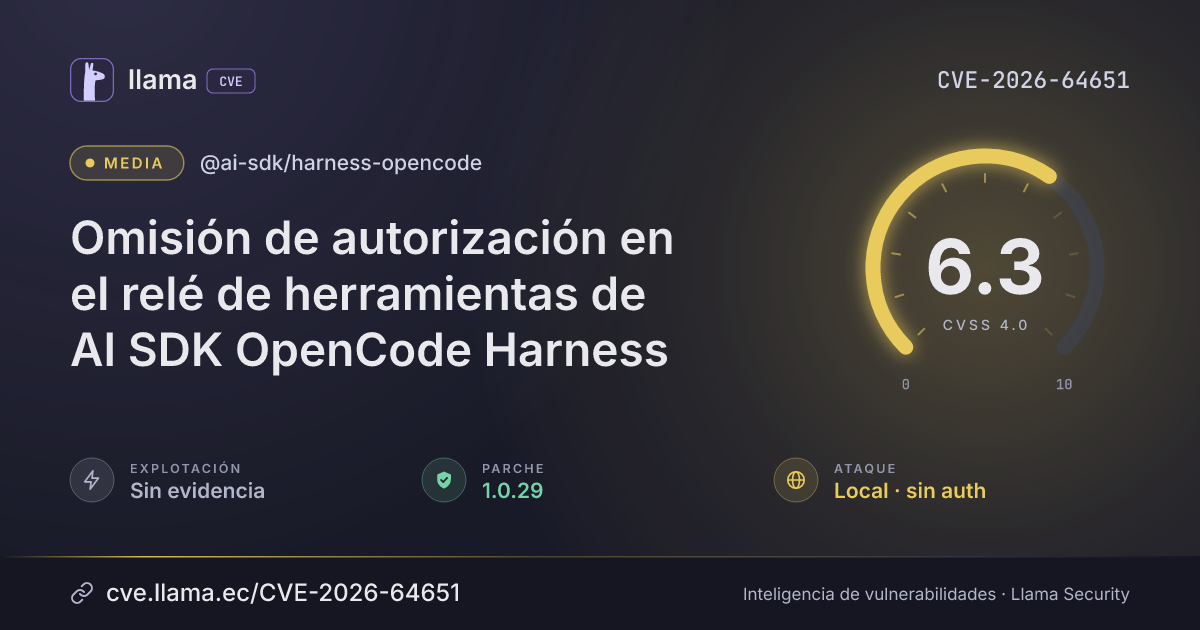
CVE-2026-64651
AI SDK OpenCode Harness Tool Relay Authorization Bypass
CVSS:4.0/AV:L/AC:L/AT:N/PR:N/UI:N/VC:N/VI:L/VA:N/SC:H/SI:H/SA:N
Fuente: CNA
Ciclo de vida de la vulnerabilidad
| Fecha | Fase | Evento | Detalle |
|---|---|---|---|
| Divulgación | Publicada | CVE-2026-64651 divulgada · CVSS 6.3 (CNA) | |
| Divulgación | Evaluación SSVC | CISA-ADP · explotación ninguna | |
| Divulgación | Modificada | Última actualización del registro | |
| Monitoreo | Detectada | Ingresó al índice |
The `@ai-sdk/harness-opencode` tool connects HarnessAgent to OpenCode through a sandboxed bridge. Prior to version 1.0.28, the tool relay authorizes requests from any process whose command line contains an allowed helper script path (`host-tool-mcp.mjs`). This allows untrusted code executing in the sandbox to invoke arbitrary host-exposed tools including secret lookups, deployment operations, and cloud API calls without a corresponding model-authorized tool-call event. Exploitation requires a Linux environment (the vulnerable fallback checks `process.platform === 'linux'` and reads `/proc`); an active harness session with one or more host-provided tools; and untrusted code executing in the sandbox (e.g. a malicious dependency, build script, or lifecycle hook) The fix in version 1.0.28 removes the process-path authorization fallback entirely. Relay requests are now only accepted after exact, short-lived, one-time authorization matching the tool name and input from a bridge-observed model event. Some workarounds are available. Do not run the OpenCode harness on untrusted repositories or with untrusted dependencies, and/or limit host-exposed tools to non-sensitive operations when working with untrusted code.
Desglose de métricas
Rangos afectados
Estado del parche por paquete
| Paquete / producto | Estado | Corregida en | Desde divulgación | Última versión |
|---|---|---|---|---|
@ai-sdk/harness-opencode |
Corregida | 1.0.29 | — | — |
1.0.29Arsenal público
Sin exploits, módulos ni PoC públicos conocidos a la fecha de verificación.
https://github.com/vercel/ai/security/advisories/GHSA-g48p-5rr5-8rgqhttps://github.com/vercel/ai/pull/17105Las referencias externas se muestran para copiar: cve.llama.ec no lo redirige a otros sitios.