llamaCVEVulnerability Intelligence
/
MikroTik RouterOS

CVE-2026-67279

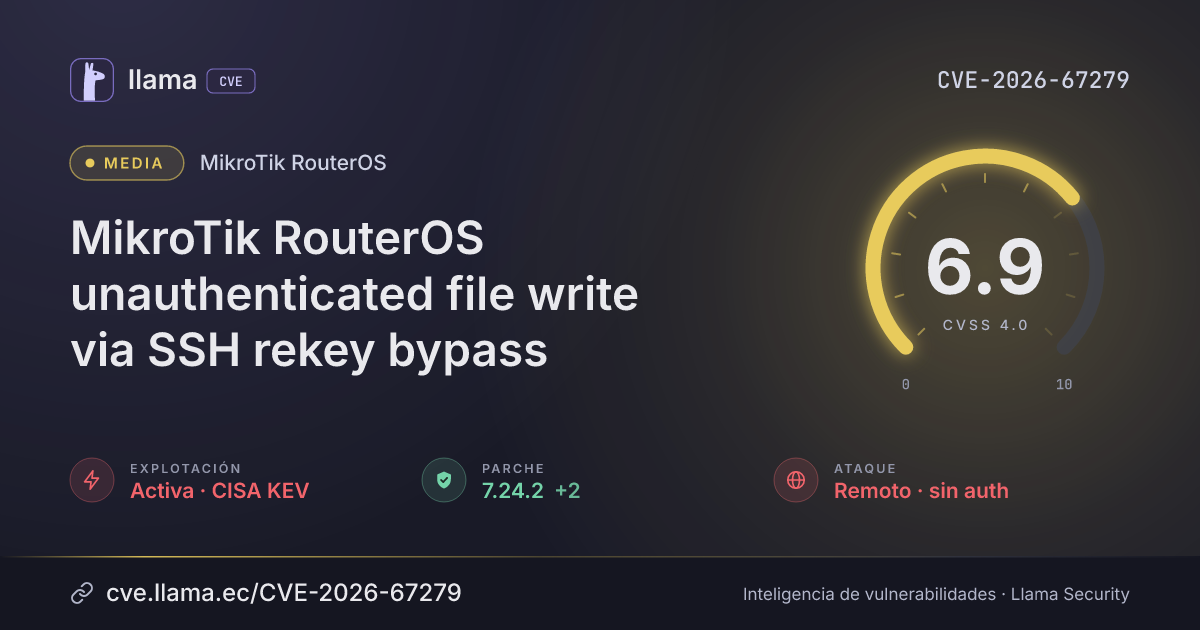
MikroTik RouterOS unauthenticated file write via SSH rekey bypass

Unauthenticated attackers can write files over SSH, including support files holding configuration data.

CISA KEV · explotación activaCrítica · en CISA KEVExplotación activaParche disponible
Descargar PNG JSON
CVSS 4.0
6.9
Media
CVSS:4.0/AV:N/AC:L/AT:N/PR:N/UI:N/VC:L/VI:L/VA:N/SC:N/SI:N/SA:N Fuente: CNA
ExplotaciónActivaEn CISA KEV desde 25 sept 2026
Exploits públicos0Ninguno conocido
Parche3 versiones6.49.21 · 7.23.4 · 7.24.2
Exposición74 dDesde la divulgación, 5 sept 2026, 3:00 p. m.
Detección47 dDesde la divulgación hasta su ingreso al índice
Decisión SSVCAtender
Priorizar en el próximo ciclo de cambios
Explotación activa, automatizable e impacto técnico parcial. Plazo KEV: 28 sept 2026.
Timeline

Ciclo de vida de la vulnerabilidad

Hoy
Divulgación
Publicada
Evaluación SSVC
Modificada
Explotación
CISA KEV
Remediación
Plazo KEV
Monitoreo
Detectada
Verificada
5 sept 26
25 sept 26
26 sept 26
28 sept 26
22 oct 26
12 nov 26
19 nov 26
5 sept 26
24 sept 26
13 oct 26
1 nov 26
19 nov 26
FechaFaseEventoDetalle
Divulgación Publicada CVE-2026-67279 divulgada · CVSS 6.9 (CNA)
Divulgación Evaluación SSVC CISA-ADP · explotación activa
Explotación CISA KEV Agregada al catálogo de vulnerabilidades explotadas
Divulgación Modificada Última actualización del registro
Remediación Plazo KEV Fecha límite de remediación para agencias federales (EE. UU.)
Monitoreo Detectada Ingresó al índice
Monitoreo Verificada Última verificación contra las fuentes
Resumen
Resumen generado por IA · CC-BY 4.0 · 11 nov 2026

MikroTik RouterOS has a flaw in its SSH service that lets an attacker skip login by requesting a key renegotiation, then run commands and create, overwrite or rebuild files in the managed file area, including support files with configuration and diagnostic data. The attacker can reach it remotely over the network without logging in, and it is being exploited in attacks.

Affects MikroTik RouterOS 7.24 before 7.24.2, 7.0.0 before 7.23.4, and 6.0.0 before 6.49.21 when the SSH service is reachable by an attacker. Fixed in 7.24.2, 7.23.4 and 6.49.21.

¿Qué significa?RouterOS SSH moves into the connection stage after a client-requested rekey even though login was never attempted. An unauthenticated attacker can then run commands and create, overwrite and reconstruct files in the RouterOS managed file namespace, including support files with configuration and diagnostic data.
¿Quién está afectado?Affected versions are RouterOS 7.24 before 7.24.2, 7.0.0 before 7.23.4, and 6.0.0 before 6.49.21, where the SSH service can be reached by an attacker. The installed RouterOS version can be compared with these ranges, and the SSH service settings show whether it is reachable.
¿Qué hacer?Upgrade to RouterOS 7.24.2, 7.23.4 or 6.49.21, depending on the release line in use. The facts name no workaround.
Descripción original del registro

RouterOS SSH enters the connection protocol after a client-requested rekey even though user authentication was never attempted, allowing an unauthenticated client to open a session channel and send an exec request. On affected builds the server dispatches the command, enabling unauthenticated creation, overwrite, and reconstruction of files in the RouterOS managed file namespace, including support files containing configuration and diagnostic data.This issue was fixed in versions: 6.49.21 (Long-term), 7.23.4 (Long-term) and 7.24.2 (Stable)

Contexto

Condiciones y alcance

Condiciones necesarias para que el fallo sea explotable
01
RouterOS SSH service reachable by the attacker“An attacker who can reach the SSH port could run commands on the router without ever logging in.”
02
RouterOS 7.24 before 7.24.2, 7.0.0 before 7.23.4, or 6.0.0 before 6.49.21“From 7.24 below 7.24.2 From 7.0.0 below 7.23.4 From 6.0.0 below 6.49.21”
03
Attacker sends a client-requested rekey, then opens a session channel and an exec request“RouterOS SSH enters the connection protocol after a client-requested rekey even though user authentication was never attempted”
¿Quién debe revisar?Anyone running MikroTik RouterOS 6 or 7 below 6.49.21, 7.23.4 or 7.24.2 with SSH reachable from untrusted networks.
Vector CVSS 4.0

Desglose de métricas

Opción resaltada = valor del vector · izquierda = peor caso · CNA
Vector de ataqueAV:N
RedAdyacenteLocalFísica
ComplejidadAC:L
BajaAlta
Requisitos de ataqueAT:N
NingunoPresentes
PrivilegiosPR:N
NingunoBajosAltos
InteracciónUI:N
NingunaPasivaActiva
Confid. (sistema)VC:L
AltoBajoNinguno
Integridad (sistema)VI:L
AltoBajoNinguno
Disponib. (sistema)VA:N
AltoBajoNinguno
Confid. (posterior)SC:N
AltoBajoNinguno
Integridad (posterior)SI:N
AltoBajoNinguno
Disponib. (posterior)SA:N
AltoBajoNinguno
Versiones

Rangos afectados

Afectada Corregida
RouterOS≥ 6.0.0 < 6.49.21
RouterOS≥ 7.0.0 < 7.23.4
RouterOS≥ 7.24 < 7.24.2
6.0.0
6.49.21
7.0.0
7.23.4
7.24
7.24.2
Remediación

Estado del parche por paquete

Paquete / productoEstadoCorregida enDesde divulgaciónÚltima versión
RouterOS
Corregida 6.49.21, 7.23.4, 7.24.2 — —
Versiones corregidas6.49.217.23.47.24.2
Explotación

Arsenal público

Sin exploits, módulos ni PoC públicos conocidos a la fecha de verificación.

Referencias
Fabricantehttps://mikrotik.com/supportsec/september-2026-vulnerability/
Fabricantehttps://forum.mikrotik.com/t/6-49-21-long-term-is-released/272802
Fabricantehttps://forum.mikrotik.com/t/7-23-4-long-term-is-released/272801
Fabricantehttps://forum.mikrotik.com/t/7-24-2-stable-is-released/272800
Exploithttps://npratley.net/reversing-mikrotiks-silent-patch-the-routeros-7-23-4-fix-they-wouldnt-explain/
Otrahttps://cert.pl/en/posts/2026/09/mikrotik-routeros-cve
Otrahttps://cert.pl/en/posts/2026/09/vulnerabilities-in-mikrotik-routeros-actively-exploited/

Las referencias externas se muestran para copiar: cve.llama.ec no lo redirige a otros sitios.