CVE-2026-67545
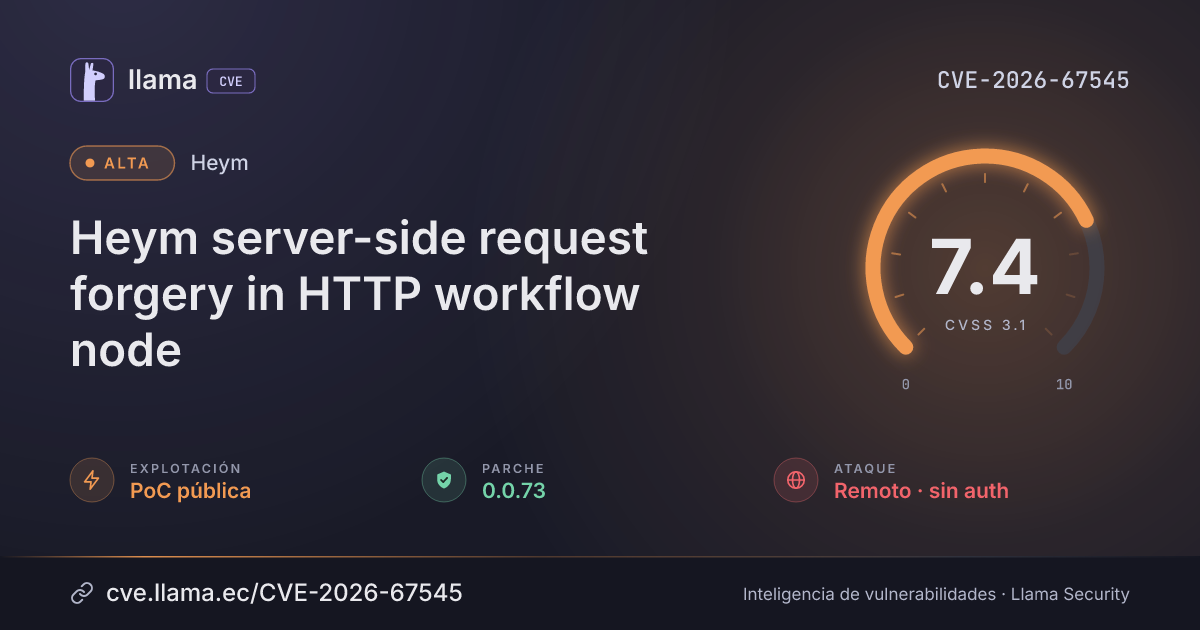
Heym server-side request forgery in HTTP workflow node
An unauthenticated network attacker can make requests to internal hosts, including cloud metadata endpoints.
CVSS:3.1/AV:N/AC:H/PR:N/UI:N/S:U/C:H/I:H/A:N
Fuente: CNA
Ciclo de vida de la vulnerabilidad
| Fecha | Fase | Evento | Detalle |
|---|---|---|---|
| Divulgación | Publicada | CVE-2026-67545 divulgada · CVSS 7.4 (CNA) | |
| Monitoreo | Detectada | Ingresó al índice | |
| Monitoreo | Fuente: NIST NVD | Registro visto por primera vez en NIST NVD | |
| Monitoreo | Fuente: OSV | Registro visto por primera vez en OSV | |
| Divulgación | Evaluación SSVC | CISA-ADP · explotación PoC pública | |
| Divulgación | Modificada | Última actualización del registro | |
| Monitoreo | Verificada | Última verificación contra las fuentes |
Heym, an automation platform, has a flaw in its HTTP workflow node that lets an unauthenticated attacker over the network make requests to internal addresses, such as cloud metadata endpoints or private hosts, but only when a workflow author has already pointed the node at such a target and the workflow is exposed with anonymous execution. The attack is not easy to carry out, and the issue is fixed in a later release.
Only affects Heym workflows that have an HTTP node targeting internal addresses and are exposed with anonymous execution. Fixed in 0.0.73.
Descripción original del registro (GitHub_M)
Heym builds and runs agentic systems and business-process automations on self-hosted infrastructure. Prior to version 0.0.73, the HTTP workflow node in Heym makes outbound HTTP requests to user-supplied URLs without validation of the target host or IP address. If a workflow author has already configured an HTTP node that targets internal addresses such as cloud metadata endpoints or private network hosts, and exposed the workflow with anonymous execution, an unauthenticated attacker can trigger the preconfigured SSRF sink. The same project has comprehensive SSRF protection in its MCP integration, which is absent from the HTTP node. This issue has been patched in version 0.0.73.
Condiciones y alcance
Desglose de métricas
Rangos afectados
Estado del parche por paquete
| Paquete / producto | Estado | Corregida en | Desde divulgación | Última versión |
|---|---|---|---|---|
heym |
Corregida | 0.0.73 | — | — |
0.0.73Arsenal público
Sin exploits, módulos ni PoC públicos conocidos a la fecha de verificación.
https://github.com/heymrun/heym/security/advisories/GHSA-8wj7-v2w6-wfcxhttps://github.com/heymrun/heym/commit/360a8de56ab9be0b11acdfe89168c5f2d7ab6b1ehttps://github.com/heymrun/heym/commit/583311603f8f81bf2f45a842727046ef17c99c9ehttps://github.com/heymrun/heym/commit/87c216f6e564c58d1dd747115d079fb487233ccfhttps://github.com/heymrun/heym/releases/tag/0.0.73Las referencias externas se muestran para copiar: cve.llama.ec no lo redirige a otros sitios.