llamaCVEVulnerability Intelligence
/
OTP

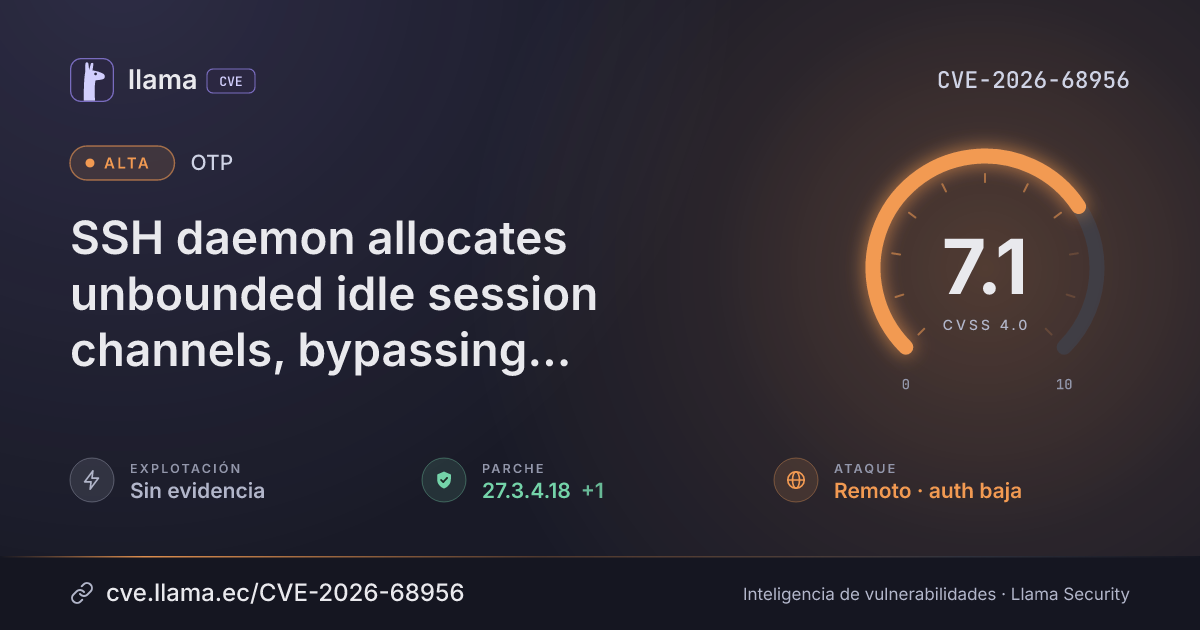
CVE-2026-68956

SSH daemon allocates unbounded idle session channels, bypassing max_channels

Specific setups onlyParche disponibledenial of service
Descargar PNG JSON
CVSS 4.0
7.1
Alta
CVSS:4.0/AV:N/AC:L/AT:N/PR:L/UI:N/VC:N/VI:N/VA:H/SC:N/SI:N/SA:N Fuente: CNA
ExplotaciónSin evidenciaSSVC: none · no figura en CISA KEV
Exploits públicos0Ninguno conocido
Parche2 versiones5.2.11.13 · 27.3.4.18
Exposición57 dDesde la divulgación, 22 sept 2026, 3:49 a. m.
Detección30 dDesde la divulgación hasta su ingreso al índice
Decisión SSVCSeguir
Remediar en la ventana regular de mantenimiento
Sin explotación conocida, no automatizable e impacto técnico parcial. Hay versiones corregidas disponibles.
Timeline

Ciclo de vida de la vulnerabilidad

Hoy
Divulgación
Publicada +1
Modificada
Explotación
Remediación
Monitoreo
Detectada
Fuente: OSV
Verificada
22 sept 26
22 oct 26
24 oct 26
11 nov 26
17 nov 26
19 nov 26
22 sept 26
6 oct 26
21 oct 26
4 nov 26
19 nov 26
FechaFaseEventoDetalle
Divulgación Publicada CVE-2026-68956 divulgada · CVSS 7.1 (CNA)
Divulgación Evaluación SSVC CISA-ADP · explotación ninguna
Monitoreo Detectada Ingresó al índice
Monitoreo Fuente: OSV Registro visto por primera vez en OSV
Divulgación Modificada Última actualización del registro
Monitoreo Verificada Última verificación contra las fuentes
Resumen

Allocation of Resources Without Limits or Throttling vulnerability in Erlang/OTP ssh allows an authenticated remote attacker to exhaust node memory by repeatedly opening session channels that are never assigned a handler. The "session" clause of ssh_connection:handle_msg/4 checks only minimal_remote_max_packet_size before calling setup_session/5, which unconditionally builds a #channel{} record and stores it in the ETS channel cache. The max_channels daemon option is consulted only by ssh_channel_sup:max_num_channels_not_exceeded/2, which counts supervisor children, so a channel that never gets a shell, exec, or subsystem handler is invisible to the limit and setting the option to a finite value does not mitigate the attack. RFC 4254 section 5.1 permits many session channels per connection, and each record costs only a few hundred bytes, so a single authenticated connection can accumulate channels until the node runs out of memory and the emulator terminates, affecting every application on it. No file contents, credentials, or write access are obtainable. This issue affects OTP from OTP 18.1.2 before OTP 27.3.4.18, OTP 28.5.0.7, and OTP 29.1.1, corresponding to ssh from 4.1.1 before 5.2.11.13, 5.5.2.6, and 6.0.6. Whether OTP before OTP 18.1.2, corresponding to ssh before 4.1.1, is affected is unknown.

¿Qué significa?An authenticated client can open many session channels on one SSH connection, and the daemon keeps them allocated while they sit idle. Enough of them exhausts the memory of the whole Erlang VM, crashing every application on the node. The impact is denial of service only.
¿Quién está afectado?The issue covers Erlang/OTP ssh from OTP 18.1.2 before 27.3.4.18, 28.5.0.7 and 29.1.1, and the ssh application from 4.1.1 before 5.2.11.13, 5.5.2.6 and 6.0.6. To check, look at the OTP release with erlang:system_info(otp_release) and the ssh application version listed for that release.
Contexto

Condiciones y alcance

Condiciones necesarias para que el fallo sea explotable
01
Erlang/OTP ssh running on OTP 18.1.2 up to (not including) OTP 27.3.4.18, OTP 28.5.0.7, and OTP 29.1.1“This issue affects OTP from OTP 18.1.2 before OTP 27.3.4.18, OTP 28.5.0.7, and OTP 29.1.1”
¿Quién debe revisar?Teams running Erlang/OTP SSH daemons from OTP 18.1.2 up to the patched releases OTP 27.3.4.18, 28.5.0.7, 29.1.1, including nodes sharing one VM with other apps.
No protegeSetting max_channels does not fix it.
MitigaciónRestrict network access to the SSH daemon to trusted clients.
Vector CVSS 4.0

Desglose de métricas

Opción resaltada = valor del vector · izquierda = peor caso · CNA
Vector de ataqueAV:N
RedAdyacenteLocalFísica
ComplejidadAC:L
BajaAlta
Requisitos de ataqueAT:N
NingunoPresentes
PrivilegiosPR:L
NingunoBajosAltos
InteracciónUI:N
NingunaPasivaActiva
Confid. (sistema)VC:N
AltoBajoNinguno
Integridad (sistema)VI:N
AltoBajoNinguno
Disponib. (sistema)VA:H
AltoBajoNinguno
Confid. (posterior)SC:N
AltoBajoNinguno
Integridad (posterior)SI:N
AltoBajoNinguno
Disponib. (posterior)SA:N
AltoBajoNinguno
Versiones

Rangos afectados

Afectada Corregida
ssh≥ 4.1.1 < 5.2.11.13
otp≥ 18.1.2 < 27.3.4.18
4.1.1
5.2.11.13
18.1.2
27.3.4.18
Remediación

Estado del parche por paquete

Paquete / productoEstadoCorregida enDesde divulgaciónÚltima versión
OTP
Corregida 5.2.11.13, 27.3.4.18 — —
Versiones corregidas5.2.11.1327.3.4.18
Explotación

Arsenal público

Sin exploits, módulos ni PoC públicos conocidos a la fecha de verificación.

Registro
EscenarioGENERALEEF
MitigaciónNo option bounds the number of idle session channels, so the following reduce exposure without eliminating the issue. * Restrict network access to the SSH daemon to trusted clients. Exploitation requires a successfully authenticated session, so limiting who can authenticate is the most effective control available. * Set the max_sessions daemon option to a finite value to bound the number of concurrent connections. This limits how many connections can mount the attack in parallel, though a single connection still suffices to exhaust memory. * Apply operating-system or firewall connection-rate and connection-count limits per source address. * Monitor node memory externally and restart the emulator when it exceeds a threshold. Setting max_channels is not a workaround: idle session channels bypass that check entirely.EEF
Referencias
Fabricantehttps://github.com/erlang/otp/security/advisories/GHSA-qhcm-px9c-rvfh
Fabricantehttps://www.erlang.org/doc/system/versions.html#order-of-versions
Parchehttps://github.com/erlang/otp/commit/79c2d2be17d902c5f53969b5806b725efda831be
Parchehttps://github.com/erlang/otp/commit/e18100975f0e5a8d59d02de00df12247a91b443b
Parchehttps://github.com/erlang/otp/commit/e2bbad0107bba41491a4d549686fd023db8740da
Otrahttps://cna.erlef.org/cves/CVE-2026-68956.html
Otrahttps://osv.dev/vulnerability/EEF-CVE-2026-68956
Otrahttps://github.com/erlang/otp/commit/84df3d4d0278e21a36a453bfee94799f0df67c2a

Las referencias externas se muestran para copiar: cve.llama.ec no lo redirige a otros sitios.