llamaCVEVulnerability Intelligence
/
OTP

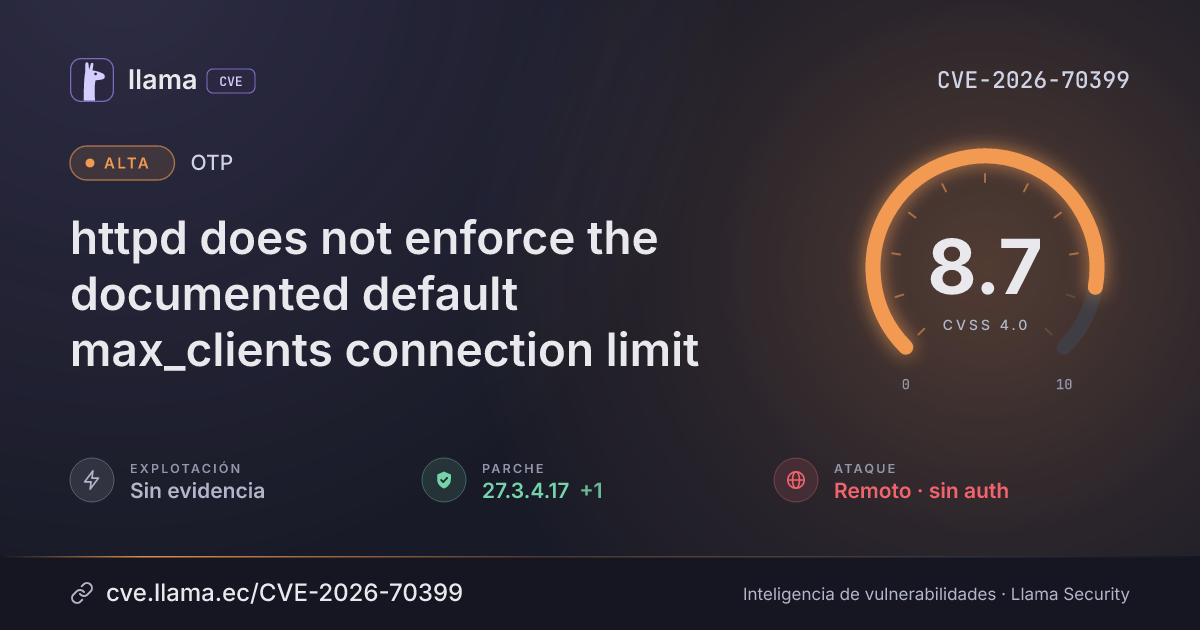
CVE-2026-70399

httpd does not enforce the documented default max_clients connection limit

Default setupsParche disponibledenial of service
Descargar PNG JSON
CVSS 4.0
8.7
Alta
CVSS:4.0/AV:N/AC:L/AT:N/PR:N/UI:N/VC:N/VI:N/VA:H/SC:N/SI:N/SA:N Fuente: CNA
ExplotaciónSin evidenciaSSVC: none · no figura en CISA KEV
Exploits públicos0Ninguno conocido
Parche2 versiones9.3.2.7 · 27.3.4.17
Exposición78 dDesde la divulgación, 1 sept 2026, 9:33 a. m.
Detección62 dDesde la divulgación hasta su ingreso al índice
Decisión SSVCSeguir
Remediar en la ventana regular de mantenimiento
Sin explotación conocida, automatizable e impacto técnico parcial. Hay versiones corregidas disponibles.
Timeline

Ciclo de vida de la vulnerabilidad

Hoy
Divulgación
Publicada +1
Modificada
Explotación
Remediación
Monitoreo
Detectada
Fuente: OSV
Verificada
1 sept 26
3 nov 26
11 nov 26
17 nov 26
19 nov 26
1 sept 26
21 sept 26
11 oct 26
30 oct 26
19 nov 26
FechaFaseEventoDetalle
Divulgación Publicada CVE-2026-70399 divulgada · CVSS 8.7 (CNA)
Divulgación Evaluación SSVC CISA-ADP · explotación ninguna
Monitoreo Detectada Ingresó al índice
Divulgación Modificada Última actualización del registro
Monitoreo Fuente: OSV Registro visto por primera vez en OSV
Monitoreo Verificada Última verificación contra las fuentes
Resumen

Allocation of Resources Without Limits or Throttling vulnerability in Erlang/OTP inets httpd allows an unauthenticated remote attacker to cause denial of service by opening and holding open a large number of connections. The max_clients option is documented to default to 150, and the inets hardening guide presents that limit as the first layer of denial-of-service defence, but a server that does not set it explicitly accepts an unlimited number of simultaneous connections. Establishing the connections is sufficient; no valid request and no authentication are required. The accept gate in httpd_manager:handle_new_connection/4 reads the option with httpd_util:lookup/2, which returns undefined when the key is absent, rather than the three-argument form carrying the 150 default that the neighbouring get_ustate/2 uses. Erlang term ordering places every integer before every atom, so the Count =< Max guard holds for any connection count and the server never returns {reject, busy}. Each accepted connection occupies a worker process and a socket for as long as it is held, driving the node towards process, memory and file descriptor exhaustion. Servers that set max_clients explicitly are unaffected, because a configured value is applied as intended. This issue affects OTP from OTP 17.0 before OTP 27.3.4.17, OTP 28.5.0.6, and OTP 29.0.6, corresponding to inets from 5.10 before 9.3.2.7, 9.6.2.3, and 9.7.2.

¿Qué significa?The httpd server does not enforce its documented default max_clients connection limit. A remote, unauthenticated client can open and hold a large number of connections, exhausting the server's processes, memory and file descriptors and causing denial of service.
Contexto

Condiciones y alcance

Condiciones necesarias para que el fallo sea explotable
01
The httpd server does not set max_clients explicitly in its configuration.“Only servers that do not set max_clients in the httpd configuration are affected.”
02
Erlang/OTP from OTP 17.0 before OTP 27.3.4.17, OTP 28.5.0.6, or OTP 29.0.6 (inets 5.10 before 9.3.2.7, 9.6.2.3, or 9.7.2).“This issue affects OTP from OTP 17.0 before OTP 27.3.4.17, OTP 28.5.0.6, and OTP 29.0.6”
03
The httpd server runs in its default configuration.“This vulnerability affects httpd in its default configuration.”
¿Quién debe revisar?Teams running Erlang/OTP inets httpd without an explicit max_clients setting, on OTP 17.0 up to the fixed releases.
MitigaciónSet max_clients explicitly in the httpd configuration, for example {max_clients, 150}.
Vector CVSS 4.0

Desglose de métricas

Opción resaltada = valor del vector · izquierda = peor caso · CNA
Vector de ataqueAV:N
RedAdyacenteLocalFísica
ComplejidadAC:L
BajaAlta
Requisitos de ataqueAT:N
NingunoPresentes
PrivilegiosPR:N
NingunoBajosAltos
InteracciónUI:N
NingunaPasivaActiva
Confid. (sistema)VC:N
AltoBajoNinguno
Integridad (sistema)VI:N
AltoBajoNinguno
Disponib. (sistema)VA:H
AltoBajoNinguno
Confid. (posterior)SC:N
AltoBajoNinguno
Integridad (posterior)SI:N
AltoBajoNinguno
Disponib. (posterior)SA:N
AltoBajoNinguno
Versiones

Rangos afectados

Afectada Corregida
inets≥ 5.10 < 9.3.2.7
otp≥ 17.0 < 27.3.4.17
5.10
9.3.2.7
17.0
27.3.4.17
Remediación

Estado del parche por paquete

Paquete / productoEstadoCorregida enDesde divulgaciónÚltima versión
OTP
Corregida 9.3.2.7, 27.3.4.17 — —
Versiones corregidas9.3.2.727.3.4.17
Explotación

Arsenal público

Sin exploits, módulos ni PoC públicos conocidos a la fecha de verificación.

Registro
EscenarioGENERALEEF
configurationOnly servers that do not set max_clients in the httpd configuration are affected. A server that sets the option to any integer value applies the limit as intended.EEF
Mitigación* Set max_clients explicitly in the httpd configuration, for example {max_clients, 150}. An explicitly configured value is read by the same accept gate and applied as intended, so this restores the documented limit without upgrading. * Limit concurrent connections in front of httpd, for example with reverse proxy or firewall connection-count and connection-rate rules. * Restrict access to the server to trusted clients where the deployment allows it.EEF
Referencias
Fabricantehttps://github.com/erlang/otp/security/advisories/GHSA-pwvh-c689-f8q5
Fabricantehttps://www.erlang.org/doc/system/versions.html#order-of-versions
Parchehttps://github.com/erlang/otp/commit/d94a94c96eb4cccbd6f7d7da5975f0c035b69612
Parchehttps://github.com/erlang/otp/commit/6746dc4e1df5257ad8ac91cbbd167cb8b0274ce7
Parchehttps://github.com/erlang/otp/commit/e0050fc00c500a4fa9ba1f594603c787ff6d20b2
Otrahttps://cna.erlef.org/cves/CVE-2026-70399.html
Otrahttps://osv.dev/vulnerability/EEF-CVE-2026-70399
Otrahttps://github.com/erlang/otp/commit/d9674f32811cd5bb02b0d6656053b5ee226bc74c

Las referencias externas se muestran para copiar: cve.llama.ec no lo redirige a otros sitios.