llamaCVEVulnerability Intelligence
/
Dinky

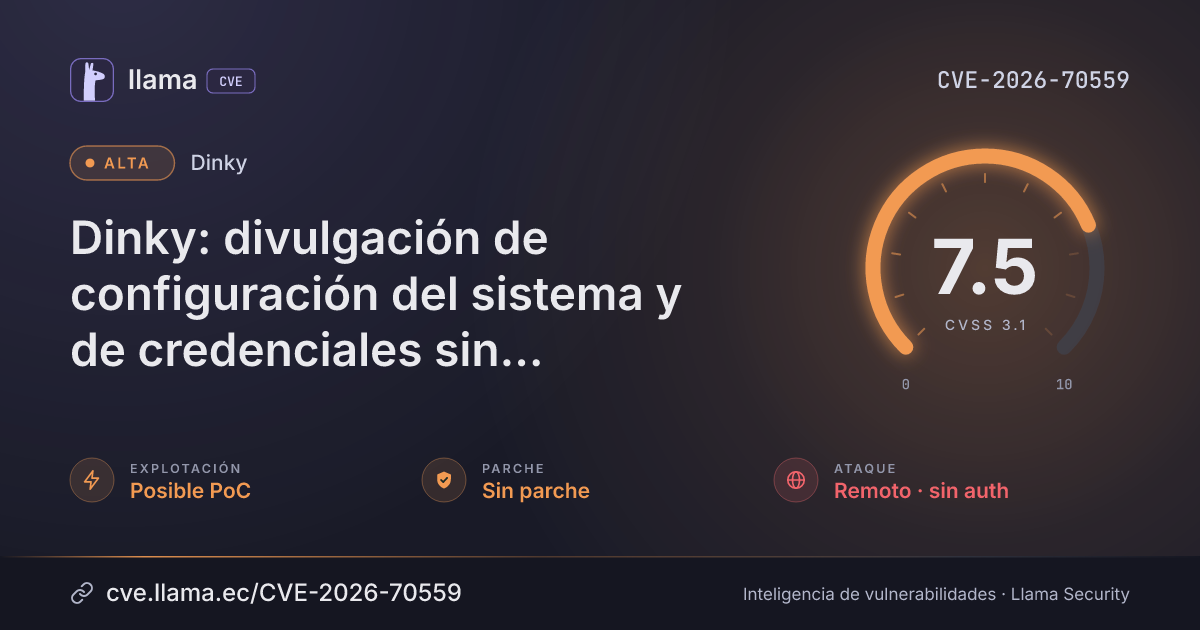
CVE-2026-70559

Dinky Unauthenticated System Configuration and Credential Disclosure via GET /api/sysConfig/getAll

Afecta la configuración por defectoSin parche publicadomissing authentication
Descargar PNG JSON
CVSS 3.1
7.5
Alta
CVSS:3.1/AV:N/AC:L/PR:N/UI:N/S:U/C:H/I:N/A:N Fuente: CNA
ExplotaciónPosible PoCSSVC de CISA-ADP decía «ninguna» · ajustado por exploit detectado
Exploits públicos11 fuente
ParcheSin parcheEl fabricante no ha publicado corrección
Exposición106 dDesde la divulgación, 6 ago 2026, 2:36 p. m.
Detección88 dDesde la divulgación hasta su ingreso al índice
Decisión SSVC · ajustadaSeguir de cerca
Monitorear y programar la remediación
Posible PoC pública sin verificar, automatizable e impacto técnico parcial. Decisión recalculada: la evaluación SSVC original indicaba explotación «ninguna». No hay versión corregida: aplique mitigaciones.
Timeline

Ciclo de vida de la vulnerabilidad

Hoy
Divulgación
Publicada
Evaluación SSVC
Modificada
Explotación
Remediación
Monitoreo
Detectada
Fuente: OSV
Verificada
6 ago 26
7 ago 26
3 nov 26
8 nov 26
16 nov 26
21 nov 26
6 ago 26
2 sept 26
29 sept 26
25 oct 26
21 nov 26
FechaFaseEventoDetalle
Divulgación Publicada CVE-2026-70559 divulgada · CVSS 7.5 (CNA)
Divulgación Evaluación SSVC CISA-ADP · explotación ninguna
Monitoreo Detectada Ingresó al índice
Divulgación Modificada Última actualización del registro
Monitoreo Fuente: OSV Registro visto por primera vez en OSV
Monitoreo Verificada Última verificación contra las fuentes
Resumen

Dinky's SysConfigController.getAll() handler for GET /api/sysConfig/getAll carries a method-level @SaIgnore annotation that short-circuits the class-level @SaCheckLogin, so the Sa-Token interceptor lets the request through with no session or role check. Any remote unauthenticated caller who can reach the Dinky HTTP port (8888 by default) receives the full live system configuration (54 entries on a stock v1.2.5 install) with one parameterless GET. Only one credential field (sys.maven.settings.repositoryPassword) has a desensitization handler wired; the other credential-bearing fields (sys.env.settings.dinkyToken, sys.ldap.settings.userPassword, sys.resource.settings.oss.accessKey and secretKey, and sys.dolphinscheduler.settings.token) return in cleartext. A bare install leaks the shipped defaults, including the hardcoded dinkyToken efda1551-7958-4e0f-80a8-dfd107df3e38 and minioadmin/minioadmin OSS keys; once an operator configures LDAP, object storage, or DolphinScheduler through the Settings Center, those live third-party credentials leak from the same endpoint. Because dinkyToken is the sole gate on the sibling POST /download/uploadFromRsByLocal arbitrary file write, this disclosure defeats token rotation as a mitigation for that vulnerability. Affects Dinky v1.2.5 (the current release, 2025-11-05) and the development branch (dev HEAD 63b5a5a), where the affected code is byte-identical.

Affects Dinky v1.2.5 and the dev branch when the HTTP application port 8888 is reachable, as the shipped compose file publishes it. No fixed version is listed yet.

¿Qué significa?The configuration endpoint GET /api/sysConfig/getAll returns the full system configuration without authentication. The response includes the cleartext Dinky token, the LDAP bind password, object-storage access and secret keys, and the DolphinScheduler API token. Live third-party credentials appear only after an operator configures the LDAP, object-storage or DolphinScheduler integrations.
¿Quién está afectado?Dinky up to and including v1.2.5, and the dev branch, are listed as affected. Check the installed Dinky version, and check whether port 8888 is reachable from networks that should not reach it. Check whether LDAP, object-storage or DolphinScheduler integrations are configured, since the third-party credentials are exposed only in that case.
¿Qué hacer?The checked facts do not name a fixed release, so no upgrade target can be given. Check the Dinky project for a release that addresses this endpoint before relying on any version.
no-patchThe checked facts list no workaround. Limiting who can reach port 8888 reduces the exposure the advisory describes, because the endpoint is reachable without authentication.
Contexto

Condiciones y alcance

Condiciones necesarias para que el fallo sea explotable
01
Affects Dinky v1.2.5 and the dev branch“v1.2.5 and dev branch, CVSS 7.5”
02
Attacker must be able to reach the Dinky HTTP application port (8888)“can reach the application port (8888, published by the shipped compose file)”
03
Live third-party credentials are exposed only after an operator configures the LDAP, object-storage or DolphinScheduler integrations“once an operator configures the LDAP / object-storage / DolphinScheduler integrations”
Vector CVSS 3.1

Desglose de métricas

Opción resaltada = valor del vector · izquierda = peor caso · CNA
Vector de ataqueAV:N
RedAdyacenteLocalFísica
ComplejidadAC:L
BajaAlta
PrivilegiosPR:N
NingunoBajosAltos
InteracciónUI:N
NingunaRequerida
AlcanceS:U
CambiadoSin cambio
ConfidencialidadC:H
AltoBajoNinguno
IntegridadI:N
AltoBajoNinguno
DisponibilidadA:N
AltoBajoNinguno
Score de explotaciónQué tan fácil y probable es que la exploten
10.0/ 10Muy alto
Vector 10.0 (muy fácil) · sin evidencia de explotación.
Versiones

Rangos afectados

Afectada Corregida
Dinky≤ 1.2.5
1.2.5
Remediación

Estado del parche por paquete

Paquete / productoEstadoCorregida enDesde divulgaciónÚltima versión
Dinky
Sin parche — — —
Explotación

Arsenal público

Exploit-DB
—
0
Metasploit
—
0
Nuclei
—
0
PoC en GitHub
codeb0ssx/CVE-2026-70559-PoC
1
Ver los 1 repositorios de GitHub
codeb0ssx/CVE-2026-70559-PoC

Los repositorios públicos incluyen exploits, escáneres, laboratorios y reglas de detección. No ejecute código de terceros sin revisarlo en un entorno aislado.

Registro
EscenarioGENERALVulnCheck
Referencias
Fabricantehttps://github.com/DataLinkDC/dinky/security/advisories/GHSA-c48m-x2xw-32rj
Reportehttps://github.com/DataLinkDC/dinky/issues/4567
Exploithttps://github.com/codeb0ssx/CVE-2026-70559-PoC
Otrahttps://github.com/DataLinkDC/dinky

Las referencias externas se muestran para copiar: cve.llama.ec no lo redirige a otros sitios.