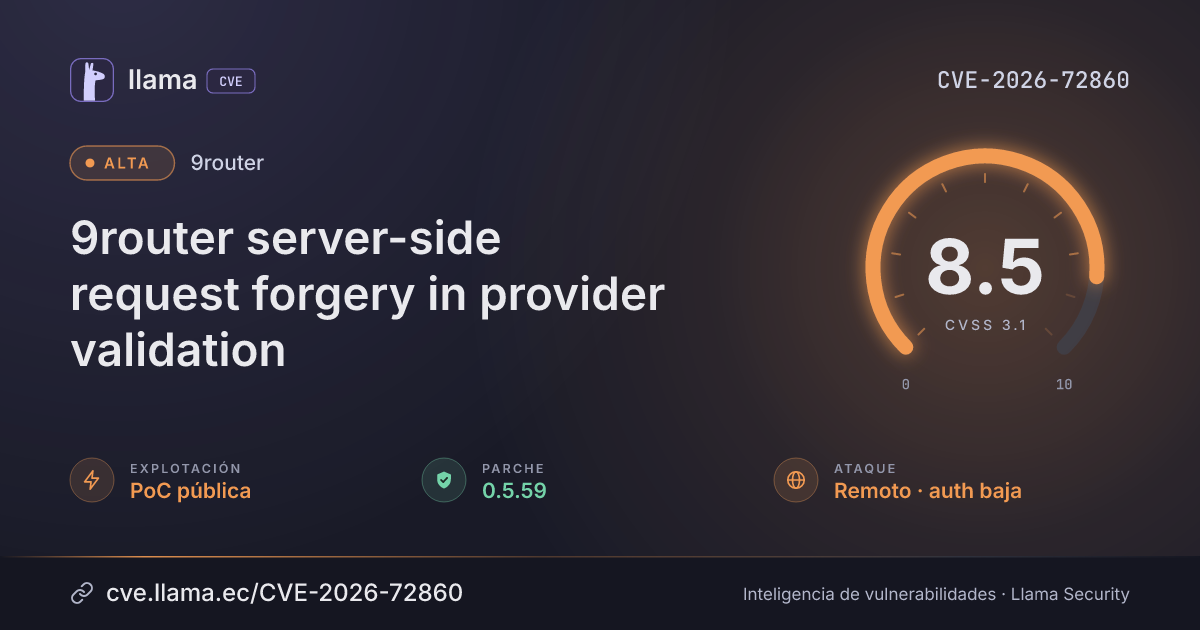
CVE-2026-72860
9router server-side request forgery in provider validation
Attackers can make the server query internal services and cloud metadata, read partial responses, and scan ports.
CVSS:3.1/AV:N/AC:L/PR:L/UI:N/S:C/C:H/I:L/A:N
Fuente: CNA
Ciclo de vida de la vulnerabilidad
| Fecha | Fase | Evento | Detalle |
|---|---|---|---|
| Divulgación | Publicada | CVE-2026-72860 divulgada · CVSS 8.5 (CNA) | |
| Divulgación | Evaluación SSVC | CISA-ADP · explotación PoC pública | |
| Remediación | Parche 0.5.59 | 9router · 9 d desde divulgación | |
| Monitoreo | Detectada | Ingresó al índice | |
| Monitoreo | Fuente: OSV | Registro visto por primera vez en OSV | |
| Divulgación | Modificada | Última actualización del registro | |
| Monitoreo | Verificada | Última verificación contra las fuentes |
The POST /api/provider-nodes/validate route in 9router takes a caller-supplied baseUrl and issues server-side HTTP requests to it, guarding the destination with assertPublicUrl from src/shared/utils/ssrfGuard.js. That guard compares hostname strings only: it resolves no DNS, does not revalidate after a redirect, and its IPv4-mapped IPv6 branch is unreachable. The branch matches ^::ffff:(\d+\.\d+\.\d+\.\d+)$, but the WHATWG URL parser canonicalizes such literals to hextets before the guard runs, so new URL("http://[::ffff:127.0.0.1]/").hostname yields [::ffff:7f00:1] and the pattern is tested against a string it is never handed. Every IPv4-mapped address therefore passes, and http://[::ffff:7f00:1] and http://[::ffff:a9fe:a9fe] reach loopback and link-local metadata addresses; a hostname whose A record points at an internal address passes as well because no resolution occurs. In the custom-embedding branch the upstream response body is truncated to 200 bytes and returned to the caller whenever the upstream status is neither 2xx nor 401 nor 403, which discloses the beginning of internal responses, and the other validation types remain usable for blind internal port scanning through status and timing differences. The caller-supplied apiKey is forwarded to the internal destination as an Authorization Bearer header. A dashboard session is required by default, and none is required when requireLogin is disabled.
Affects 9router 0.5.55 and earlier. A dashboard session is required by default, but none is needed when requireLogin is disabled. The facts name no fixed version.
Condiciones y alcance
Desglose de métricas
Rangos afectados
Estado del parche por paquete
| Paquete / producto | Estado | Corregida en | Desde divulgación | Última versión |
|---|---|---|---|---|
npm9router |
Corregida | 0.5.59 | 9 d | 0.5.119 no afectada |
0.5.59Arsenal público
Sin exploits, módulos ni PoC públicos conocidos a la fecha de verificación.
https://github.com/decolua/9router/pull/3370https://github.com/decolua/9router/issues/3293https://github.com/decolua/9router/blob/master/src/shared/utils/ssrfGuard.jshttps://github.com/decolua/9router/blob/master/src/app/api/provider-nodes/validate/route.jshttps://github.com/decolua/9routerhttps://www.vulncheck.com/advisories/9router-server-side-request-forgery-via-api-provider-nodes-validate-because-the-ipv4-mapped-ipv6-denylist-check-is-unreachableLas referencias externas se muestran para copiar: cve.llama.ec no lo redirige a otros sitios.