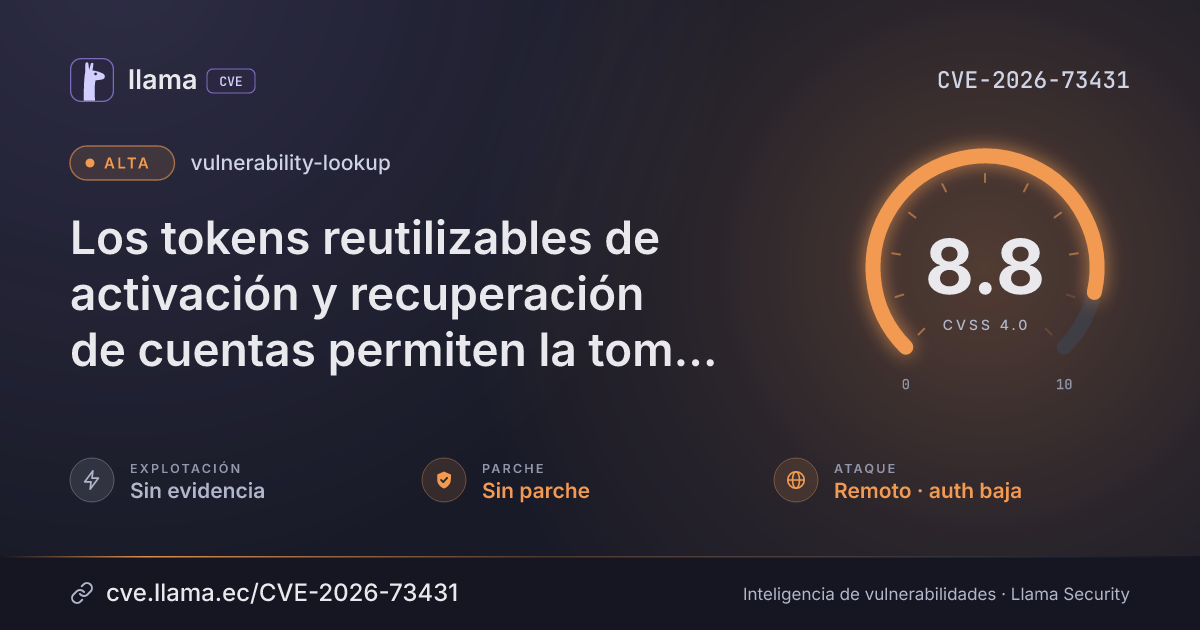
CVE-2026-73431
Reusable Account Activation and Recovery Tokens Allow Repeated Account Takeover in vulnerability-lookup
CVSS:4.0/AV:N/AC:H/AT:N/PR:L/UI:N/VC:H/VI:H/VA:N/SC:H/SI:H/SA:N
Fuente: CNA
Ciclo de vida de la vulnerabilidad
| Fecha | Fase | Evento | Detalle |
|---|---|---|---|
| Divulgación | Publicada | CVE-2026-73431 divulgada · CVSS 8.8 (CNA) | |
| Divulgación | Evaluación SSVC | CISA-ADP · explotación ninguna | |
| Divulgación | Modificada | Última actualización del registro | |
| Monitoreo | Detectada | Ingresó al índice |
Vulnerability-Lookup contains an authentication weakness in its account activation and password-recovery mechanism. Activation and recovery links were generated using stateless signed tokens containing only the user's login. Although the token signature and age were validated, the application did not track whether a token had already been successfully used. As a result, a captured activation or password-recovery link remained valid for the entire configured TOKEN_VALIDITY_PERIOD, even after the associated password had been changed. An attacker who obtains a valid activation or recovery token could therefore replay it multiple times during its validity period to set a new password and repeatedly take control of the affected account. In addition, tokens were not bound to a specific purpose, allowing the same token mechanism to be used across activation and recovery workflows. The patch introduces purpose-bound tokens and a random nonce whose SHA-256 digest is stored with the user account. The nonce is invalidated after a successful password change, making tokens single-use, while issuing a new token invalidates any previously issued token. The password-setting operation now explicitly consumes the token before committing the account change. Successful exploitation requires the attacker to obtain a currently valid activation or recovery link, but does not require knowledge of the victim's existing password or an authenticated session.
Desglose de métricas
Rangos afectados
Estado del parche por paquete
| Paquete / producto | Estado | Corregida en | Desde divulgación | Última versión |
|---|---|---|---|---|
vulnerability-lookup |
Sin parche | — | — | — |
Arsenal público
Sin exploits, módulos ni PoC públicos conocidos a la fecha de verificación.
https://github.com/vulnerability-lookup/vulnerability-lookup/commit/bef837242657acf680832be56b94428df130ed67Las referencias externas se muestran para copiar: cve.llama.ec no lo redirige a otros sitios.