llamaCVEVulnerability Intelligence
/
OTP

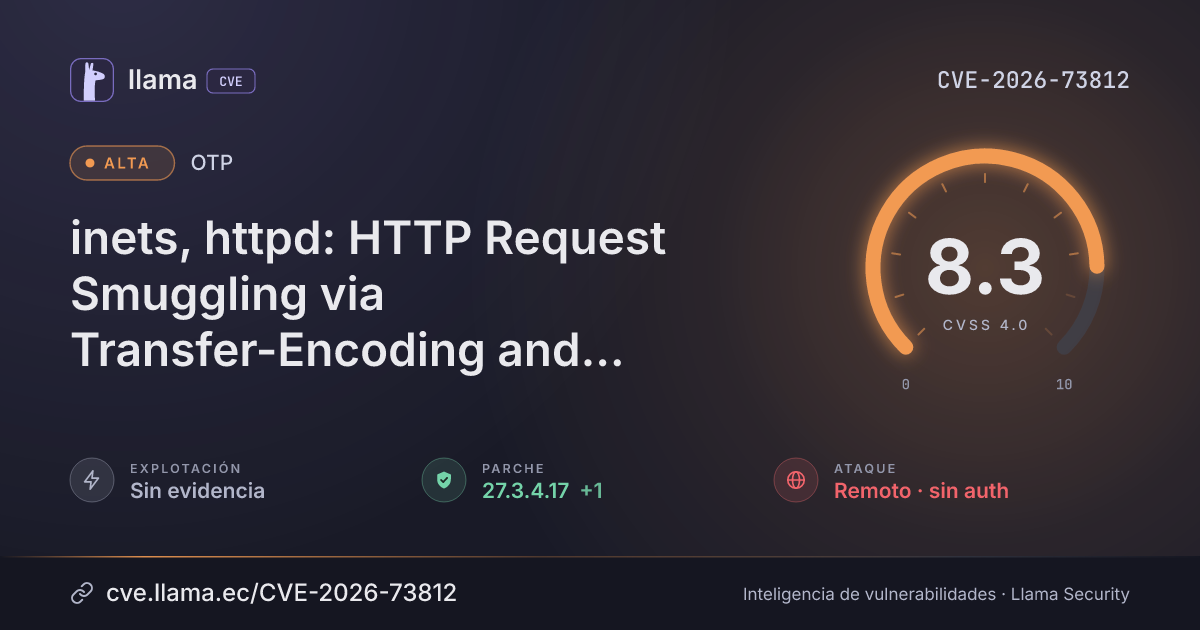
CVE-2026-73812

inets, httpd: HTTP Request Smuggling via Transfer-Encoding and Content-Length

Default setupsParche disponibleHTTP request smuggling
Descargar PNG JSON
CVSS 4.0
8.3
Alta
CVSS:4.0/AV:N/AC:L/AT:P/PR:N/UI:N/VC:L/VI:H/VA:N/SC:N/SI:N/SA:N Fuente: CNA
ExplotaciónSin evidenciaSSVC: none · no figura en CISA KEV
Exploits públicos0Ninguno conocido
Parche2 versiones9.3.2.7 · 27.3.4.17
Exposición78 dDesde la divulgación, 1 sept 2026, 9:42 a. m.
Detección62 dDesde la divulgación hasta su ingreso al índice
Decisión SSVCSeguir
Remediar en la ventana regular de mantenimiento
Sin explotación conocida, no automatizable e impacto técnico parcial. Hay versiones corregidas disponibles.
Timeline

Ciclo de vida de la vulnerabilidad

Hoy
Divulgación
Publicada +1
Modificada
Explotación
Remediación
Monitoreo
Detectada
Fuente: OSV
Verificada
1 sept 26
3 nov 26
11 nov 26
19 nov 26
1 sept 26
21 sept 26
11 oct 26
30 oct 26
19 nov 26
FechaFaseEventoDetalle
Divulgación Publicada CVE-2026-73812 divulgada · CVSS 8.3 (CNA)
Divulgación Evaluación SSVC CISA-ADP · explotación ninguna
Monitoreo Detectada Ingresó al índice
Monitoreo Fuente: OSV Registro visto por primera vez en OSV
Divulgación Modificada Última actualización del registro
Monitoreo Verificada Última verificación contra las fuentes
Resumen

httpd function check_header/3 rejects duplicate Content-Length (per CVE-2026-23941) but never checks for the TE+CL co-presence that RFC 9112 §6.3 identifies as a probable smuggling attempt. handle_body/3 frames by chunked and silently discards Content-Length. A CL-preferring front-end paired with chunked-preferring inets creates a classic CL.TE front-end/back-end desync. This issue affects OTP from OTP 17.0 before OTP 27.3.4.17, OTP 28.5.0.6, and OTP 29.0.6, corresponding to inets from 5.10 before 9.3.2.7, 9.6.2.3, and 9.7.2. Whether OTP before OTP 17.0, corresponding to inets before 5.10, is affected is unknown.

Affects inets httpd in OTP 17.0 up to 27.3.4.17, 28.5.0.6 or 29.0.6 when httpd sits behind a reverse proxy that prefers Content-Length over Transfer-Encoding. Fixed in OTP 27.3.4.17 and inets 9.3.2.7.

¿Qué significa?The bug lets a second HTTP request be hidden inside the body of the first, because the proxy and httpd disagree on where the request ends. A smuggled request can bypass the proxy's access controls, poison responses meant for other users sharing the connection, and bypass authentication enforced at the proxy layer.
¿Quién está afectado?Affected are OTP from 17.0 before 27.3.4.17, 28.5.0.6 and 29.0.6, and inets from 5.10 before 9.3.2.7, 9.6.2.3 and 9.7.2. The issue requires httpd deployed behind a reverse proxy that processes Content-Length preferentially over Transfer-Encoding. Check your installed OTP and inets versions and whether httpd sits behind such a proxy.
¿Qué hacer?Upgrade to OTP 27.3.4.17 or inets 9.3.2.7, the fixed versions listed for this vulnerability. If you cannot upgrade yet, deploy httpd without a reverse proxy in front, or configure the reverse proxy to reject requests containing both Transfer-Encoding and Content-Length headers.
Contexto

Condiciones y alcance

Condiciones necesarias para que el fallo sea explotable
01
OTP 17.0 up to (not including) OTP 27.3.4.17, 28.5.0.6 or 29.0.6; inets 5.10 up to (not including) 9.3.2.7, 9.6.2.3 or 9.7.2.“This issue affects OTP from OTP 17.0 before OTP 27.3.4.17, OTP 28.5.0.6, and OTP 29.0.6”
02
httpd is deployed behind a reverse proxy that processes Content-Length preferentially over Transfer-Encoding.“Exploitation requires httpd to be deployed behind a reverse proxy that processes Content-Length”
¿Quién debe revisar?Teams running Erlang/OTP httpd (inets) behind a reverse proxy that prefers Content-Length over Transfer-Encoding, on OTP 17.0+ with inets 5.10+ before the patched releases.
MitigaciónDeploy httpd without a reverse proxy in front, or configure the reverse proxy to reject requests containing both Transfer-Encoding and Content-Length headers.
Vector CVSS 4.0

Desglose de métricas

Opción resaltada = valor del vector · izquierda = peor caso · CNA
Vector de ataqueAV:N
RedAdyacenteLocalFísica
ComplejidadAC:L
BajaAlta
Requisitos de ataqueAT:P
NingunoPresentes
PrivilegiosPR:N
NingunoBajosAltos
InteracciónUI:N
NingunaPasivaActiva
Confid. (sistema)VC:L
AltoBajoNinguno
Integridad (sistema)VI:H
AltoBajoNinguno
Disponib. (sistema)VA:N
AltoBajoNinguno
Confid. (posterior)SC:N
AltoBajoNinguno
Integridad (posterior)SI:N
AltoBajoNinguno
Disponib. (posterior)SA:N
AltoBajoNinguno
Versiones

Rangos afectados

Afectada Corregida
inets≥ 5.10 < 9.3.2.7
otp≥ 17.0 < 27.3.4.17
5.10
9.3.2.7
17.0
27.3.4.17
Remediación

Estado del parche por paquete

Paquete / productoEstadoCorregida enDesde divulgaciónÚltima versión
OTP
Corregida 9.3.2.7, 27.3.4.17 — —
Versiones corregidas9.3.2.727.3.4.17
Explotación

Arsenal público

Sin exploits, módulos ni PoC públicos conocidos a la fecha de verificación.

Registro
EscenarioGENERALEEF
Referencias
Fabricantehttps://github.com/erlang/otp/security/advisories/GHSA-7j6m-4ffg-hg46
Fabricantehttps://www.erlang.org/doc/system/versions.html#order-of-versions
Parchehttps://github.com/erlang/otp/commit/591dc00dc99dc2a426167a3b5257c0c94bd45e91
Otrahttps://cna.erlef.org/cves/CVE-2026-73812.html
Otrahttps://osv.dev/vulnerability/EEF-CVE-2026-73812

Las referencias externas se muestran para copiar: cve.llama.ec no lo redirige a otros sitios.