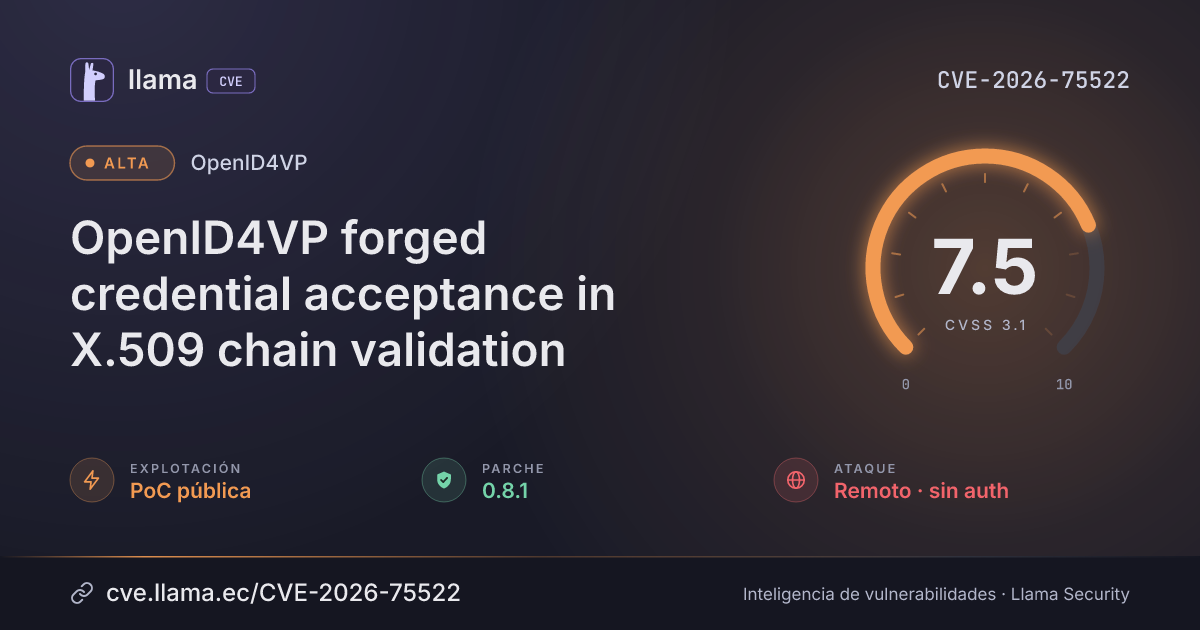
CVE-2026-75522
OpenID4VP forged credential acceptance in X.509 chain validation
Remote attackers without login can get forged credentials accepted as issued by a trusted authority.
CVSS:3.1/AV:N/AC:L/PR:N/UI:N/S:U/C:N/I:H/A:N
Fuente: CNA
Ciclo de vida de la vulnerabilidad
| Fecha | Fase | Evento | Detalle |
|---|---|---|---|
| Divulgación | Publicada | CVE-2026-75522 divulgada · CVSS 7.5 (CNA) | |
| Monitoreo | Detectada | Ingresó al índice | |
| Monitoreo | Fuente: NIST NVD | Registro visto por primera vez en NIST NVD | |
| Divulgación | Evaluación SSVC | CISA-ADP · explotación PoC pública | |
| Divulgación | Modificada | Última actualización del registro | |
| Monitoreo | Fuente: ENISA EUVD | Registro visto por primera vez en ENISA EUVD | |
| Monitoreo | Fuente: OSV | Registro visto por primera vez en OSV | |
| Monitoreo | Verificada | Última verificación contra las fuentes |
OpenID4VP, an open-source credential parsing library for SD-JWT VC and mDOC/mDL formats, can be attacked remotely without logging in. An attacker can submit a self-signed certificate that reuses a trusted authority's subject name, which gets credentials signed with the attacker's own key accepted as issued by that trusted authority.
Only affects @openeudi/openid4vp 0.8.0 and earlier when a relying party verifies mdoc or SD-JWT VC presentations via TrustEvaluator or the credential-parsing API. Fixed in 0.8.1.
Descripción original del registro (GitHub_M)
OpenID4VP is an open-source credential parsing library for SD-JWT VC and mDOC/mDL formats. Prior to 0.8.1, src/trust/ChainBuilder.ts ChainBuilder.tryBuild() terminates chain construction when an attacker-controlled certificate Subject Distinguished Name equals a trusted anchor subject, without verifying cryptographic closure to the anchor public key. A remote unauthenticated attacker can supply a self-signed leaf or intermediate that reuses the trusted Subject Distinguished Name and have credentials signed by the attacker key accepted as issued by the trusted authority. The public src/trust/TrustEvaluator.ts TrustEvaluator.evaluate() path compounds the error by matching a terminus through serialNumber and falling back to anchors[0], which can attribute the forged chain to genuine trusted-authority metadata. This issue is fixed in version 0.8.1.
Condiciones y alcance
Desglose de métricas
Rangos afectados
Estado del parche por paquete
| Paquete / producto | Estado | Corregida en | Desde divulgación | Última versión |
|---|---|---|---|---|
openid4vp |
Corregida | 0.8.1 | — | — |
0.8.1Arsenal público
Sin exploits, módulos ni PoC públicos conocidos a la fecha de verificación.
https://github.com/openeudi/openid4vp/security/advisories/GHSA-4c2f-96cf-f5fchttps://github.com/openeudi/openid4vp/pull/25https://github.com/openeudi/openid4vp/commit/a3ffd435aadd61aff1f75ec4b2e1a0f44ffabf16https://github.com/openeudi/openid4vp/releases/tag/v0.8.1Las referencias externas se muestran para copiar: cve.llama.ec no lo redirige a otros sitios.