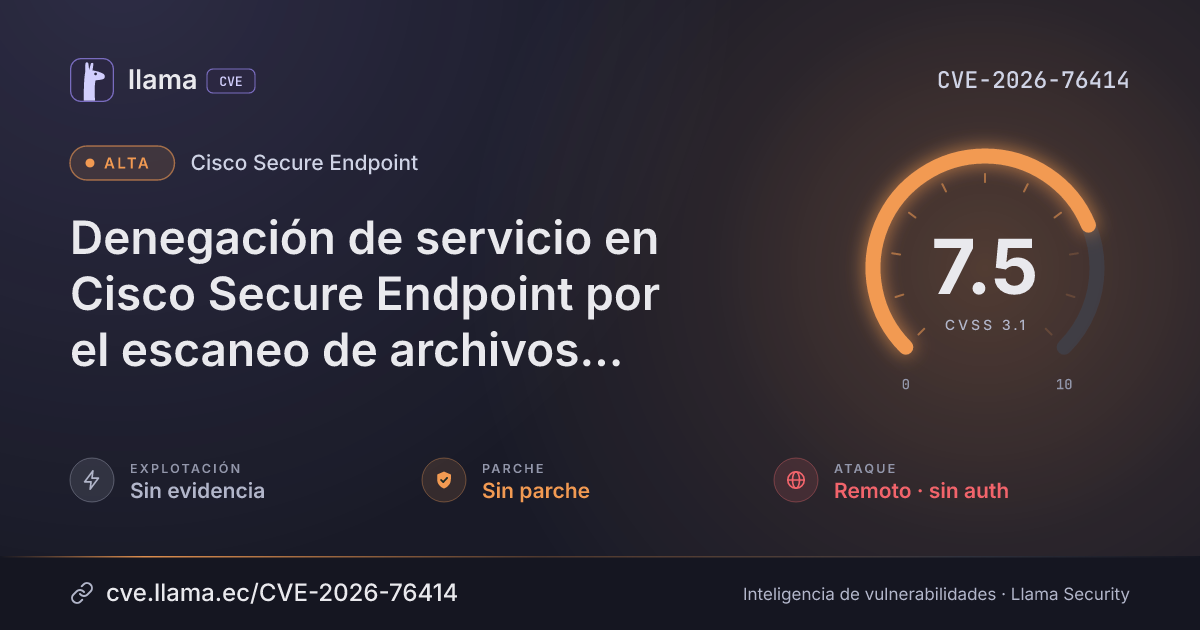
CVE-2026-76414
Cisco Secure Endpoint denial of service in ClamAV CHM file scanning
A remote attacker without logging in can send a crafted CHM file that makes the scanning process terminate.
Texto original en inglés · Ver en español
CVSS:3.1/AV:N/AC:L/PR:N/UI:N/S:U/C:N/I:N/A:H
Fuente: CNA
Ciclo de vida de la vulnerabilidad
| Fecha | Fase | Evento | Detalle |
|---|---|---|---|
| Divulgación | Publicada | CVE-2026-76414 divulgada · CVSS 7.5 (CNA) | |
| Monitoreo | Detectada | Ingresó al índice | |
| Divulgación | Evaluación SSVC | CISA-ADP · explotación ninguna | |
| Divulgación | Modificada | Última actualización del registro | |
| Monitoreo | Fuente: NIST NVD | Registro visto por primera vez en NIST NVD | |
| Monitoreo | Verificada | Última verificación contra las fuentes |
A logic error in how ClamAV scans Microsoft Compiled HTML Help (CHM) files in Cisco Secure Endpoint lets a remote attacker, without logging in, cause a denial of service. The attacker sends a crafted CHM file for scanning, which sends the ClamAV decode process into an infinite loop and makes it terminate.
Affects Cisco Secure Endpoint Connector software (Windows, Linux or Mac) that includes the affected ClamAV CHM scanning. No fixed version or patch is listed in the checked facts.
Descripción original del registro (cisco)
A vulnerability in Microsoft Compiled HTML Help (CHM) file scanning of ClamAV could allow an unauthenticated, remote attacker to cause a DoS condition on an affected device. This vulnerability is due to a logic error when scanning the CHM file and following the internal file pointers. An attacker could exploit this vulnerability by sending a crafted CHM file for scanning. A successful exploit could allow the attacker to cause the ClamAV decode process to terminate due to an infinite loop, resulting in a DoS condition on the affected software.
Condiciones y alcance
Desglose de métricas
Versiones afectadas
6.0.96.0.76.1.56.1.76.1.96.2.16.2.56.2.196.2.36.2.96.3.56.3.16.3.76.3.37.0.57.1.17.1.51.12.11.12.21.12.51.12.01.12.61.12.31.12.71.12.41.13.01.13.11.13.22.0.02.0.22.0.11.1.01.11.11.11.01.10.21.10.11.10.01.14.01.14.11.6.01.9.01.9.11.8.11.8.01.8.41.7.07.2.137.2.77.2.37.2.117.2.57.3.17.3.97.3.37.3.57.3.137.3.158.1.78.1.58.1.3.21242Estado del parche por paquete
| Paquete / producto | Estado | Corregida en | Desde divulgación | Última versión |
|---|---|---|---|---|
Cisco Secure Endpoint |
Sin parche | — | — | — |
Arsenal público
Sin exploits, módulos ni PoC públicos conocidos a la fecha de verificación.
https://sec.cloudapps.cisco.com/security/center/content/CiscoSecurityAdvisory/cisco-sa-clamav-multi-e93M3vdALas referencias externas se muestran para copiar: cve.llama.ec no lo redirige a otros sitios.