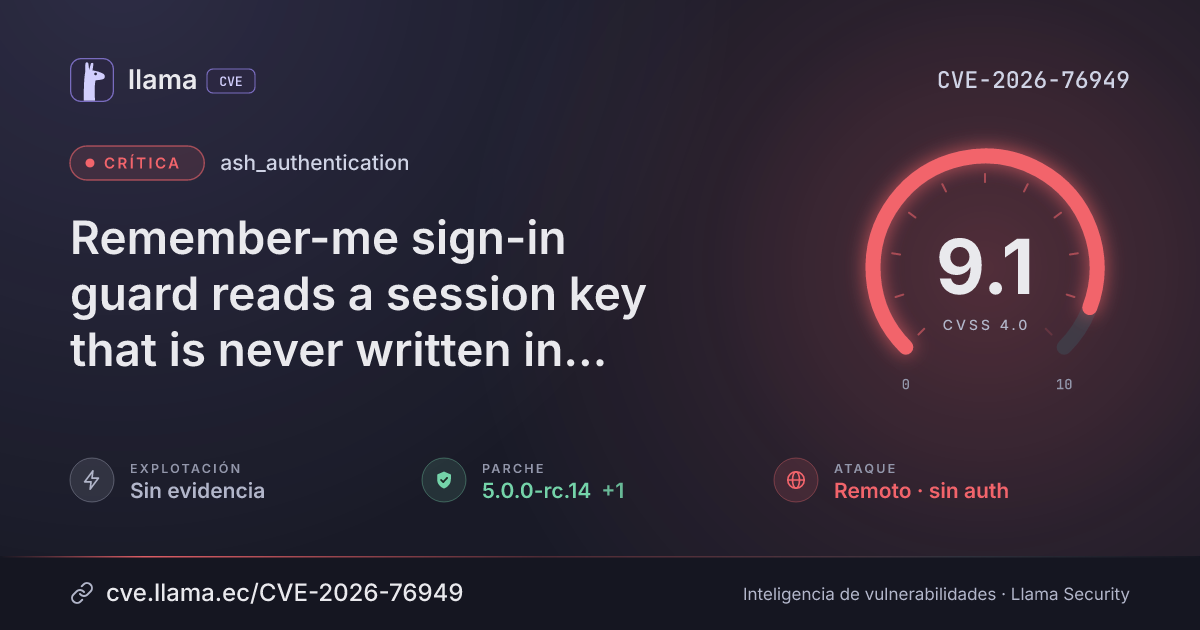
ExplotaciónSin evidenciaSSVC: none · no figura en CISA KEV
Exploits públicos0Ninguno conocido
Parche2 versiones4.15.0 · 5.0.0-rc.14
Exposición62 dDesde la divulgación, 17 sept 2026, 4:57 p. m.
Detección60 dDesde la divulgación hasta su ingreso al índice
Decisión SSVCAtender
Priorizar en el próximo ciclo de cambios
Sin explotación conocida, automatizable e impacto técnico total. Hay versiones corregidas disponibles.
Timeline
Ciclo de vida de la vulnerabilidad
Hoy
Divulgación
Publicada
Evaluación SSVC
Modificada
Explotación
Remediación
Monitoreo
Detectada
Verificada
17 sept 26
18 sept 26
17 nov 26
19 nov 26
17 sept 26
3 oct 26
19 oct 26
3 nov 26
19 nov 26
Fecha
Fase
Evento
Detalle
Divulgación
Publicada
CVE-2026-76949 divulgada · CVSS 9.1 (CNA)
Divulgación
Evaluación SSVC
CISA-ADP · explotación ninguna
Monitoreo
Detectada
Ingresó al índice
Divulgación
Modificada
Última actualización del registro
Monitoreo
Verificada
Última verificación contra las fuentes
Resumen
Authentication Bypass by Spoofing vulnerability in team-alembic ash_authentication allows an attacker who can plant a remember-me cookie in a victim's browser to replace that victim's authenticated session with one for the attacker's own account.
AshAuthentication.Plug.Helpers.sign_in_using_remember_me/3 skips re-authenticating an already-signed-in visitor by checking the session for "<subject_name>_token", but store_in_session/2 writes that key only when require_token_presence_for_authentication? is enabled and otherwise writes the bare subject name. At the default setting the guard therefore reads a key that is never written, its already-signed-in branch is unreachable, and the remember-me sign-in runs on every request through the per-request browser pipeline plug. A planted remember-me cookie is consequently honoured even for a visitor holding a live authenticated session, so whatever the victim enters afterwards lands in data the attacker controls. The read path in authenticate_resource_from_session/4 selects the key correctly, so the guard and the reader disagree about which key holds the session.
This issue affects ash_authentication: from 4.10.0 before 4.15.0 and from 5.0.0-rc.0 before 5.0.0-rc.14.
Affects ash_authentication 4.10.0 to before 4.15.0 and 5.0.0-rc.0 to before 5.0.0-rc.14 when the remember_me strategy runs in the browser pipeline. Fixed in 4.15.0 and 5.0.0-rc.14.
¿Qué significa?The remember-me sign-in guard reads a session key that is never written in ash_authentication. An attacker who can plant a remember-me cookie in the victim's browser can replace the victim's authenticated session with one for the attacker's own account, so data the victim enters lands in attacker-controlled records.
¿Quién está afectado?Versions 4.10.0 to before 4.15.0 and 5.0.0-rc.0 to before 5.0.0-rc.14 are affected, but only where the remember_me strategy is enabled with its per-request plug in the browser pipeline and require_token_presence_for_authentication? is at its default of false. Check the ash_authentication version in the project's dependency lock file and the remember_me and token settings in the authenticated resource.
¿Qué hacer?Upgrade to 4.15.0 on the 4.x line or 5.0.0-rc.14 on the 5.0 release candidates. Until the upgrade is applied, the advisory's workaround is to set require_token_presence_for_authentication? to true on the authenticated resource's token configuration.
Contexto
Condiciones y alcance
Condiciones necesarias para que el fallo sea explotable
01
The remember_me strategy is enabled and its per-request plug runs in the browser pipeline.“The application must enable the remember_me strategy and run its per-request plug in the browser pipeline”
02
require_token_presence_for_authentication? is at its default of false.“with require_token_presence_for_authentication? at its default of false”
03
The attacker can set a cookie in the victim's browser, for example via cookie tossing from a sibling subdomain, an HTTP host without HSTS, or a shared or kiosk browser.“The attacker also needs a position from which to set a cookie in the victim's browser”
04
Affected versions are ash_authentication 4.10.0 to before 4.15.0 and 5.0.0-rc.0 to before 5.0.0-rc.14.“This issue affects ash_authentication: from 4.10.0 before 4.15.0 and from 5.0.0-rc.0 before 5.0.0-rc.14.”
¿Quién debe revisar?Teams running ash_authentication 4.10.x to 4.14.x or 5.0.0-rc.0 to rc.13 with the remember_me strategy and its plug in the browser pipeline
MitigaciónSet require_token_presence_for_authentication? true on the authenticated resource's token configuration.
Vector CVSS 4.0
Desglose de métricas
Opción resaltada = valor del vector · izquierda = peor caso · CNA
Vector de ataqueAV:N
RedAdyacenteLocalFísica
ComplejidadAC:L
BajaAlta
Requisitos de ataqueAT:P
NingunoPresentes
PrivilegiosPR:N
NingunoBajosAltos
InteracciónUI:N
NingunaPasivaActiva
Confid. (sistema)VC:H
AltoBajoNinguno
Integridad (sistema)VI:H
AltoBajoNinguno
Disponib. (sistema)VA:N
AltoBajoNinguno
Confid. (posterior)SC:N
AltoBajoNinguno
Integridad (posterior)SI:N
AltoBajoNinguno
Disponib. (posterior)SA:N
AltoBajoNinguno
Versiones
Rangos afectados
AfectadaCorregida
ash_authentication≥ 4.10.0 < 4.15.0
ash_authentication≥ 5.0.0-rc.0 < 5.0.0-rc.14
4.10.0
4.15.0
5.0.0-rc.0
5.0.0-rc.14
Remediación
Estado del parche por paquete
Paquete / producto
Estado
Corregida en
Desde divulgación
Última versión
ash_authentication
Corregida
4.15.0, 5.0.0-rc.14
—
—
Versiones corregidas4.15.05.0.0-rc.14
Explotación
Arsenal público
Sin exploits, módulos ni PoC públicos conocidos a la fecha de verificación.
Registro
EscenarioGENERALEEF
configurationThe application must enable the remember_me strategy and run its per-request plug in the browser pipeline, with require_token_presence_for_authentication? at its default of false. Enabling that setting makes the guard read the key the session actually holds, which closes the issue.
The attacker also needs a position from which to set a cookie in the victim's browser, such as cookie tossing from a sibling subdomain, an HTTP host without HSTS, or a shared or kiosk browser.EEF
MitigaciónSet require_token_presence_for_authentication? true on the authenticated resource's token configuration. store_in_session/2 then writes the key the guard reads, so the already-signed-in branch fires and the remember-me sign-in no longer runs against a live session. Note this changes session storage semantics for the whole application and requires a token resource.
Otherwise remove the remember-me plug from the browser pipeline, which disables remember-me auto-login entirely.EEF
Usamos cookies propias estrictamente necesarias para que el sitio funcione y sea seguro. Con tu permiso, también usamos almacenamiento local para recordar tus preferencias y medir el uso del sitio de forma agregada. Puedes aceptar, rechazar o configurar cada categoría, y cambiar tu decisión cuando quieras desde el enlace “Preferencias de cookies” del pie de página. Más información
Preferencias de cookies
Elige qué permites
Solo usamos tecnologías propias de este dominio. Sin publicidad ni rastreadores de terceros. Detalle en la Política de cookies.