llamaCVEVulnerability Intelligence
/
safeurl

CVE-2026-77972

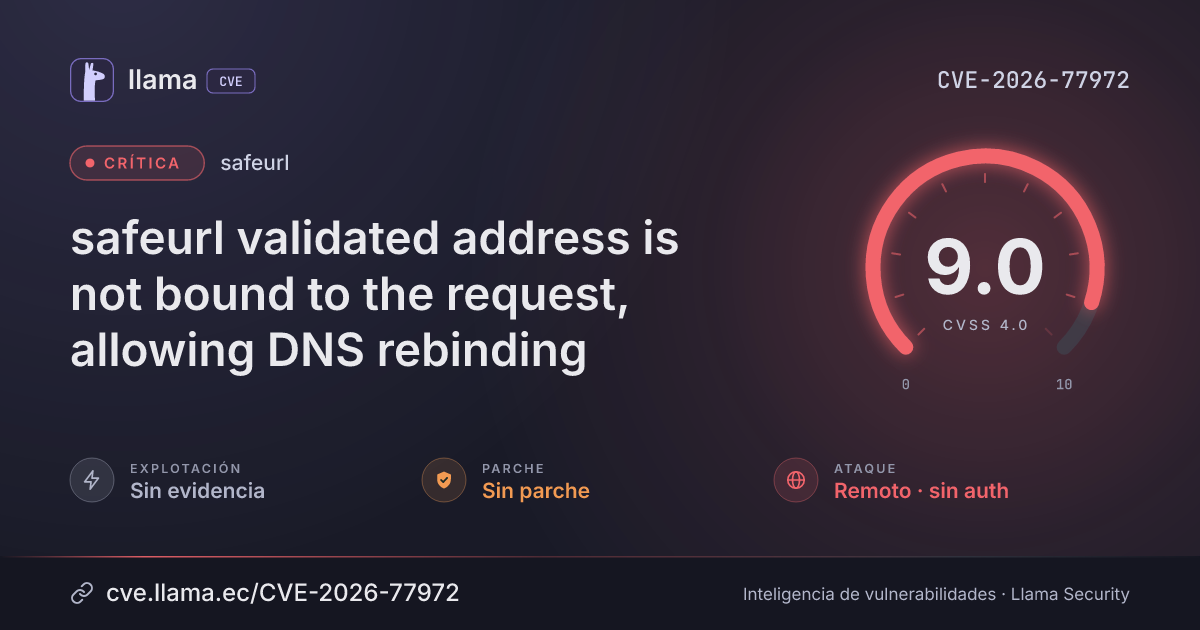
safeurl validated address is not bound to the request, allowing DNS rebinding

UnclearSin parche publicadorace condition
Descargar PNG JSON
CVSS 4.0
9.0
Crítica
CVSS:4.0/AV:N/AC:H/AT:P/PR:N/UI:N/VC:H/VI:L/VA:N/SC:H/SI:L/SA:N Fuente: CNA
ExplotaciónSin evidenciaSSVC: none · no figura en CISA KEV
Exploits públicos0Ninguno conocido
ParcheSin parcheEl fabricante no ha publicado corrección
Exposición65 dDesde la divulgación, 15 sept 2026, 10:37 a. m.
Detección62 dDesde la divulgación hasta su ingreso al índice
Decisión SSVCSeguir
Remediar en la ventana regular de mantenimiento
Sin explotación conocida, no automatizable e impacto técnico parcial. No hay versión corregida: aplique mitigaciones.
Timeline

Ciclo de vida de la vulnerabilidad

Hoy
Divulgación
Publicada
Evaluación SSVC
Modificada
Explotación
Remediación
Monitoreo
Detectada
Verificada
15 sept 26
21 sept 26
17 nov 26
19 nov 26
15 sept 26
1 oct 26
18 oct 26
3 nov 26
19 nov 26
FechaFaseEventoDetalle
Divulgación Publicada CVE-2026-77972 divulgada · CVSS 9 (CNA)
Divulgación Evaluación SSVC CISA-ADP · explotación ninguna
Monitoreo Detectada Ingresó al índice
Divulgación Modificada Última actualización del registro
Monitoreo Verificada Última verificación contra las fuentes
Resumen

Time-of-check Time-of-use (TOCTOU) Race Condition in Slab safeurl allows an attacker who controls a hostname's DNS responses to reach internal network destinations that validation rejected. Validation returns a verdict and not the address it approved, so the HTTP clients the library ships receive the original hostname and resolve it a second time when the request is made. An attacker who controls the authoritative DNS for a name can answer the first lookup with a permitted address and the second with a blocked one, and the request then reaches a destination validation never approved. The same window opens without an attacker whenever a name legitimately resolves to different addresses across lookups, such as short record lifetimes or rotation between several addresses. This issue affects safeurl: from 0.1.0 onward.

¿Qué significa?The library validates a hostname's address but does not bind that validated address to the actual request. An attacker who controls a hostname's DNS responses can make the library's HTTP requests reach internal network destinations that validation rejected, which is a server-side request forgery. The same gap can open without an attacker when a name legitimately resolves to different addresses between the validation lookup and the request lookup.
¿Quién está afectado?The issue affects safeurl from 0.1.0 onward on Hex, and the git code from commit feabbd0 onward. It applies when the application makes requests through the HTTP clients the library ships, HTTPoison or Tesla middleware. To check a project's version, look at the safeurl entry in mix.lock or mix.exs.
¿Qué hacer?The checked facts do not name a fixed version or vendor patch ids for this vulnerability. Check the advisory for a fixed release before relying on any version.
no-patchThe checked facts do not describe a workaround. Until a fix is published, follow the advisory for any guidance it gives on the affected HTTP clients.
Contexto

Condiciones y alcance

Condiciones necesarias para que el fallo sea explotable
01
safeurl 0.1.0 or later (Hex), or the git code from commit feabbd0 onward“This issue affects safeurl: from 0.1.0 onward.”
02
The application makes requests through the HTTP clients the library ships (HTTPoison or Tesla middleware)“so the HTTP clients the library ships receive the original hostname”
03
The hostname's DNS answers change between the validation lookup and the request lookup, either by attacker control or legitimate rotation or short record lifetimes“The same window opens without an attacker whenever a name legitimately resolves to different addresses across lookups”
¿Quién debe revisar?Teams running the Elixir safeurl library (version 0.1.0 and later, from Hex or GitHub) to make outbound HTTP requests, including through its HTTPoison or Tesla clients.
Vector CVSS 4.0

Desglose de métricas

Opción resaltada = valor del vector · izquierda = peor caso · CNA
Vector de ataqueAV:N
RedAdyacenteLocalFísica
ComplejidadAC:H
BajaAlta
Requisitos de ataqueAT:P
NingunoPresentes
PrivilegiosPR:N
NingunoBajosAltos
InteracciónUI:N
NingunaPasivaActiva
Confid. (sistema)VC:H
AltoBajoNinguno
Integridad (sistema)VI:L
AltoBajoNinguno
Disponib. (sistema)VA:N
AltoBajoNinguno
Confid. (posterior)SC:H
AltoBajoNinguno
Integridad (posterior)SI:L
AltoBajoNinguno
Disponib. (posterior)SA:N
AltoBajoNinguno
Versiones

Rangos afectados

Afectada Corregida
safeurl≥ 0.1.0
0.1.0
Remediación

Estado del parche por paquete

Paquete / productoEstadoCorregida enDesde divulgaciónÚltima versión
Hexsafeurl
Sin parche — — —
slab/safeurl-elixir
Sin parche — — —
Explotación

Arsenal público

Sin exploits, módulos ni PoC públicos conocidos a la fecha de verificación.

Registro
EscenarioGENERALEEF
Referencias
Otrahttps://cna.erlef.org/cves/CVE-2026-77972.html
Otrahttps://osv.dev/vulnerability/EEF-CVE-2026-77972
Otrahttps://github.com/slab/safeurl-elixir/commit/feabbd0a13f83028ab24b71710526e9da9841f70

Las referencias externas se muestran para copiar: cve.llama.ec no lo redirige a otros sitios.