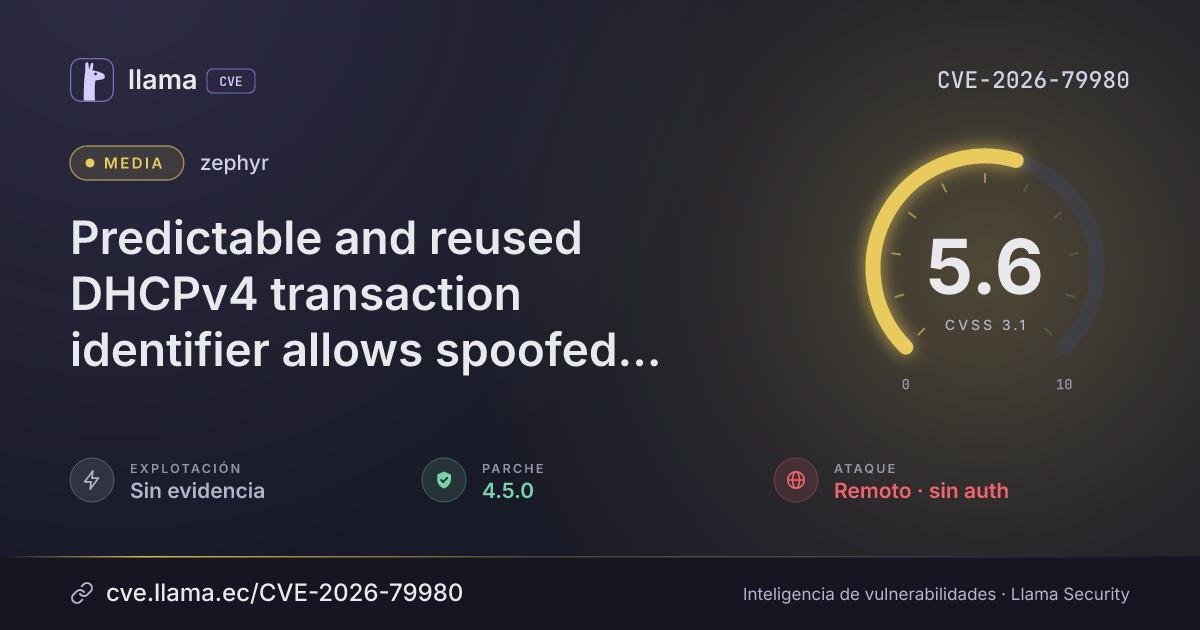
CVE-2026-79980
Predictable and reused DHCPv4 transaction identifier allows spoofed DHCP replies to reconfigure gateway and DNS
CVSS:3.1/AV:N/AC:H/PR:N/UI:N/S:U/C:L/I:L/A:L
Fuente: CNA
Ciclo de vida de la vulnerabilidad
| Fecha | Fase | Evento | Detalle |
|---|---|---|---|
| Divulgación | Publicada | CVE-2026-79980 divulgada · CVSS 5.6 (CNA) | |
| Monitoreo | Detectada | Ingresó al índice | |
| Monitoreo | Fuente: NIST NVD | Registro visto por primera vez en NIST NVD | |
| Monitoreo | Fuente: OSV | Registro visto por primera vez en OSV | |
| Divulgación | Evaluación SSVC | CISA-ADP · explotación ninguna | |
| Divulgación | Modificada | Última actualización del registro | |
| Monitoreo | Verificada | Última verificación contra las fuentes |
This vulnerability affects the DHCPv4 client networking component of Zephyr RTOS, which is used in embedded and IoT devices. An attacker who can send spoofed DHCP replies could reconfigure the device's default gateway and DNS resolvers, redirecting its network traffic, and could also alter or remove its IP address lease.
Descripción original del registro (zephyr)
The DHCPv4 client in subsys/net/lib/dhcpv4/dhcpv4.c maintained its transaction identifier (iface->config.dhcpv4.xid) as a counter rather than as a per-transaction random value. It was seeded once with sys_rand32_get() in dhcpv4_start_internal(), incremented by one in dhcpv4_send_discover() and dhcpv4_send_decline(), and never changed by dhcpv4_send_request() — so every RENEWING and REBINDING exchange reused, unchanged, the identifier that had already appeared on the wire in the broadcast DHCPDISCOVER at boot, and where the identifier did move it moved predictably by one. RFC 2131 4.1 requires a single identifier per transaction, chosen so that clients are unlikely to collide. This identifier is the client's only unpredictable reply-validation token. net_dhcpv4_input() accepts a BOOTP reply on op, a matching xid, and a matching chaddr (the interface MAC, which is public); the UDP callback is registered with a wildcard remote address and port, and no server-identifier or source-address check is applied. An attacker who learns one identifier — for example any host on the same segment that sees the broadcast DHCPDISCOVER, or a DHCP server or relay on a network the device previously joined — therefore retains a valid token for the device's whole uptime, and can predict the identifiers of later exchanges, without having to observe the unicast renew traffic or race the legitimate server. A forged reply that passes those checks has effect regardless of client state, because dhcpv4_parse_options() applies its side effects before the state machine gate in dhcpv4_handle_reply(): the router option calls net_if_ipv4_set_gw() and the DNS option calls dns_resolve_reconfigure(). A single accepted datagram can thus repoint the device's default gateway and resolvers at attacker-controlled addresses, redirecting its traffic; during RENEWING or REBINDING a forged DHCPACK re-binds the lease with attacker-chosen parameters and a forged DHCPNAK removes the address and restarts configuration. The fix draws a fresh sys_rand32_get() value at each point where a transaction begins — entering SELECTING, RENEWING and REBINDING, and at the INIT/INIT-REBOOT entry taken when an interface with a lease goes down — while REQUESTING and DECLINE keep the identifier of the exchange they belong to, as RFC 2131 requires. As a side effect the client also no longer discards a slow server's offer after retransmitting a discover, and the initial-discover backoff now draws its own randomness instead of deriving it from the identifier.
Desglose de métricas
Rangos afectados
Estado del parche por paquete
| Paquete / producto | Estado | Corregida en | Desde divulgación | Última versión |
|---|---|---|---|---|
zephyr |
Corregida | 4.5.0 | — | — |
4.5.0Arsenal público
Sin exploits, módulos ni PoC públicos conocidos a la fecha de verificación.
https://github.com/zephyrproject-rtos/zephyr/security/advisories/GHSA-p2q6-38x2-wmc8https://github.com/zephyrproject-rtos/zephyr/commit/6a96770a1ea8c38a54a45f892c3e97be0f7dac41Las referencias externas se muestran para copiar: cve.llama.ec no lo redirige a otros sitios.