llamaCVEVulnerability Intelligence
/
mcp-use

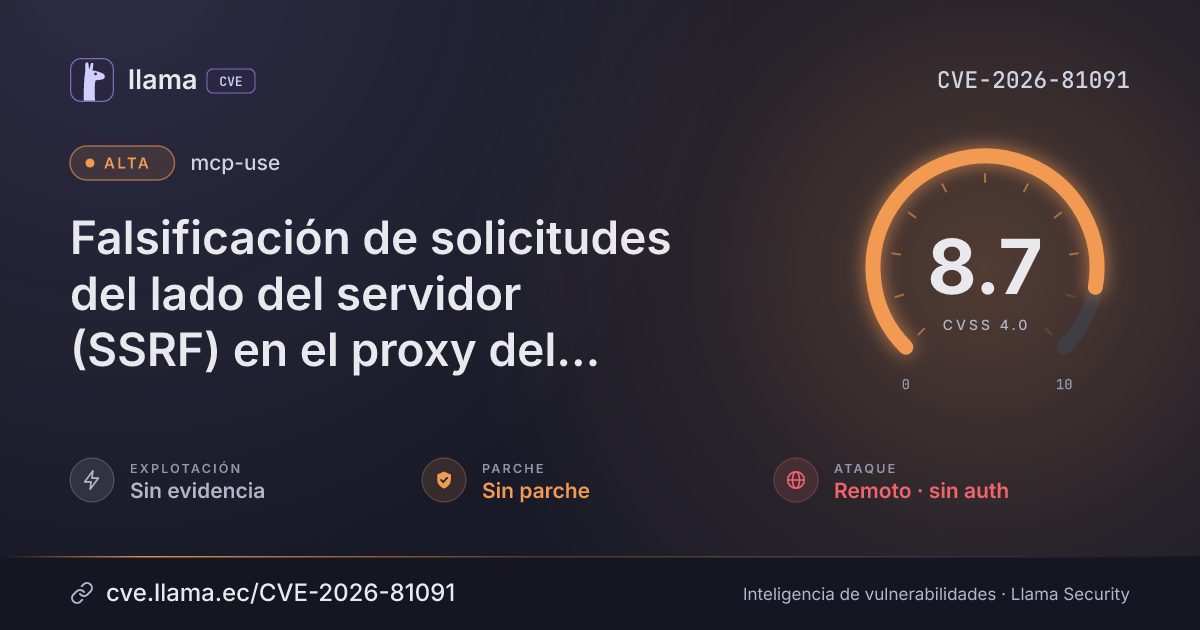
CVE-2026-81091

mcp-use Inspector Proxy Server-Side Request Forgery via Caller-Supplied Target URL

UnclearSin parche publicadoserver-side request forgery (SSRF)
Descargar PNG JSON
CVSS 4.0
8.7
Alta
CVSS:4.0/AV:N/AC:L/AT:N/PR:N/UI:N/VC:H/VI:N/VA:N/SC:N/SI:N/SA:N Fuente: CNA
ExplotaciónSin evidenciaSSVC: ninguna · no figura en CISA KEV
Exploits públicos0Ninguno conocido
ParcheSin parcheEl fabricante no ha publicado corrección
Exposición85 dDesde la divulgación, 27 ago 2026, 9:50 a. m.
Detección81 dDesde la divulgación hasta su ingreso al índice
Decisión SSVCSeguir
Remediar en la ventana regular de mantenimiento
Sin explotación conocida, automatizable e impacto técnico parcial. No hay versión corregida: aplique mitigaciones.
Timeline

Ciclo de vida de la vulnerabilidad

Hoy
Divulgación
Publicada +1
Modificada
Explotación
Remediación
Monitoreo
Detectada
Verificada
27 ago 26
17 nov 26
20 nov 26
21 nov 26
27 ago 26
18 sept 26
9 oct 26
30 oct 26
21 nov 26
FechaFaseEventoDetalle
Divulgación Publicada CVE-2026-81091 divulgada · CVSS 8.7 (CNA)
Divulgación Evaluación SSVC CISA-ADP · explotación ninguna
Monitoreo Detectada Ingresó al índice
Divulgación Modificada Última actualización del registro
Monitoreo Verificada Última verificación contra las fuentes
Resumen

The proxy middleware in mcp-use's inspector forwards requests to a destination the caller names. mountMcpProxy in libraries/typescript/packages/mcp-use/src/server/middleware/mcp-proxy.ts read the target from the X-Target-URL header or the __mcp_target parameter and proxied to it without inspecting the host, so loopback, link-local and private addresses were all accepted, as were names that resolve to them, and the validation was not reapplied to a redirect the destination returned. A caller could therefore make the server issue requests to addresses reachable only from the host it runs on and read the responses. In mcp-use 2.x the proxy moved to the @mcp-use/inspector package, whose mcp-proxy.ts calls isSafeProxyTarget, which checks the resolved address against private, loopback and link-local ranges before proxying and bounds the number of redirects followed.

Affects mcp-use 2.3.2 and earlier where the Inspector proxy (mountMcpProxy) accepts a caller-supplied target URL, letting callers reach addresses only the host can access. No vendor rating or fixed version is given.

¿Qué significa?The Inspector proxy reads a target URL from the X-Target-URL header or the __mcp_target parameter and sends the request there. A caller can therefore make the server request loopback, link-local and private addresses and read the responses.
¿Quién está afectado?The advisory names mcp-use 2.3.2 and earlier, but the product range lists 1.34.8 as the last affected version, so the sources give different version numbers. To check a setup, look at the installed mcp-use version and whether the application mounts the Inspector proxy with mountMcpProxy.
¿Qué hacer?The facts name no fixed version and no vendor patch ids, so no upgrade target can be stated from them. Check the advisory for a fix before relying on any version.
no-patchThe facts give no workaround. The condition named is the Inspector proxy accepting a caller-supplied target, so removing or limiting the mountMcpProxy Inspector proxy would remove that condition until a fix is available.
Contexto

Condiciones y alcance

Condiciones necesarias para que el fallo sea explotable
01
Affected mcp-use versions 2.3.2 and earlier“Affecting mcp-use <= 2.3.2”
02
Inspector proxy (mountMcpProxy) accepting a caller-supplied target via the X-Target-URL header or __mcp_target parameter“read the target from the X-Target-URL header or the __mcp_target parameter and proxied to it”
¿Quién debe revisar?Teams running mcp-use 2.3.2 or earlier with the Inspector proxy (mountMcpProxy) enabled
Vector CVSS 4.0

Desglose de métricas

Opción resaltada = valor del vector · izquierda = peor caso · CNA
Vector de ataqueAV:N
RedAdyacenteLocalFísica
ComplejidadAC:L
BajaAlta
Requisitos de ataqueAT:N
NingunoPresentes
PrivilegiosPR:N
NingunoBajosAltos
InteracciónUI:N
NingunaPasivaActiva
Confid. (sistema)VC:H
AltoBajoNinguno
Integridad (sistema)VI:N
AltoBajoNinguno
Disponib. (sistema)VA:N
AltoBajoNinguno
Confid. (posterior)SC:N
AltoBajoNinguno
Integridad (posterior)SI:N
AltoBajoNinguno
Disponib. (posterior)SA:N
AltoBajoNinguno
Score de explotaciónQué tan fácil y probable es que la exploten
10.0/ 10Muy alto
Vector 10.0 (muy fácil) · sin evidencia de explotación.
Versiones

Rangos afectados

Afectada Corregida
mcp-use≤ 1.34.8
1.34.8
Remediación

Estado del parche por paquete

Paquete / productoEstadoCorregida enDesde divulgaciónÚltima versión
mcp-use
Sin parche — — —
Explotación

Arsenal público

Sin exploits, módulos ni PoC públicos conocidos a la fecha de verificación.

Registro
EscenarioGENERALVulnCheck
Referencias
Fabricantehttps://github.com/mcp-use/mcp-use/security/advisories/GHSA-f2jg-rm2x-hc5p
Otrahttps://github.com/mcp-use/mcp-use
Otrahttps://www.vulncheck.com/advisories/mcp-use-inspector-proxy-server-side-request-forgery-via-caller-supplied-target-url

Las referencias externas se muestran para copiar: cve.llama.ec no lo redirige a otros sitios.