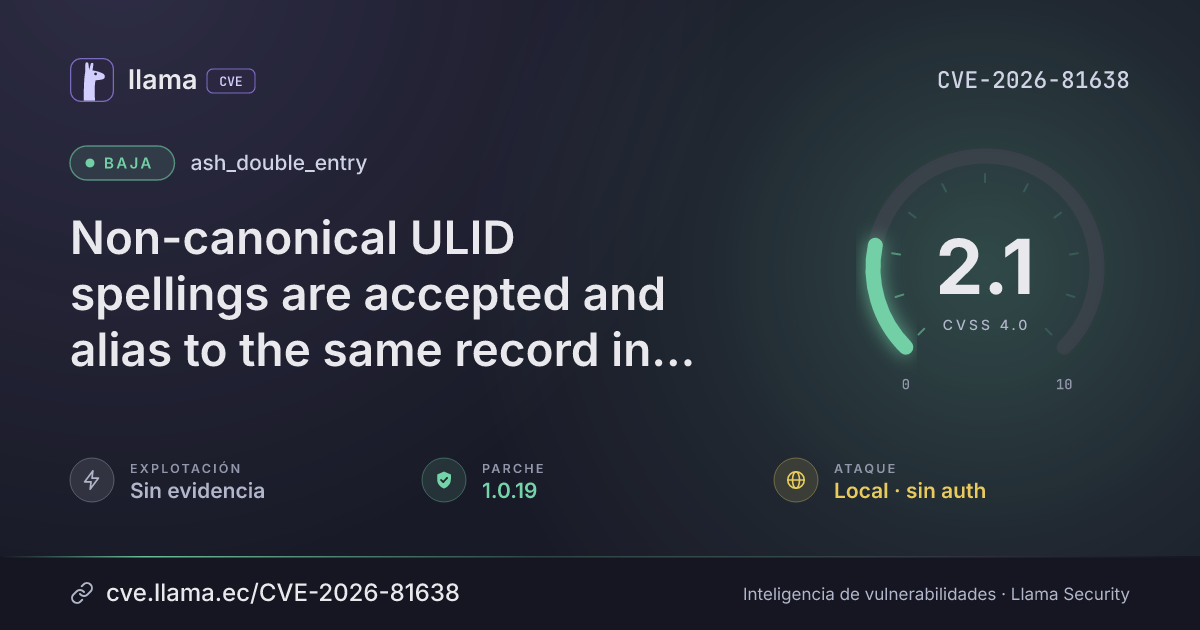
CVE-2026-81638
Non-canonical ULID spellings are accepted and alias to the same record in ash_double_entry
CVSS:4.0/AV:L/AC:L/AT:P/PR:N/UI:N/VC:N/VI:L/VA:N/SC:N/SI:L/SA:N
Fuente: CNA
Ciclo de vida de la vulnerabilidad
| Fecha | Fase | Evento | Detalle |
|---|---|---|---|
| Divulgación | Publicada | CVE-2026-81638 divulgada · CVSS 2.1 (CNA) | |
| Divulgación | Evaluación SSVC | CISA-ADP · explotación ninguna | |
| Monitoreo | Detectada | Ingresó al índice | |
| Divulgación | Modificada | Última actualización del registro | |
| Monitoreo | Verificada | Última verificación contra las fuentes |
Improper Handling of Alternate Encoding vulnerability in ash-project ash_double_entry allows an attacker to submit several distinct string spellings of the same identifier. AshDoubleEntry.ULID renders a 128-bit ULID as 26 Crockford base-32 characters, but the first character encodes only 3 bits, so canonical values are 0 to 7. decode/1 in lib/ulid.ex masks the first character to its low 3 bits and valid?/1 accepts all 32 characters in that position, so 0..., 8..., G... and R... decode to the identical 16-byte value and resolve to the same row. When the type is exposed as a public ID over an HTTP or API boundary, an attacker-supplied ID can be spelled differently from the record it actually reads or writes, desynchronizing or bypassing string-level checks such as idempotency and deduplication keys, deny-lists, audit correlation, or signatures computed over the submitted ID. This issue affects ash_double_entry: from 0.1.0 before 1.0.19.
Desglose de métricas
Rangos afectados
Estado del parche por paquete
| Paquete / producto | Estado | Corregida en | Desde divulgación | Última versión |
|---|---|---|---|---|
ash_double_entry |
Corregida | 1.0.19 | — | — |
1.0.19Arsenal público
Sin exploits, módulos ni PoC públicos conocidos a la fecha de verificación.
https://github.com/ash-project/ash_double_entry/security/advisories/GHSA-qxp2-vgp9-268qhttps://github.com/ash-project/ash_double_entry/commit/d3e688d300a581ae214b3ca7d95ef4de63fbb050https://cna.erlef.org/cves/CVE-2026-81638.htmlhttps://osv.dev/vulnerability/EEF-CVE-2026-81638https://github.com/ash-project/ash_double_entry/commit/1e5f7ce8ff25f519c904731a29eb1258324e561aLas referencias externas se muestran para copiar: cve.llama.ec no lo redirige a otros sitios.