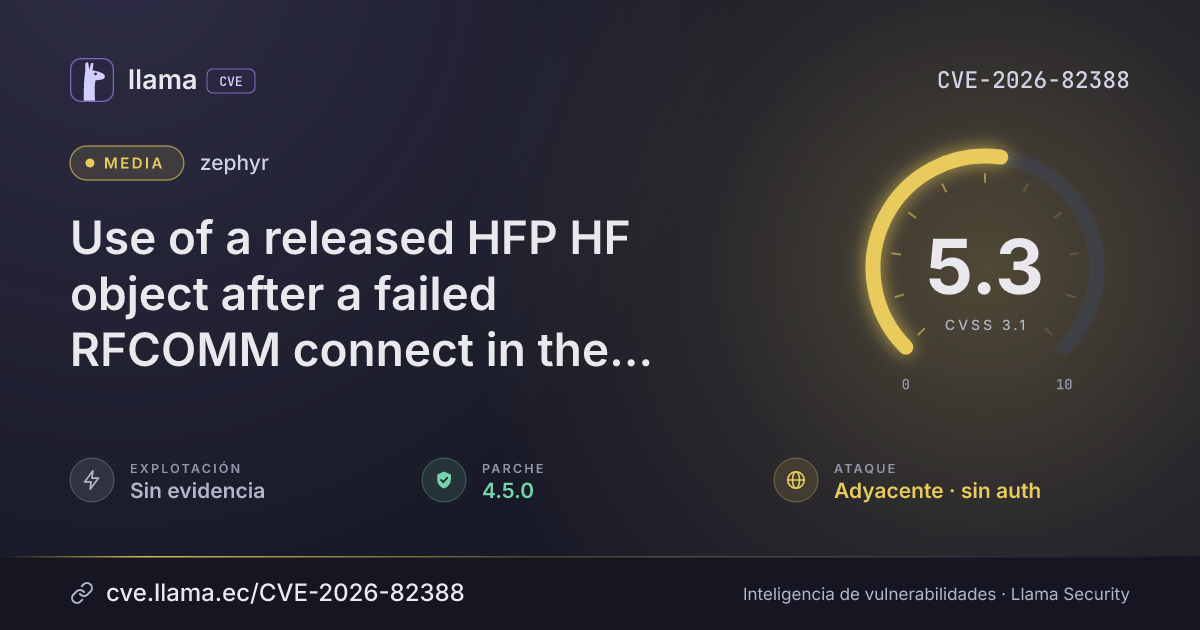
CVE-2026-82388
Use of a released HFP HF object after a failed RFCOMM connect in the Bluetooth Classic host
CVSS:3.1/AV:A/AC:H/PR:N/UI:N/S:U/C:N/I:N/A:H
Fuente: CNA
Ciclo de vida de la vulnerabilidad
| Fecha | Fase | Evento | Detalle |
|---|---|---|---|
| Divulgación | Publicada | CVE-2026-82388 divulgada · CVSS 5.3 (CNA) | |
| Monitoreo | Detectada | Ingresó al índice | |
| Divulgación | Evaluación SSVC | CISA-ADP · explotación ninguna | |
| Divulgación | Modificada | Última actualización del registro | |
| Monitoreo | Fuente: NIST NVD | Registro visto por primera vez en NIST NVD | |
| Monitoreo | Fuente: ENISA EUVD | Registro visto por primera vez en ENISA EUVD | |
| Monitoreo | Verificada | Última verificación contra las fuentes |
The affected software is the Zephyr Bluetooth Classic host stack, specifically its HFP Hands-Free and SDP client components. A remote device advertising a malformed HFP Audio Gateway record, or otherwise controlling connection timing, can trigger a use-after-free-style condition that leads to memory corruption, system crashes, or unpredictable behavior on the local device.
Descripción original del registro (zephyr)
bt_hfp_hf_connect() in subsys/bluetooth/host/classic/hfp_hf.c allocates the per-connection HFP Hands-Free object with hfp_hf_create(), which starts an SDP discovery by passing the object's embedded hf->sdp_param to bt_sdp_discover(). That call links the caller-owned parameter block into the SDP client's request list (session->reqs in subsys/bluetooth/host/classic/sdp.c). If the subsequent bt_rfcomm_dlc_connect() then failed, the affected code wiped the entire object with (void)memset(new_hf, 0, sizeof(*new_hf)) while that discovery was still outstanding, zeroing the sys_snode_t _node that is still linked in the SDP client's list along with the request's func, uuid and pool pointers, and zeroing the hf->slc_work work item that may already be queued on the system workqueue. The discovery could not be retracted instead: bt_sdp_discover_cancel() is declared in include/zephyr/bluetooth/classic/sdp.h but has no implementation. The failing branch is reachable with peer-supplied input. The documented use of bt_hfp_hf_connect() is to pass the RFCOMM channel read out of the remote Audio Gateway's SDP record; neither bt_sdp_get_proto_param() nor bt_hfp_hf_connect() range-checks that value, so a remote device advertising an HFP AG record with an RFCOMM channel outside 1-30 makes bt_rfcomm_dlc_connect() return -EINVAL and drives the local device into the wipe. The same branch is reached without any application misuse when the remote peer controls connection timing, for example when the RFCOMM session is in BT_RFCOMM_STATE_DISCONNECTING or the ACL is dropped between object creation and the RFCOMM call. Once the object has been wiped, the Bluetooth host continues to use it: sdp_client_alloc_buf() dereferences session->param->pool, which is now NULL, and the SDP receive paths call session->param->func() through a null function pointer, neither of which is NULL-checked. Because the wipe also clears hf->acl, the pool slot is considered free and a retry or an incoming HFP connection re-appends the same still-linked list node, turning session->reqs into a self-referential list that the host's list walkers never leave. The result is a fault or an unrecoverable hang in the Bluetooth host thread; the stray indirect call is through an all-zero pointer whose target the attacker does not control, so the practical impact is denial of service. The fix keeps the object allocated and marks it with a new BT_HFP_HF_FLAG_RELEASING flag, letting bt_hfp_hf_discover_cb() release it once the discovery completes instead of destroying it under the SDP client. Only builds with CONFIG_BT_CLASSIC and CONFIG_BT_HFP_HF enabled are affected.
Desglose de métricas
Rangos afectados
Estado del parche por paquete
| Paquete / producto | Estado | Corregida en | Desde divulgación | Última versión |
|---|---|---|---|---|
zephyr |
Corregida | 4.5.0 | — | — |
4.5.0Arsenal público
Sin exploits, módulos ni PoC públicos conocidos a la fecha de verificación.
https://github.com/zephyrproject-rtos/zephyr/security/advisories/GHSA-398x-f7rq-5jj9https://github.com/zephyrproject-rtos/zephyr/commit/6119da5d632594131304dec85000a75dc17743d2Las referencias externas se muestran para copiar: cve.llama.ec no lo redirige a otros sitios.