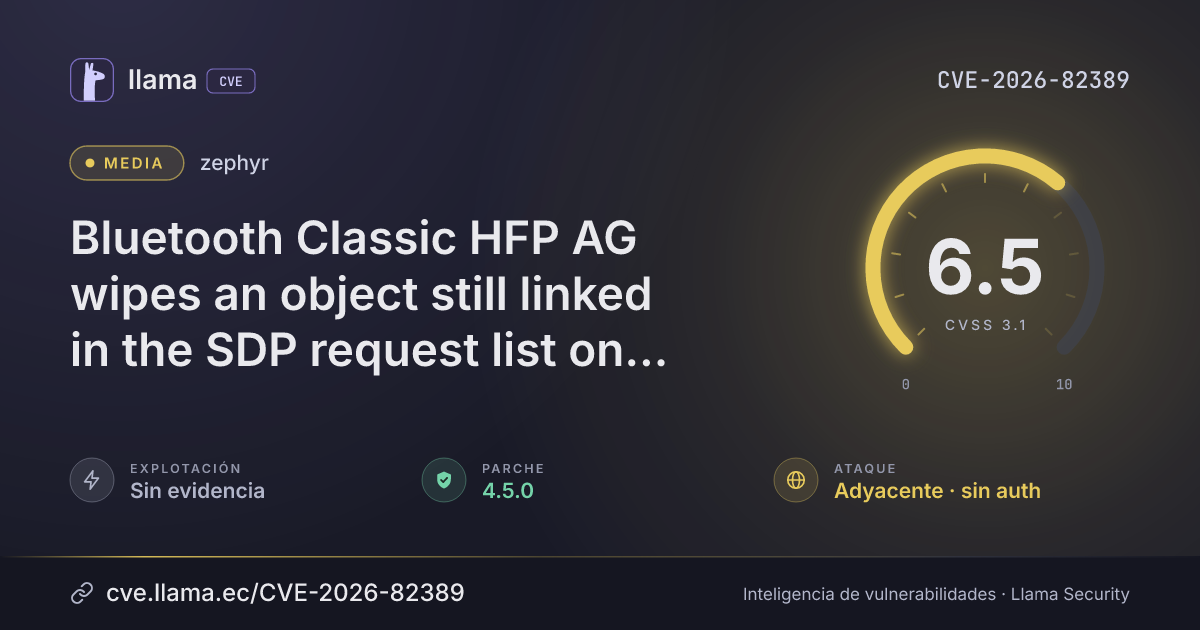
CVE-2026-82389
Bluetooth Classic HFP AG wipes an object still linked in the SDP request list on connect failure, causing a NULL dereference
CVSS:3.1/AV:A/AC:L/PR:N/UI:N/S:U/C:N/I:N/A:H
Fuente: CNA
Ciclo de vida de la vulnerabilidad
| Fecha | Fase | Evento | Detalle |
|---|---|---|---|
| Divulgación | Publicada | CVE-2026-82389 divulgada · CVSS 6.5 (CNA) | |
| Monitoreo | Detectada | Ingresó al índice | |
| Divulgación | Evaluación SSVC | CISA-ADP · explotación ninguna | |
| Divulgación | Modificada | Última actualización del registro | |
| Monitoreo | Fuente: NIST NVD | Registro visto por primera vez en NIST NVD | |
| Monitoreo | Fuente: ENISA EUVD | Registro visto por primera vez en ENISA EUVD | |
| Monitoreo | Verificada | Última verificación contra las fuentes |
This vulnerability affects the Zephyr RTOS Bluetooth Classic host stack, specifically its Hands-Free Profile Audio Gateway and SDP client components. A nearby remote Bluetooth device can trigger a NULL pointer dereference that crashes or hangs the Bluetooth stack.
Descripción original del registro (zephyr)
In the Bluetooth Classic Hands-Free Profile Audio Gateway role, hfp_ag_create() in subsys/bluetooth/host/classic/hfp_ag.c starts an SDP discovery toward the peer, which links the embedded ag->sdp_param._node into the SDP client's pending request list in subsys/bluetooth/host/classic/sdp.c. If the subsequent bt_rfcomm_dlc_connect() call fails, bt_hfp_ag_connect() cleaned up by memset()-ing the entire AG object while that node was still linked, and while ag->slc_work could still be queued on the system work queue. An in-flight SDP discovery cannot be cancelled — bt_sdp_discover_cancel() is declared in the public header but has no implementation — so the request stays in the list with its func, pool and uuid pointers zeroed. The RFCOMM channel passed to bt_hfp_ag_connect() is taken from the peer's own SDP Hands-Free service record in the normal AG flow (bt_sdp_get_proto_param() performs no range validation, and samples/bluetooth/classic/handsfree_ag feeds the value straight through), so a remote BR/EDR device in radio range that advertises an RFCOMM channel outside the valid range 0x01..0x1e deterministically forces bt_rfcomm_dlc_connect() to fail and reach the wipe. Reading the peer's SDP record requires no pairing, and the peer can also trigger the failure by dropping the ACL or racing an RFCOMM DLC on the same DLCI at the right moment. When the SDP client next advances its request list, sdp_client_discover() dereferences the zeroed parameters — net_buf_alloc(param->pool, …) with a NULL pool and param->uuid->type — and the result-notification paths call through the NULL params->func. Zeroing a linked node also truncates the request list behind a stale tail pointer, and re-arming the freed AG slot re-appends the same node and can produce a self-looping list that hangs the Bluetooth RX thread. The impact is a crash or hang of the Bluetooth stack; the written value is a constant zero at a fixed static address, so no attacker-controlled write is available. Only builds with CONFIG_BT_CLASSIC and CONFIG_BT_HFP_AG that use the Audio Gateway role are affected.
Desglose de métricas
Rangos afectados
Estado del parche por paquete
| Paquete / producto | Estado | Corregida en | Desde divulgación | Última versión |
|---|---|---|---|---|
zephyr |
Corregida | 4.5.0 | — | — |
4.5.0Arsenal público
Sin exploits, módulos ni PoC públicos conocidos a la fecha de verificación.
https://github.com/zephyrproject-rtos/zephyr/security/advisories/GHSA-rrqj-542q-26jmhttps://github.com/zephyrproject-rtos/zephyr/commit/18a3243b21ef6298988a3034dbda2704a7ad73a4Las referencias externas se muestran para copiar: cve.llama.ec no lo redirige a otros sitios.