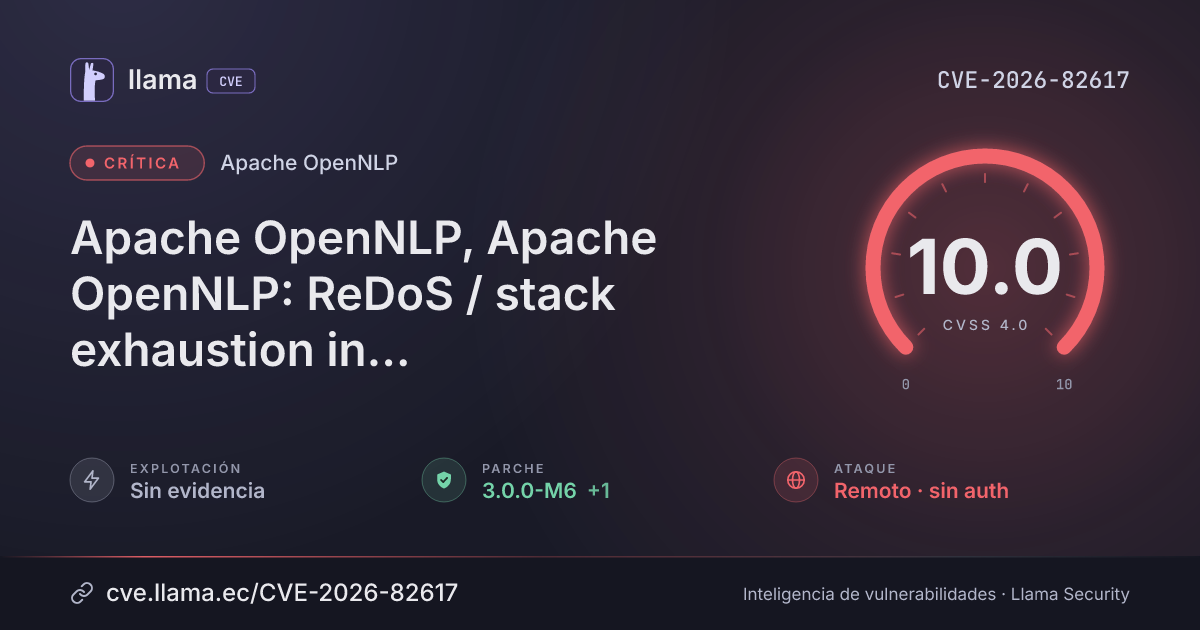
CVE-2026-82617
Apache OpenNLP, Apache OpenNLP: ReDoS / stack exhaustion in RegexNameFinderFactory built-in EMAIL and URL patterns
CVSS:4.0/AV:N/AC:L/AT:N/PR:N/UI:N/VC:H/VI:H/VA:H/SC:H/SI:H/SA:H
Fuente: CNA
Ciclo de vida de la vulnerabilidad
| Fecha | Fase | Evento | Detalle |
|---|---|---|---|
| Remediación | Parche 2.5.12 | org.apache.opennlp:opennlp-tools · -3 d desde divulgación | |
| Divulgación | Publicada | CVE-2026-82617 divulgada · CVSS 10 (CNA) | |
| Divulgación | Evaluación SSVC | CISA-ADP · explotación ninguna | |
| Divulgación | Modificada | Última actualización del registro | |
| Remediación | Parche 3.0.0-M6 | org.apache.opennlp:opennlp-core · 1 d desde divulgación | |
| Monitoreo | Detectada | Ingresó al índice |
The two built-in name-finder patterns exposed by opennlp.tools.namefind.RegexNameFinderFactory - DEFAULT_REGEX_NAME_FINDER.EMAIL and DEFAULT_REGEX_NAME_FINDER.URL - contain ambiguous nested quantifiers. An application that obtains these finders through RegexNameFinderFactory.getDefaultRegexNameFinders(...) and then applies them to untrusted text through RegexNameFinder.find(String[]) or RegexNameFinder.find(String) can be driven into super-linear backtracking or into unbounded matcher recursion by a small crafted input. For the EMAIL pattern, a long run of local-part characters that is never followed by an @ forces the matcher to re-scan to end-of-input from every starting offset. Cost grows quadratically with input length: an input of approximately 32 KB consumes several seconds of CPU in a single find() call and returns no match, and each doubling of the input multiplies the cost roughly four-fold. For the URL pattern, the query-string sub-expression nests a capturing repetition inside an outer repetition. The JDK matcher recurses once per query token, so an input of approximately 4 KB containing many &-separated tokens exhausts the thread stack and causes java.lang.StackOverflowError to propagate out of find(), terminating the calling thread. On a thread created with a smaller stack (for example -Xss512k, typical of server worker pools) approximately 1 KB is sufficient. In both cases an attacker who can supply text for analysis can convert a single request into seconds to minutes of pinned CPU, or into an abrupt thread death, denying service to the embedding application. No authentication, special configuration, or model file is required beyond the application having selected one of the two built-in finders. This issue affects Apache OpenNLP: from 2.0.0 through 2.5.11; from 3.0.0-M1 through 3.0.0-M5. Users are recommended to upgrade to version 2.5.12, or to 3.0.0-M6 for users tracking the 3.0.0 milestone line, which fix the issue.
Desglose de métricas
Rangos afectados
Estado del parche por paquete
| Paquete / producto | Estado | Corregida en | Desde divulgación | Última versión |
|---|---|---|---|---|
mavenorg.apache.opennlp:opennlp-core |
Corregida | 3.0.0-M6 | 1 d | 3.0.0-M6 no afectada |
mavenorg.apache.opennlp:opennlp-tools |
Corregida | 2.5.12 | -3 d | 2.5.12 no afectada |
2.5.123.0.0-M6Arsenal público
Sin exploits, módulos ni PoC públicos conocidos a la fecha de verificación.
https://lists.apache.org/thread/spzhcxxszqdpppg70m1zz2l3mv29mhl3http://www.openwall.com/lists/oss-security/2026/09/11/10Las referencias externas se muestran para copiar: cve.llama.ec no lo redirige a otros sitios.