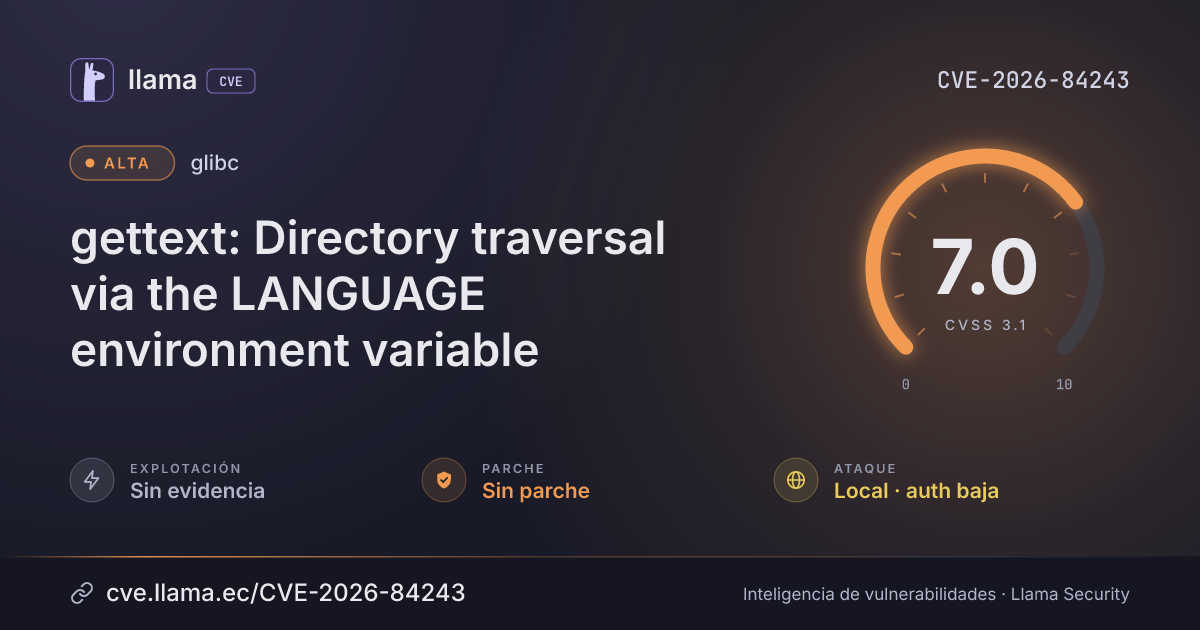
CVE-2026-84243
gettext: Directory traversal via the LANGUAGE environment variable
CVSS:3.1/AV:L/AC:H/PR:L/UI:N/S:U/C:H/I:H/A:H
Fuente: CNA
Ciclo de vida de la vulnerabilidad
| Fecha | Fase | Evento | Detalle |
|---|---|---|---|
| Divulgación | Evaluación SSVC | CISA-ADP · explotación ninguna | |
| Divulgación | Publicada | CVE-2026-84243 divulgada · CVSS 7 (CNA) | |
| Monitoreo | Detectada | Ingresó al índice | |
| Monitoreo | Fuente: NIST NVD | Registro visto por primera vez en NIST NVD | |
| Monitoreo | Fuente: ENISA EUVD | Registro visto por primera vez en ENISA EUVD | |
| Divulgación | Modificada | Última actualización del registro | |
| Monitoreo | Verificada | Última verificación contra las fuentes |
The GNU C Library (glibc) gettext functions are affected, which are used by many programs for translated messages. An attacker who can set environment variables for such a program may be able to make it load a malicious message catalog from an arbitrary file location, potentially causing a crash or running code with the program's privileges.
Affects glibc gettext from version 2.0 onward when the LC_MESSAGES locale is not C, C.<encoding> or POSIX and the program is not setuid or setgid. No vendor rating is given, and no fixed version is listed.
Descripción original del registro (glibc)
The gettext family of functions in the GNU C Library version 2.0 and later accept LANGUAGE environment variable entries that contain '/' or that are equal to "..", unless the program is setuid or setgid (AT_SECURE). An attacker who can set LANGUAGE in the environment of a program that uses gettext can make it load a message catalog (.mo file) from an arbitrary location in the file system. A crafted .mo file can crash the program through out-of-range offsets, or supply translations whose format directives do not match the arguments passed by the program. That causes undefined behaviour in the printf family of functions and may allow arbitrary code execution with the privileges of the program. The safety of message catalogs relies on them being installed in trusted, read-only locations, and the directory traversal bypasses this. The fix for CVE-2014-0475 rejects ".." path components in locale names passed to setlocale or taken from the LC_ALL, LC_* and LANG environment variables. gettext reads LANGUAGE directly and appends each colon-separated entry to the message catalog directory, so that fix did not cover LANGUAGE. LANGUAGE is only used when the LC_MESSAGES locale is not "C", "C.<encoding>" or "POSIX", so the attacker must also be able to select another installed locale, for example through LANG or LC_ALL. Exploitation also requires that the attacker can place the crafted file in a location readable by the target program, and that the environment crosses a trust boundary without the program running as AT_SECURE. An example is an SSH server that accepts LANGUAGE and LANG from clients through the AcceptEnv directive and restricts an account to a forced command; the attacker may use this to escape the restriction.
Condiciones y alcance
Desglose de métricas
Rangos afectados
Estado del parche por paquete
| Paquete / producto | Estado | Corregida en | Desde divulgación | Última versión |
|---|---|---|---|---|
glibc |
Sin parche | — | — | — |
Arsenal público
Sin exploits, módulos ni PoC públicos conocidos a la fecha de verificación.
https://sourceware.org/git/?p=glibc.git;a=blob_plain;f=advisories/GLIBC-SA-2026-0025https://inbox.sourceware.org/libc-alpha/20261012112453.47383-1-avinal.xlvii@gmail.comhttps://sourceware.org/bugzilla/show_bug.cgi?id=17142Las referencias externas se muestran para copiar: cve.llama.ec no lo redirige a otros sitios.