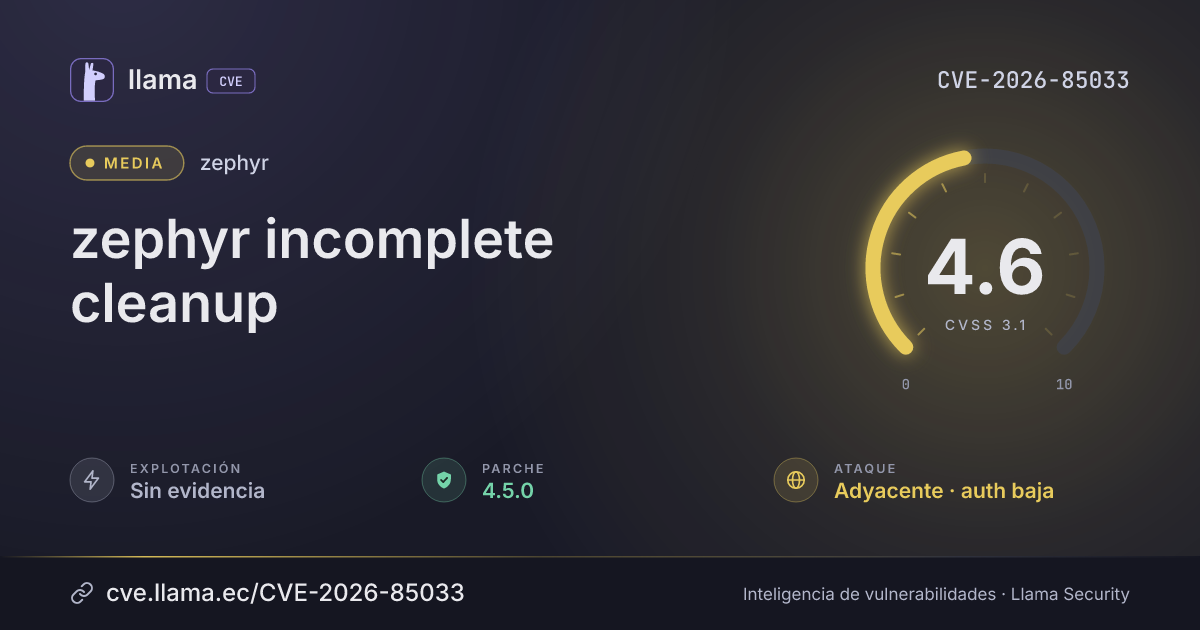
CVE-2026-85033
zephyr incomplete cleanup
CVSS:3.1/AV:A/AC:L/PR:L/UI:N/S:U/C:L/I:N/A:L
Fuente: CNA
Ciclo de vida de la vulnerabilidad
| Fecha | Fase | Evento | Detalle |
|---|---|---|---|
| Divulgación | Publicada | CVE-2026-85033 divulgada · CVSS 4.6 (CNA) | |
| Monitoreo | Detectada | Ingresó al índice | |
| Monitoreo | Fuente: NIST NVD | Registro visto por primera vez en NIST NVD | |
| Divulgación | Evaluación SSVC | CISA-ADP · explotación ninguna | |
| Divulgación | Modificada | Última actualización del registro | |
| Monitoreo | Fuente: ENISA EUVD | Registro visto por primera vez en ENISA EUVD | |
| Monitoreo | Verificada | Última verificación contra las fuentes |
The affected software is the Bluetooth Classic AVRCP Target implementation in Zephyr's Bluetooth host stack, which handles vendor-dependent responses for paired peers. A nearby, paired remote device can disconnect mid-transfer to permanently stop the device's AVRCP Target from sending responses until it reboots, and can cause leftover response data from one peer to be sent to a later connecting peer.
Descripción original del registro (zephyr)
The AVRCP Target role in subsys/bluetooth/host/classic/avrcp.c keeps its vendor-dependent response transmit state in a per-connection object selected by connection index (get_avrcp_tg()), with the per-transfer context (tid, sent_len, and the BT_AVRCP_TG_FLAG_TX_ONGOING flag) stored in the user_data of the queued response net_buf. The AVCTP teardown handler avrcp_disconnected() did not cancel tg->vd_rsp_tx_work and did not release the buffers still queued on tg->vd_rsp_tx_pending, so a link drop in the middle of a fragmented response left the buffer on the list with TX_ONGOING still set. A remote AVRCP Controller can trigger this deterministically: it issues a vendor-dependent command whose response exceeds one AVRCP fragment (for example GetElementAttributes or GetCapabilities), lets bt_avrcp_tg_vendor_tx_work() emit the START fragment, and then drops the ACL link instead of sending REQUEST_CONTINUING_RESPONSE. The AVCTP control channel requires an encrypted BR/EDR link (BT_SECURITY_L2), so the attacker must be a paired peer within radio range; no user interaction is needed. Because the Target objects are static and reused, the next connection landing on the same connection index finds the stale buffer at the head of vd_rsp_tx_pending. Every run of the TX work sees TX_ONGOING and returns immediately, so all further vendor-dependent responses queue behind the stale head and are never sent — a persistent loss of AVRCP Target function that no timeout clears and only a reboot recovers. Each cycle also leaks one response buffer from a shallow application pool, and a new peer that sends REQUEST_CONTINUING_RESPONSE clears the stale TX_ONGOING via bt_avrcp_tg_process_continuing_cmd(), causing the un-sent remainder of the previous peer's response to be transmitted to it. The fix cancels tg->vd_rsp_tx_work and unrefs every buffer on tg->vd_rsp_tx_pending in avrcp_disconnected(); since the TX context lives in the buffer user_data, releasing the buffers also resets the TX state machine. There is no memory corruption: the pre-fix buffer is leaked with a live reference, so no use-after-free arises.
Desglose de métricas
Rangos afectados
Estado del parche por paquete
| Paquete / producto | Estado | Corregida en | Desde divulgación | Última versión |
|---|---|---|---|---|
zephyr |
Corregida | 4.5.0 | — | — |
4.5.0Arsenal público
Sin exploits, módulos ni PoC públicos conocidos a la fecha de verificación.
https://github.com/zephyrproject-rtos/zephyr/security/advisories/GHSA-2fqc-xhj4-qvp7https://github.com/zephyrproject-rtos/zephyr/commit/47728746bb52863607f06072c13a0a524ad6b654Las referencias externas se muestran para copiar: cve.llama.ec no lo redirige a otros sitios.