CVE-2026-86000
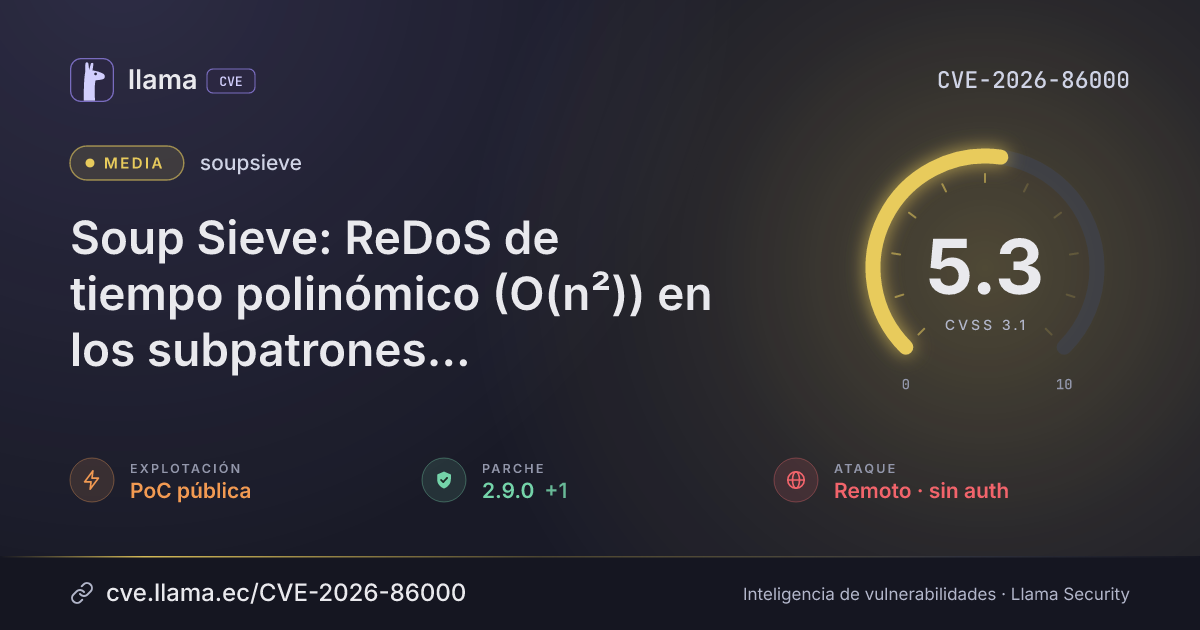
Soup Sieve: Polynomial-time ReDoS (O(n²)) in the IDENTIFIER / VALUE selector sub-patterns
CVSS:3.1/AV:N/AC:L/PR:N/UI:N/S:U/C:N/I:N/A:L
Fuente: CNA
Ciclo de vida de la vulnerabilidad
| Fecha | Fase | Evento | Detalle |
|---|---|---|---|
| Remediación | Parche 2.9.0 | soupsieve · -60 d desde divulgación | |
| Divulgación | Publicada | CVE-2026-86000 divulgada · CVSS 5.3 (CNA) | |
| Divulgación | Evaluación SSVC | CISA-ADP · explotación PoC pública | |
| Divulgación | Modificada | Última actualización del registro | |
| Monitoreo | Detectada | Ingresó al índice |
Soup Sieve is a CSS selector library designed to be used with Beautiful Soup 4. Prior to 2.9, the selector parser in src/soupsieve/css_parser.py defines IDENTIFIER with adjacent quantified groups over overlapping character classes, and VALUE embeds IDENTIFIER for attribute selectors. When an attacker-controlled selector contains a long identifier or unquoted attribute-value run followed by input that makes the overall match fail, the regular expression engine explores quadratically many splits between the overlapping groups. User-controlled selectors can reach this path through soupsieve.compile(), soupsieve.select(), or BeautifulSoup.select(), while applications using only hard-coded selectors are unaffected. The resulting CPU consumption can hold the Python GIL, exhaust application workers, and stall a service; successful plain identifier matches are linear, and the issue does not cause memory corruption or code execution. The issue is fixed in version 2.9.
Desglose de métricas
Rangos afectados
Estado del parche por paquete
| Paquete / producto | Estado | Corregida en | Desde divulgación | Última versión |
|---|---|---|---|---|
pypisoupsieve |
Corregida | 2.9.0 | -60 d | 4.1.2 no afectada |
2.92.9.0Arsenal público
Sin exploits, módulos ni PoC públicos conocidos a la fecha de verificación.
https://github.com/facelessuser/soupsieve/security/advisories/GHSA-gjv8-xp57-g29chttps://github.com/facelessuser/soupsieve/commit/ce44e4996e6632871c18cdd7a7fb641be8ef34efhttps://github.com/facelessuser/soupsieve/releases/tag/2.9Las referencias externas se muestran para copiar: cve.llama.ec no lo redirige a otros sitios.