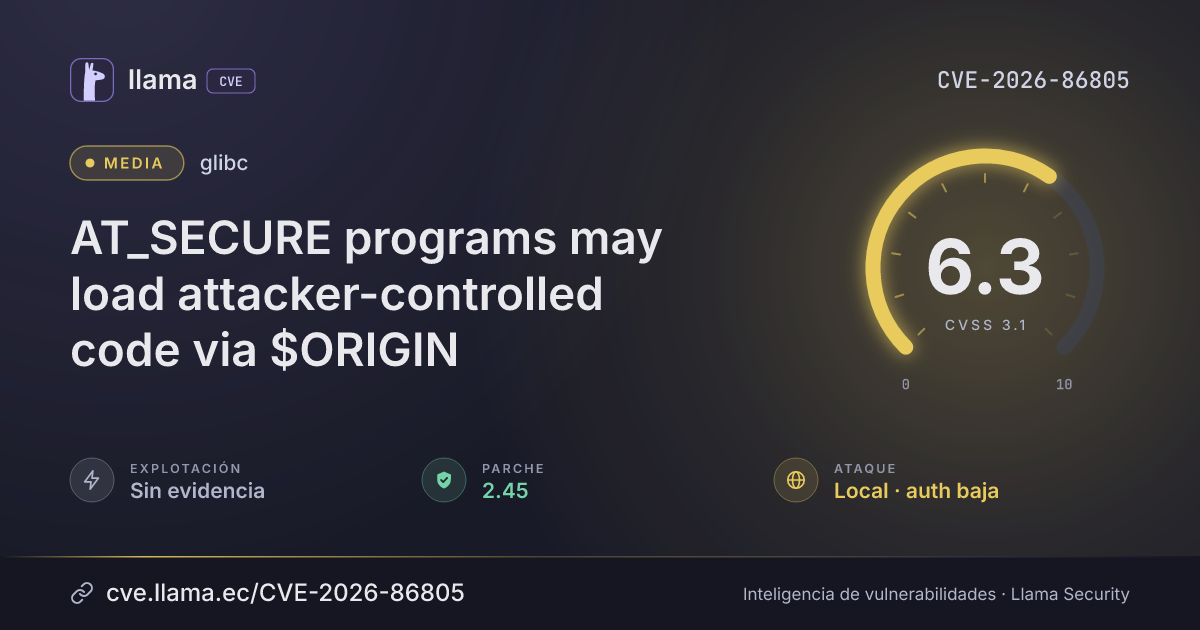
CVE-2026-86805
AT_SECURE programs may load attacker-controlled code via $ORIGIN
CVSS:3.1/AV:L/AC:H/PR:L/UI:R/S:U/C:H/I:H/A:L
Fuente: CNA
Ciclo de vida de la vulnerabilidad
| Fecha | Fase | Evento | Detalle |
|---|---|---|---|
| Divulgación | Evaluación SSVC | CISA-ADP · explotación ninguna | |
| Divulgación | Publicada | CVE-2026-86805 divulgada · CVSS 6.3 (CNA) | |
| Divulgación | Modificada | Última actualización del registro | |
| Monitoreo | Detectada | Ingresó al índice |
A time-of-check to time-of-use (TOCTOU) race condition in the dynamic loader (ld.so) of the GNU C Library (glibc) versions 2.14 through 2.44 allows a local attacker to escalate privileges. When expanding $ORIGIN in DT_RPATH for setuid/setgid (AT_SECURE) programs, glibc validates the lexically normalized search path against the trusted directories but then opens the raw, un-normalized path. On systems where the Linux fs.protected_hardlinks sysctl is disabled, a local attacker who hard-links such a program into an attacker-controlled directory and wins a race to replace an intermediate path component with a symbolic link can direct the loader outside the trusted directory, causing it to load an attacker-controlled shared object and execute arbitrary code with the elevated privileges of the program. Exploitation requires an installed setuid or setgid binary whose DT_RPATH uses $ORIGIN followed by ".." traversal that normalizes into a trusted directory, and the ability to hard-link that binary and win the race by swapping a path component for a symbolic link. Major Linux-based OS distributions ship with fs.protected_hardlinks enabled by default and mitigate the vulnerability.
Desglose de métricas
Rangos afectados
Estado del parche por paquete
| Paquete / producto | Estado | Corregida en | Desde divulgación | Última versión |
|---|---|---|---|---|
glibc |
Corregida | 2.45 | — | — |
2.45Arsenal público
Sin exploits, módulos ni PoC públicos conocidos a la fecha de verificación.
https://sourceware.org/git/?p=glibc.git;a=blob_plain;f=advisories/GLIBC-SA-2026-0022https://sourceware.org/bugzilla/show_bug.cgi?id=34360Las referencias externas se muestran para copiar: cve.llama.ec no lo redirige a otros sitios.