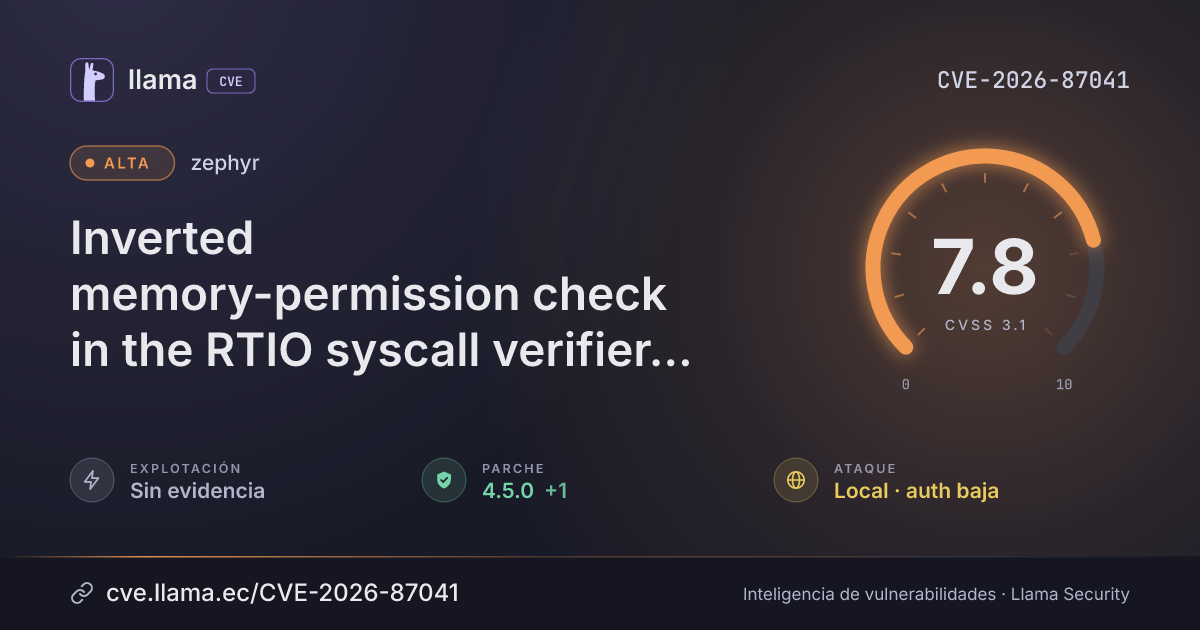
CVE-2026-87041
Inverted memory-permission check in the RTIO syscall verifier allows a user-mode thread to read and write arbitrary kernel memory
CVSS:3.1/AV:L/AC:L/PR:L/UI:N/S:U/C:H/I:H/A:H
Fuente: CNA
Ciclo de vida de la vulnerabilidad
| Fecha | Fase | Evento | Detalle |
|---|---|---|---|
| Divulgación | Publicada | CVE-2026-87041 divulgada · CVSS 7.8 (CNA) | |
| Monitoreo | Detectada | Ingresó al índice | |
| Monitoreo | Fuente: NIST NVD | Registro visto por primera vez en NIST NVD | |
| Divulgación | Evaluación SSVC | CISA-ADP · explotación ninguna | |
| Divulgación | Modificada | Última actualización del registro | |
| Monitoreo | Fuente: OSV | Registro visto por primera vez en OSV | |
| Monitoreo | Verificada | Última verificación contra las fuentes |
The RTIO submission-queue verifier rtio_vrfy_sqe() in subsys/rtio/rtio_syscalls.c (subsys/rtio/rtio_handlers.c before v4.3.0) accumulated the results of K_SYSCALL_MEMORY() into its valid_sqe flag with &=. That macro returns nonzero on failure (it is built on K_SYSCALL_VERIFY_MSG(), which yields !(expr)), so every buffer permission check contributed the opposite of its result. A submission whose tx.buf, rx.buf or txrx.tx_buf/txrx.rx_buf pointer was not accessible to the calling thread was accepted, while a legitimate, thread-owned buffer caused the calling thread to be killed with a kernel oops. The verifier runs on behalf of the rtio_sqe_copy_in_get_handles() system call (also reached through the inline rtio_sqe_copy_in() wrapper), so it is driven directly by untrusted user-mode input on any image built with CONFIG_USERSPACE. A user thread that has been granted an RTIO context and an rtio_iodev object — the intended usage of RTIO userspace support, established via rtio_access_grant() — can submit an SQE whose buffer pointer and length name arbitrary kernel memory; the object check on sqe->iodev is unaffected and still passes, and the crafted SQE is forwarded to the bus driver unchanged. Downstream consumers dereference the pointer with supervisor privilege. The generic I2C and I3C RTIO fallback handlers (drivers/i2c/i2c_rtio_default.c, drivers/i3c/i3c_rtio_default.c) copy sqe.rx.buf/sqe.tx.buf into struct i2c_msg and call i2c_transfer(), and the vendor SPI/I2C RTIO drivers behave equivalently. An RTIO_OP_RX submission therefore has peripheral data written into kernel memory of the attacker's choosing (arbitrary kernel write), an RTIO_OP_TX submission clocks kernel memory out over the bus (kernel memory disclosure), and a pointer to unmapped memory faults the kernel. This is a full escape from the user-mode isolation boundary that CONFIG_USERSPACE exists to enforce. The defect was masked for years because the in-tree user-mode RTIO tests only exercise RTIO_OP_NOP and mempool-backed reads, neither of which reaches the affected checks. The fix negates each K_SYSCALL_MEMORY() result and additionally validates the TXRX transmit buffer read-only, matching the SPI, I2C and I3C handlers.
Only Zephyr builds with CONFIG_USERSPACE and CONFIG_RTIO both enabled are affected, and only for threads granted an RTIO context and rtio_iodev. Fixed in 4.3.2 and 4.5.0.
Condiciones y alcance
Desglose de métricas
Rangos afectados
Estado del parche por paquete
| Paquete / producto | Estado | Corregida en | Desde divulgación | Última versión |
|---|---|---|---|---|
zephyr |
Corregida | 4.3.2, 4.5.0 | — | — |
4.3.24.5.0Arsenal público
Sin exploits, módulos ni PoC públicos conocidos a la fecha de verificación.
https://github.com/zephyrproject-rtos/zephyr/security/advisories/GHSA-mvxr-jx9h-jxh4https://github.com/zephyrproject-rtos/zephyr/commit/454a848006595ce2d77fc2c9e458b0c557f5e4afLas referencias externas se muestran para copiar: cve.llama.ec no lo redirige a otros sitios.