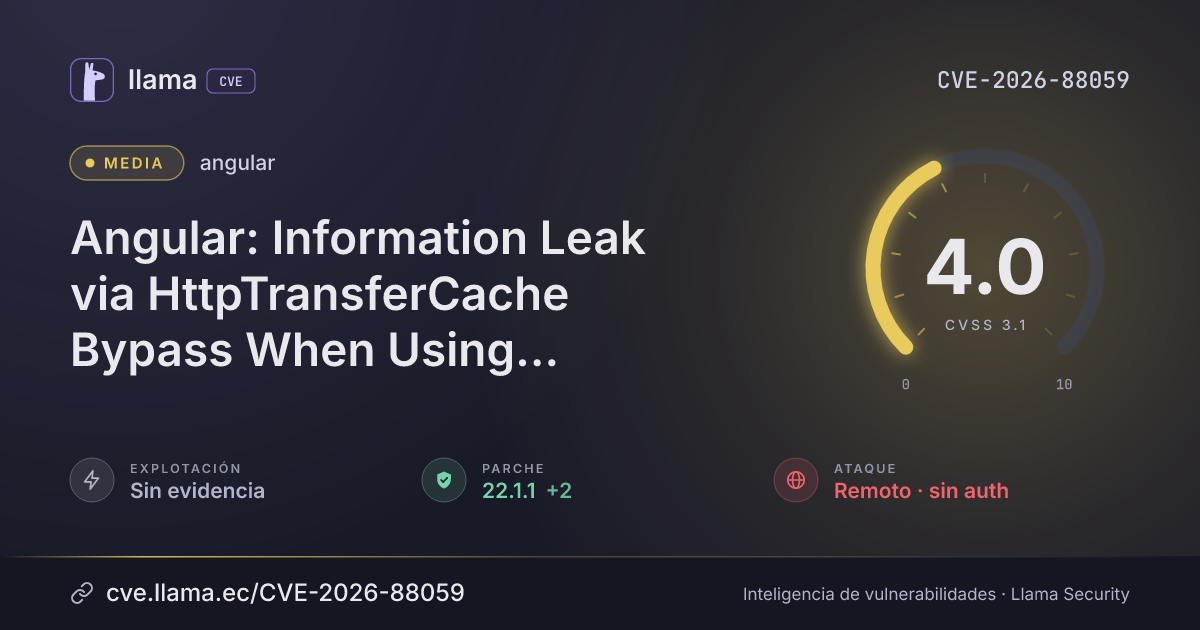
CVE-2026-88059
Angular: Information Leak via HttpTransferCache Bypass When Using withRequestsMadeViaParent
CVSS:3.1/AV:N/AC:H/PR:N/UI:N/S:C/C:L/I:N/A:N
Fuente: CNA
Ciclo de vida de la vulnerabilidad
| Fecha | Fase | Evento | Detalle |
|---|---|---|---|
| Remediación | Parche 22.1.1 | @angular/common · -34 d desde divulgación | |
| Remediación | Parche 20.3.28 | @angular/common · -28 d desde divulgación | |
| Remediación | Parche 21.2.20 | @angular/common · -28 d desde divulgación | |
| Divulgación | Publicada | CVE-2026-88059 divulgada · CVSS 4 (CNA) | |
| Divulgación | Evaluación SSVC | CISA-ADP · explotación ninguna | |
| Divulgación | Modificada | Última actualización del registro | |
| Monitoreo | Detectada | Ingresó al índice |
Angular is a development platform for building mobile and desktop web applications using TypeScript/JavaScript and other languages. Prior to 20.3.28, 21.2.20, and 22.1.1, Angular's @angular/common HttpTransferCache can cache an authenticated response when Server-Side Rendering (SSR) and hydration use a hierarchical HttpClient configured with withRequestsMadeViaParent. The child TransferCache evaluates an initially anonymous request before delegation, then a parent withInterceptors chain adds an Authorization header, cookie, or API token; although the parent cache skips the authenticated request, the child still stores the private response in TransferState serialized as JSON in the ng-state script. Exploitation requires provideClientHydration, child provideHttpClient delegation through withRequestsMadeViaParent, parent-level credential injection, and an SSR HTML response shared across users by a CDN, reverse proxy, or application cache. A later unauthenticated or unauthorized visitor can receive the cached HTML containing the earlier authenticated user's sensitive response data. Applications can mitigate by attaching credentials at the child, filtering sensitive endpoints with withHttpTransferCacheOptions, disabling transfer caching for sensitive routes, or marking personalized HTML private or no-store. This issue is fixed in versions 20.3.28, 21.2.20, and 22.1.1.
Desglose de métricas
Rangos afectados
Estado del parche por paquete
| Paquete / producto | Estado | Corregida en | Desde divulgación | Última versión |
|---|---|---|---|---|
npm@angular/common |
Corregida | 20.3.28, 21.2.20, 22.1.1 | -28 d · -28 d · -34 d | 22.2.6 no afectada |
20.3.2821.2.2022.1.1Arsenal público
Sin exploits, módulos ni PoC públicos conocidos a la fecha de verificación.
https://github.com/angular/angular/security/advisories/GHSA-p297-fm68-3q8chttps://github.com/angular/angular/issues/69777https://github.com/angular/angular/pull/69778https://github.com/angular/angular/commit/c45028e44f5f3c1e0006eaccf86642deca51b2afhttps://github.com/angular/angular/commit/caf616670fd20d528aa69e0131cc17d60f0cc27dhttps://github.com/angular/angular/commit/e4c416c20a1cb222ce73d29c035452b257380c56https://github.com/angular/angular/releases/tag/v20.3.28https://github.com/angular/angular/releases/tag/v21.2.20https://github.com/angular/angular/releases/tag/v22.1.1Las referencias externas se muestran para copiar: cve.llama.ec no lo redirige a otros sitios.