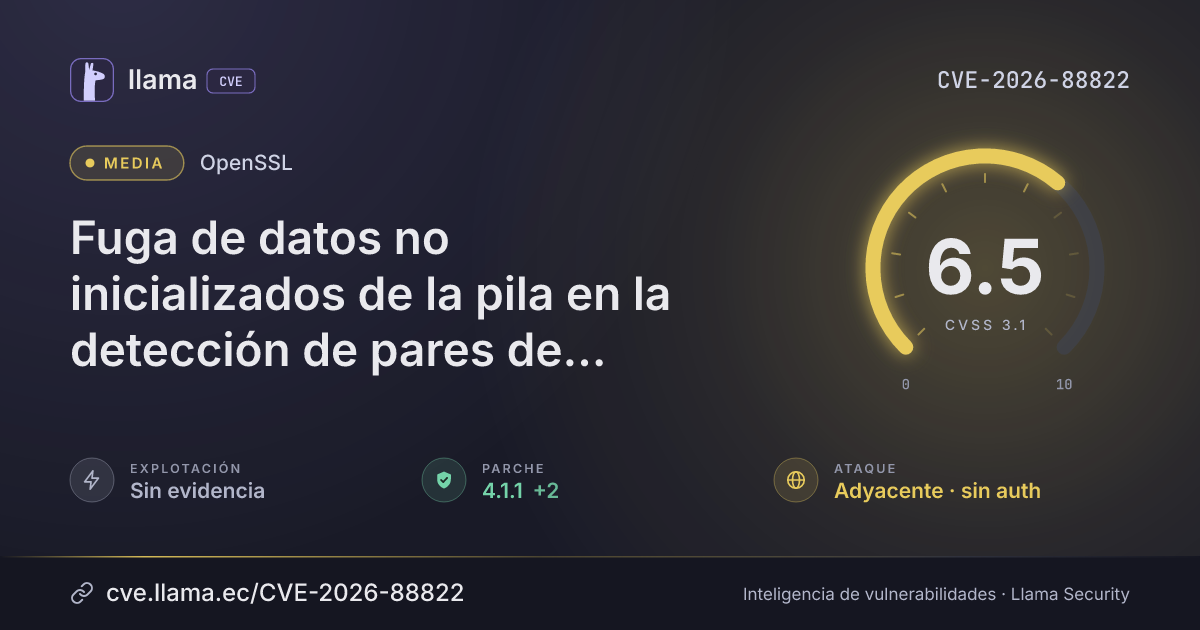
CVE-2026-88822
OpenSSL uninitialized stack data leak in QUIC peer detection
A passive network observer can read leaked stack memory in outgoing QUIC traffic, and connections may break.
Texto original en inglés · Ver en español
CVSS:3.1/AV:A/AC:L/PR:N/UI:N/S:U/C:H/I:N/A:N
Fuente: CISA-ADP
Ciclo de vida de la vulnerabilidad
| Fecha | Fase | Evento | Detalle |
|---|---|---|---|
| Divulgación | Publicada | CVE-2026-88822 divulgada · CVSS 6.5 (CISA-ADP) | |
| Monitoreo | Detectada | Ingresó al índice | |
| Divulgación | Evaluación SSVC | CISA-ADP · explotación ninguna | |
| Divulgación | Modificada | Última actualización del registro | |
| Monitoreo | Verificada | Última verificación contra las fuentes |
Issue summary: QUIC, when performing automated peer detection, may allow uninitialized stack data to leak into the received address which is then used as the destination for outgoing packets. Impact summary: Applications using QUIC's automated peer detection mechanism may receive an invalid address, leading to connection loss and disclosure of uninitialized stack data to an attacker observing the outgoing network traffic. CWE: CWE-457 (Use of Uninitialized Variable) Description: The OpenSSL QUIC stack contains a feature in which, when using an already connected socket, it will auto-detect the peer address during the SSL handshake. This feature uses the getpeername() function, passing a buffer of sufficient length to hold any supported address family, but passes a buffer length that is only sized such that larger addresses, such as IPv6, cannot be retrieved. The getpeername() function however, still returns the full address length, which is accepted as the valid input buffer length, leading to the address buffer containing uninitialized stack data instead of the actual peer address. The invalid peer address is then used as destination for the outgoing packets which leads to a connectivity breakage and a leakage of the uninitialized stack data to passive network observers. FIPS impact: no The FIPS modules in 4.0, 3.6, 3.5, 3.4, and 3.0 are not affected by this CVE as the affected protocol is not implemented in the FIPS module.
Desglose de métricas
Rangos afectados
Estado del parche por paquete
| Paquete / producto | Estado | Corregida en | Desde divulgación | Última versión |
|---|---|---|---|---|
OpenSSL |
Corregida | 3.5.10, 4.0.4, 4.1.1 | — | — |
3.5.104.0.44.1.1Arsenal público
Sin exploits, módulos ni PoC públicos conocidos a la fecha de verificación.
https://openssl-library.org/news/secadv/20261110.txthttps://github.com/openssl/openssl/commit/7b4f5344aa0401e7b777640050b5257ed2a70e88https://github.com/openssl/openssl/commit/911eee8eb7550b95a206f1ad8cbdb986098982f3https://github.com/openssl/openssl/commit/1a73dc590cbad62d6f0329ea4779eadaa8d8fd75Las referencias externas se muestran para copiar: cve.llama.ec no lo redirige a otros sitios.