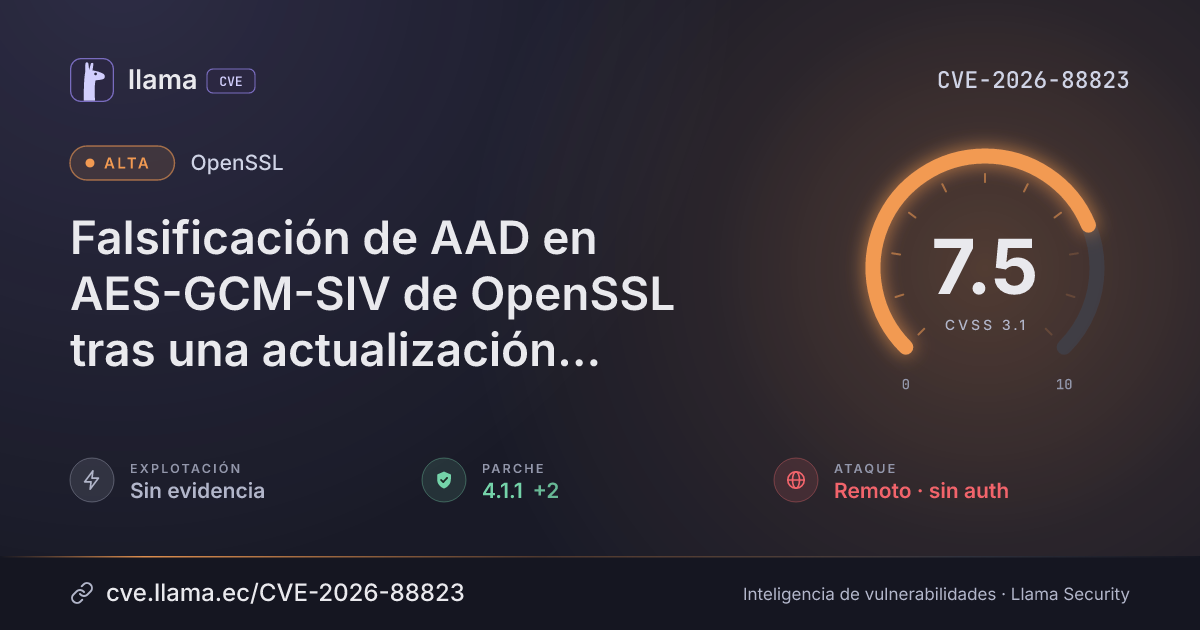
CVE-2026-88823
OpenSSL forgery of AAD in AES-GCM-SIV after empty update
An attacker can forge additional authenticated data on messages protected after an empty AAD update.
Texto original en inglés · Ver en español
CVSS:3.1/AV:N/AC:L/PR:N/UI:N/S:U/C:N/I:H/A:N
Fuente: CISA-ADP
Ciclo de vida de la vulnerabilidad
| Fecha | Fase | Evento | Detalle |
|---|---|---|---|
| Divulgación | Publicada | CVE-2026-88823 divulgada · CVSS 7.5 (CISA-ADP) | |
| Monitoreo | Detectada | Ingresó al índice | |
| Divulgación | Evaluación SSVC | CISA-ADP · explotación ninguna | |
| Divulgación | Modificada | Última actualización del registro | |
| Monitoreo | Verificada | Última verificación contra las fuentes |
Issue summary: The AES-GCM-SIV implementation treats a zero-length Additional Authenticated Data (AAD) update as a reset of all the AAD supplied so far, instead of leaving the AAD unchanged. An application that supplies its AAD in several fragments, one of which is empty, therefore produces or verifies messages whose authentication tag does not cover the AAD supplied before the empty fragment. Impact summary: Data an application intended to authenticate alongside a message is silently left unauthenticated. An attacker can forge the AAD of such a message. CWE: CWE-325: Missing Cryptographic Step Description: An application passing AAD in multiple chunks of which some have zero length will have the previous AAD chunks effectively unauthenticated. Also, on context re-initialisation, the AAD was not reset, which meant that any AAD accumulated from the previous context usage were also included in the AAD of the new message. The fix makes a zero-length AAD update a no-op and clears any accumulated AAD whenever the context is re-initialised with a key or a nonce. A re-initialisation that only changes parameters keeps the AAD. FIPS impact: no The FIPS modules are not affected, as AES-GCM-SIV is not a FIPS approved algorithm and is implemented only in the default provider, outside the OpenSSL FIPS module boundary.
Affects OpenSSL 3.5, 4.0 and 4.1 applications that supply AAD in several chunks with one zero-length chunk. No vendor rating is given, so only the CVSS score of 7.5 applies. Fixed in 4.1.1, 4.0.4 and 3.5.10.
Condiciones y alcance
Desglose de métricas
Rangos afectados
Estado del parche por paquete
| Paquete / producto | Estado | Corregida en | Desde divulgación | Última versión |
|---|---|---|---|---|
OpenSSL |
Corregida | 3.5.10, 4.0.4, 4.1.1 | — | — |
3.5.104.0.44.1.1Arsenal público
Sin exploits, módulos ni PoC públicos conocidos a la fecha de verificación.
https://openssl-library.org/news/secadv/20261110.txthttps://github.com/openssl/openssl/commit/6747b1a278816dd7db46438040a70b0b5e5e0a90https://github.com/openssl/openssl/commit/2f5fc833ff9b5bfe00b32f8b5c74f73c5773c682https://github.com/openssl/openssl/commit/159e1de0c448d7b9f09ad768c8e141def4aa1eb4Las referencias externas se muestran para copiar: cve.llama.ec no lo redirige a otros sitios.