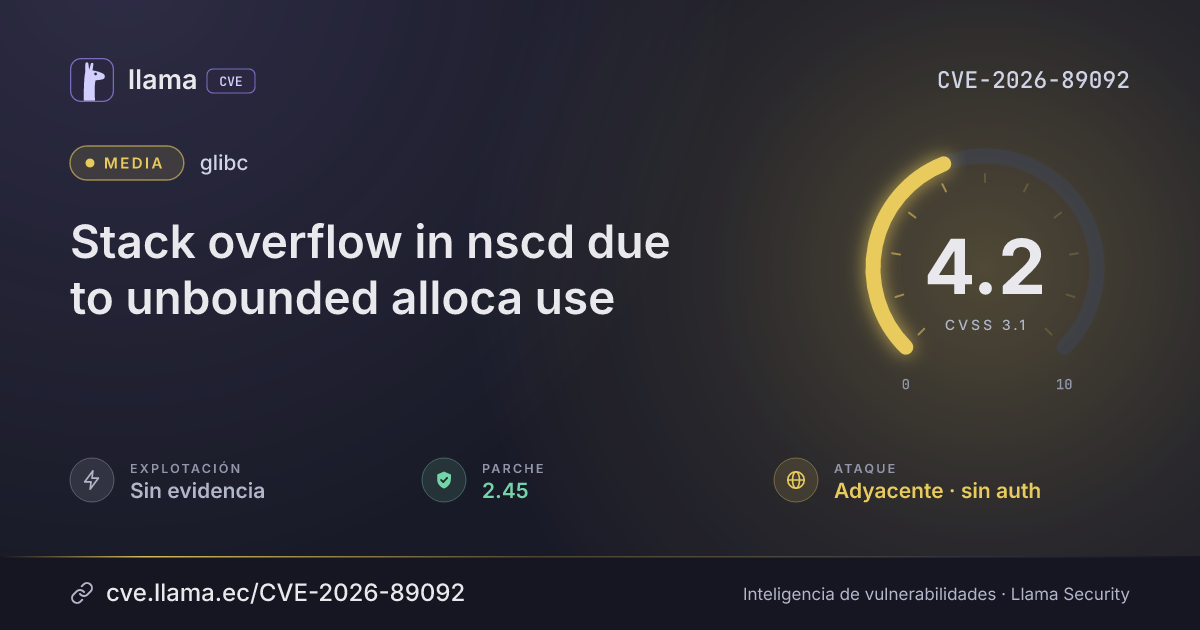
CVE-2026-89092
Stack overflow in nscd due to unbounded alloca use
CVSS:3.1/AV:A/AC:H/PR:N/UI:N/S:U/C:N/I:L/A:L
Fuente: CNA
Ciclo de vida de la vulnerabilidad
| Fecha | Fase | Evento | Detalle |
|---|---|---|---|
| Divulgación | Publicada | CVE-2026-89092 divulgada · CVSS 4.2 (CNA) | |
| Divulgación | Evaluación SSVC | CISA-ADP · explotación ninguna | |
| Divulgación | Modificada | Última actualización del registro | |
| Monitoreo | Detectada | Ingresó al índice |
The nscd service in the GNU C Library 2.3.4 onwards may crash due to a stack overflow when a malicious DNS server returns too large a response for a DNS query, resulting in degraded DNS resolution for the system. Exploitation of this bug needs a system that has nscd enabled and using an untrusted DNS server for name resolution, with the compromised DNS server being capable of processing records large enough to result in a stack overflow in an nscd thread stack. During experimentation, bind 9 was unable to handle large records, but that could change in future or with a different name server. In typical installations, nscd is executed in an isolated context as its own user without a shell, due to which any compromise of that service is isolated. There is a remote possibility of nscd cache corruption if an attacker manages to get the stack pointer into a desired point in the heap, potentially resulting in other caches in nscd being overwritten with corrupt data through the stack overflow, until the buggy code path eventually results in a crash. Finally, a crash in nscd may result in performance degradation when resolving names, but it does not result in a denial of service.
Desglose de métricas
Rangos afectados
Estado del parche por paquete
| Paquete / producto | Estado | Corregida en | Desde divulgación | Última versión |
|---|---|---|---|---|
glibc |
Corregida | 2.45 | — | — |
2.45Arsenal público
Sin exploits, módulos ni PoC públicos conocidos a la fecha de verificación.
https://sourceware.org/git/?p=glibc.git;a=blob_plain;f=advisories/GLIBC-SA-2026-0016https://sourceware.org/bugzilla/show_bug.cgi?id=34624http://www.openwall.com/lists/oss-security/2026/09/11/2Las referencias externas se muestran para copiar: cve.llama.ec no lo redirige a otros sitios.