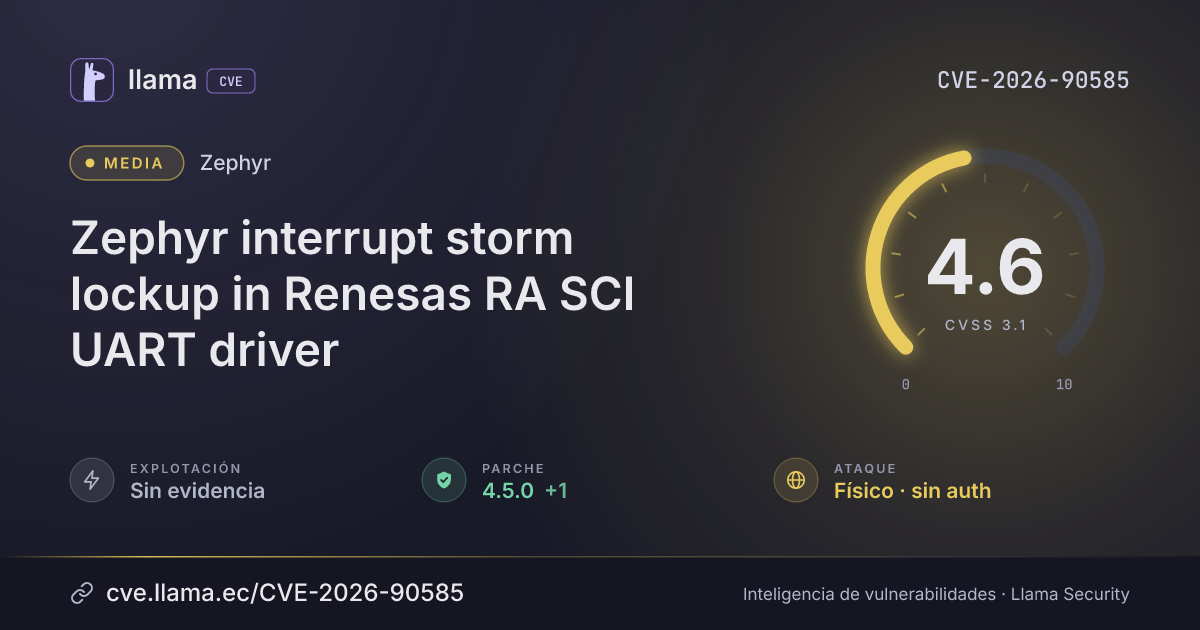
CVE-2026-90585
Zephyr interrupt storm lockup in Renesas RA SCI UART driver
An attacker with physical serial access can freeze the CPU using one malformed frame until a reset occurs.
CVSS:3.1/AV:P/AC:L/PR:N/UI:N/S:U/C:N/I:N/A:H
Fuente: CNA
Ciclo de vida de la vulnerabilidad
| Fecha | Fase | Evento | Detalle |
|---|---|---|---|
| Divulgación | Publicada | CVE-2026-90585 divulgada · CVSS 4.6 (CNA) | |
| Monitoreo | Detectada | Ingresó al índice | |
| Divulgación | Evaluación SSVC | CISA-ADP · explotación ninguna | |
| Divulgación | Modificada | Última actualización del registro | |
| Monitoreo | Fuente: OSV | Registro visto por primera vez en OSV | |
| Monitoreo | Fuente: NIST NVD | Registro visto por primera vez en NIST NVD | |
| Monitoreo | Verificada | Última verificación contra las fuentes |
Zephyr's Renesas RA SCI UART driver can be locked up by an attacker with physical access to the serial link, who needs no login or user action. A single receive error, such as a break or a frame at a mismatched baud rate, leaves the error interrupt firing endlessly and captures the CPU until an external reset or hardware watchdog intervenes, causing denial of service only.
Descripción original del registro (zephyr)
The Renesas RA SCI UART driver's receive-error ISR, uart_ra_sci_eri_isr() in drivers/serial/uart_renesas_ra_sci.c, acknowledged the error condition only when a Zephyr interrupt-driven callback had already been registered. With CONFIG_UART_INTERRUPT_DRIVEN=y and CONFIG_UART_ASYNC_API=n, if data->user_cb is NULL the ISR body is empty: the SCI error flags (SSR.ORER, SSR.FER, SSR.PER) are left set and the ICU event flag R_ICU->IELSR_b[eri_irq].IR is never cleared, so the interrupt re-pends immediately and the ISR is re-entered without end. The error interrupt is masked at boot by uart_ra_sci_init(), but FSP's R_SCI_UART_Open() unconditionally re-enables it, and uart_ra_sci_configure() - the back end of the public uart_configure() API, enabled by default via CONFIG_UART_USE_RUNTIME_CONFIGURE - performs a Close()/Open() pair without re-masking it. Any runtime uart_configure() therefore leaves the error interrupt live regardless of whether a callback has been set, as does calling uart_irq_err_enable() on its own. An instance used with the polling API, or the window between uart_configure() and uart_irq_callback_user_data_set(), thus runs with the error interrupt unmasked and no callback registered. The trigger is an ordinary receive line error - overrun, framing, parity, or a break condition - which is fully determined by the device attached to the serial link. A peer able to assert a break or transmit at a mismatched baud rate produces such an error at will, so a single frame is enough to enter the state. The impact is availability only: the CPU is captured in the re-entering ISR and never returns to thread context, hanging the entire system until an external reset or hardware watchdog fires. There is no memory corruption or information disclosure. Builds using the asynchronous UART API are unaffected, because the fall-through to FSP's sci_uart_eri_isr() clears both the error flags and the pending IRQ.
Desglose de métricas
Rangos afectados
Estado del parche por paquete
| Paquete / producto | Estado | Corregida en | Desde divulgación | Última versión |
|---|---|---|---|---|
zephyr |
Corregida | 4.3.2, 4.5.0 | — | — |
4.3.24.5.0Arsenal público
Sin exploits, módulos ni PoC públicos conocidos a la fecha de verificación.
https://github.com/zephyrproject-rtos/zephyr/security/advisories/GHSA-p99p-qqr7-mqcxhttps://github.com/zephyrproject-rtos/zephyr/commit/acfc8ca181600e8ca3a13f94c96e7da89e1e86ceLas referencias externas se muestran para copiar: cve.llama.ec no lo redirige a otros sitios.