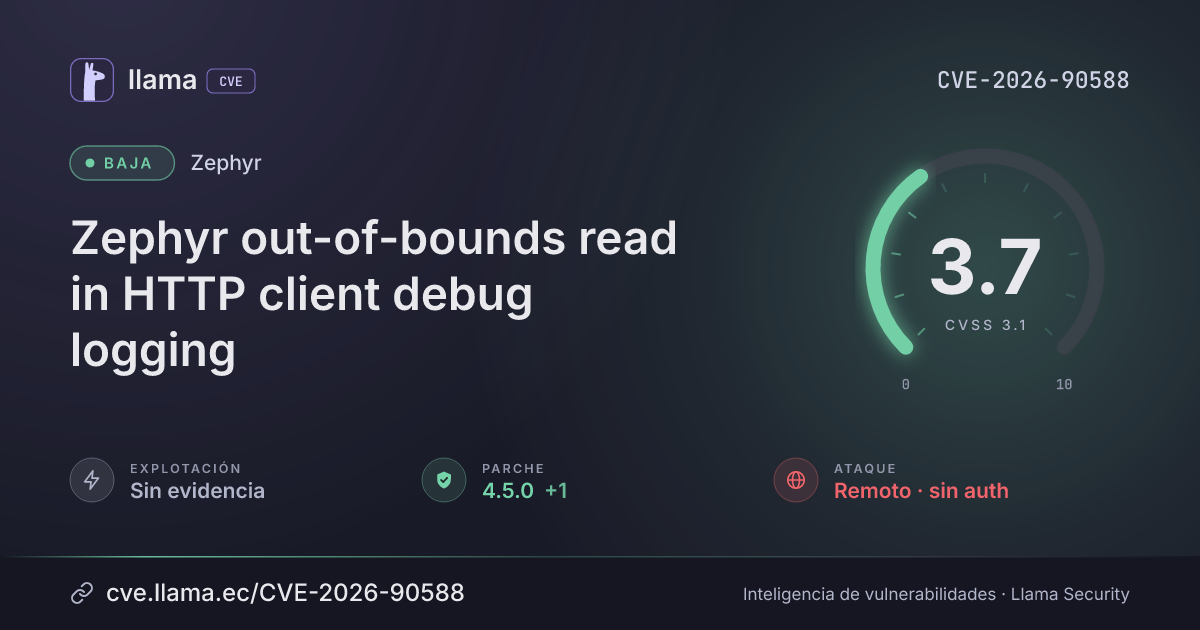
CVE-2026-90588
Zephyr out-of-bounds read in HTTP client debug logging
A remote attacker without logging in can make a device read past its receive buffer, crashing or panicking it.
CVSS:3.1/AV:N/AC:H/PR:N/UI:N/S:U/C:N/I:N/A:L
Fuente: CNA
Ciclo de vida de la vulnerabilidad
| Fecha | Fase | Evento | Detalle |
|---|---|---|---|
| Divulgación | Publicada | CVE-2026-90588 divulgada · CVSS 3.7 (CNA) | |
| Monitoreo | Detectada | Ingresó al índice | |
| Divulgación | Evaluación SSVC | CISA-ADP · explotación ninguna | |
| Divulgación | Modificada | Última actualización del registro | |
| Monitoreo | Fuente: OSV | Registro visto por primera vez en OSV | |
| Monitoreo | Fuente: NIST NVD | Registro visto por primera vez en NIST NVD | |
| Monitoreo | Verificada | Última verificación contra las fuentes |
The Zephyr HTTP client has an out-of-bounds read in its debug logging of response header fields. A remote attacker, without logging in, can make a device read past the end of its receive buffer, which can crash or panic the device; only builds with HTTP client debug logging enabled are affected.
Descripción original del registro (zephyr)
The HTTP client's debug helper print_header_field() in subsys/net/lib/http/http_client.c formatted an http_parser data-callback slice with a %s conversion: snprintk(output, len + 1, "%s", str). The parser hands its callbacks a pointer and a length into the caller's receive buffer, and those bytes are not NUL terminated. The size argument of snprintk() bounds only the destination, while the %s conversion measures the source first — lib/os/cbprintf_complete.c uses strlen() when no precision is given, and lib/os/cbprintf_nano.c uses strlen() unconditionally — so the read walks past the end of the header field and past the end of the receive buffer until it finds a zero byte. The slice reaches the helper from on_url(), on_header_field() and on_header_value(), which the parser invokes on bytes that http_wait_data() read straight off the socket into the application-supplied recv_buf. A malicious or compromised HTTP server, or an attacker able to answer a plaintext request, therefore controls both the header field and the bytes that follow it in the buffer, and can guarantee that no zero byte appears before the buffer ends, forcing the over-read. The in-tree tests/net/lib/http_client suite reproduces the over-read under CONFIG_ASAN=y on an ordinary GET. The impact is bounded. The whole helper body is compiled only when the HTTP client log module is explicitly set to Debug (CONFIG_NET_HTTP_LOG_LEVEL_DBG=y, which the global CONFIG_LOG_DEFAULT_LEVEL does not set), so default builds are unaffected. No out-of-bounds write occurs and none of the over-read bytes are emitted into the log, so there is no information disclosure; the consequence is an out-of-bounds read that can fault and panic the device where the buffer abuts an unmapped or MPU/MMU-protected region. The fix copies exactly the len bytes the parser offered with memcpy() and terminates them, instead of relying on a %s conversion (a %.*s precision would not have sufficed, since cbprintf_nano.c measures the source in full before applying it).
Desglose de métricas
Rangos afectados
Estado del parche por paquete
| Paquete / producto | Estado | Corregida en | Desde divulgación | Última versión |
|---|---|---|---|---|
zephyr |
Corregida | 4.3.2, 4.5.0 | — | — |
4.3.24.5.0Arsenal público
Sin exploits, módulos ni PoC públicos conocidos a la fecha de verificación.
https://github.com/zephyrproject-rtos/zephyr/security/advisories/GHSA-pmg7-7q9m-mx35https://github.com/zephyrproject-rtos/zephyr/commit/0b2d0c2609cb0a4cd5cd82d2471e9ce8e3a14a8dLas referencias externas se muestran para copiar: cve.llama.ec no lo redirige a otros sitios.