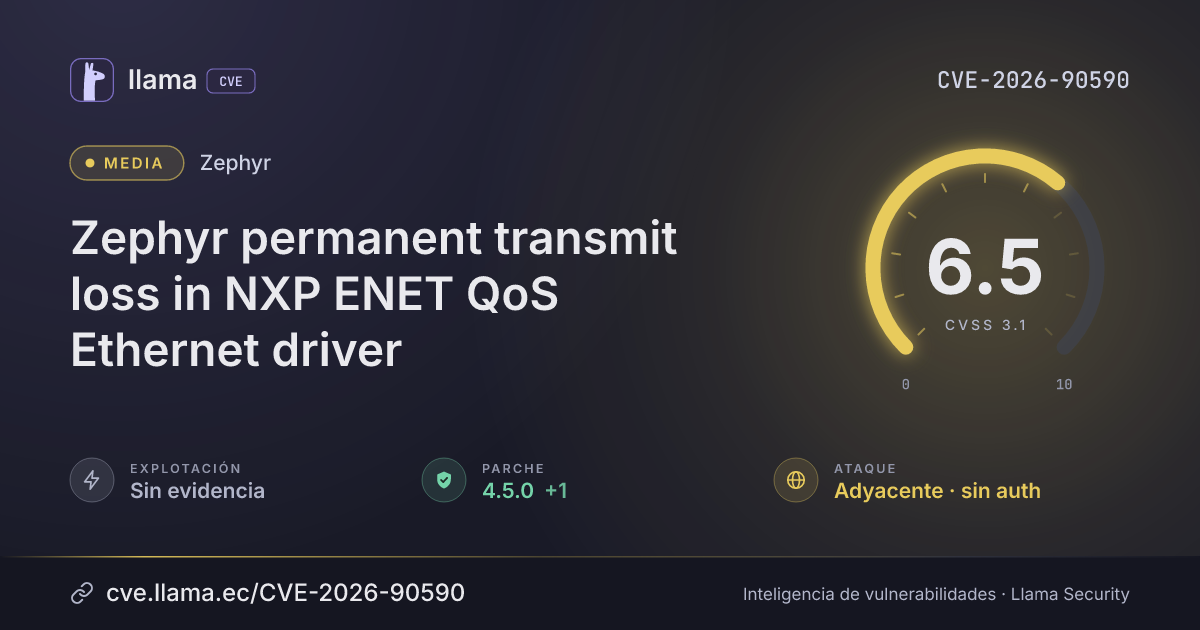
CVE-2026-90590
Zephyr permanent transmit loss in NXP ENET QoS Ethernet driver
An unauthenticated attacker on the local network can cut the link and stop the device from sending until it is reset.
CVSS:3.1/AV:A/AC:L/PR:N/UI:N/S:U/C:N/I:N/A:H
Fuente: CNA
Ciclo de vida de la vulnerabilidad
| Fecha | Fase | Evento | Detalle |
|---|---|---|---|
| Divulgación | Publicada | CVE-2026-90590 divulgada · CVSS 6.5 (CNA) | |
| Monitoreo | Detectada | Ingresó al índice | |
| Divulgación | Evaluación SSVC | CISA-ADP · explotación ninguna | |
| Divulgación | Modificada | Última actualización del registro | |
| Monitoreo | Fuente: OSV | Registro visto por primera vez en OSV | |
| Monitoreo | Fuente: NIST NVD | Registro visto por primera vez en NIST NVD | |
| Monitoreo | Verificada | Última verificación contra las fuentes |
The NXP ENET QoS Ethernet driver can permanently stop transmitting after a momentary Ethernet link drop, so the interface keeps receiving but cannot send anything until the device is reset. An attacker on the adjacent network, without logging in, can trigger this by flapping the link at the right moment, causing a denial of service that lasts beyond the attacker's access to the link.
Descripción original del registro (zephyr)
The NXP ENET QoS Ethernet driver in drivers/ethernet/eth_nxp_enet_qos serialises transmission with a binary semaphore, data->tx.tx_sem, taken in eth_nxp_enet_qos_tx() and returned only by the transmit-completion interrupt handler tx_dma_done(). A frame that has been handed to the transmit DMA when the Ethernet link goes down is never written back, so that completion interrupt never arrives. The PHY callback eth_nxp_enet_qos_phy_cb() reacts to carrier loss only by calling net_eth_carrier_set(); it does not stop the DMA, take the descriptors back or release the outstanding frame, and no timeout exists to do so. The trigger is a link-down/link-up transition that lands while a frame is under the transmit DMA. It can be produced by anyone who controls the link partner or the cable — for example by administratively downing and restoring the attached switch port, or by restarting auto-negotiation from a peer device — and can be made reliable by generating traffic that keeps the device transmitting and repeating the transition. No credentials or user interaction are required, and the trigger is at the link layer rather than over IP. Because the semaphore is never given back, every subsequent call to eth_nxp_enet_qos_tx() fails with -EBUSY for the remaining life of the boot; restoring the link does not recover the interface, since the link-up path only rewrites MAC_CONFIGURATION. The affected interface continues to receive but can no longer transmit anything — no ARP replies, no TCP acknowledgements, no DHCP renewals — until the device is reset. The net_pkt and the net_buf fragments of the abandoned frame are likewise never unreferenced and never return to their pools. The security-relevant property is persistence: a momentary link flap leaves the interface permanently unable to send, so the denial of service outlasts the attacker's access to the link. There is no confidentiality or integrity impact. The fix adds a claim/release pair around the outstanding packet so that completion and abandonment are mutually exclusive, aborts an outstanding frame from the PHY callback on carrier loss (stopping the DMA, flushing the MTL transmit queue and reinitialising the descriptor ring), and arms a transmit watchdog, CONFIG_ETH_NXP_ENET_QOS_TX_TIMEOUT_MS, so that any non-completing DMA — not only a carrier loss — reclaims the transmit slot and the packet.
Desglose de métricas
Rangos afectados
Estado del parche por paquete
| Paquete / producto | Estado | Corregida en | Desde divulgación | Última versión |
|---|---|---|---|---|
zephyr |
Corregida | 4.3.2, 4.5.0 | — | — |
4.3.24.5.0Arsenal público
Sin exploits, módulos ni PoC públicos conocidos a la fecha de verificación.
https://github.com/zephyrproject-rtos/zephyr/security/advisories/GHSA-996m-g5pm-w3gvhttps://github.com/zephyrproject-rtos/zephyr/commit/b099a89cf2a06b410c91f8cd8453d2d0cd2d6fedLas referencias externas se muestran para copiar: cve.llama.ec no lo redirige a otros sitios.