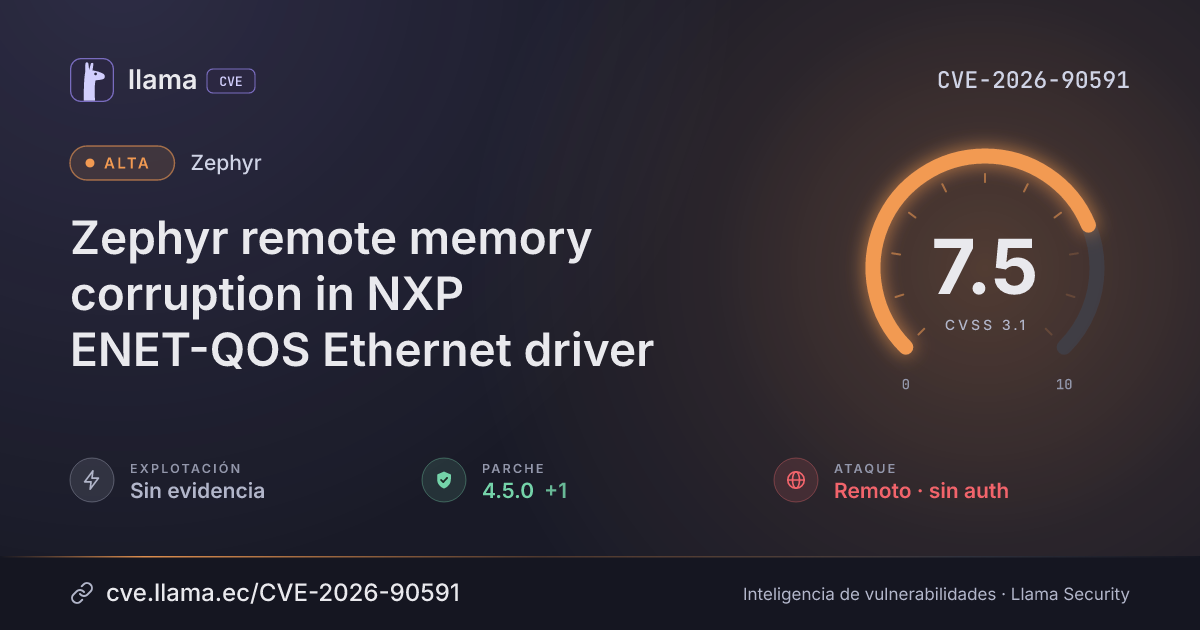
CVE-2026-90591
Zephyr remote memory corruption in NXP ENET-QOS Ethernet driver
Remote attackers can send a few frames to stop reception until reboot or feed stale data to the network stack.
CVSS:3.1/AV:N/AC:L/PR:N/UI:N/S:U/C:N/I:N/A:H
Fuente: CNA
Ciclo de vida de la vulnerabilidad
| Fecha | Fase | Evento | Detalle |
|---|---|---|---|
| Divulgación | Publicada | CVE-2026-90591 divulgada · CVSS 7.5 (CNA) | |
| Monitoreo | Detectada | Ingresó al índice | |
| Divulgación | Evaluación SSVC | CISA-ADP · explotación ninguna | |
| Divulgación | Modificada | Última actualización del registro | |
| Monitoreo | Fuente: OSV | Registro visto por primera vez en OSV | |
| Monitoreo | Fuente: NIST NVD | Registro visto por primera vez en NIST NVD | |
| Monitoreo | Verificada | Última verificación contra las fuentes |
The NXP ENET-QOS Ethernet driver can be remotely attacked without logging in, by sending a short burst of network frames that makes it re-arm receive descriptors with corrupted DMA buffer addresses. An attacker can use this to trigger a fatal bus error that permanently stops packet reception until the device is rebooted, and on some hardware it can instead deliver stale buffer contents to the network stack as if they were received frames.
Affects Zephyr 4.2.x before 4.3.2 and 4.4.x before 4.5.0 when the NXP ENET-QOS Ethernet driver is used. Fixed in 4.3.2 and 4.5.0.
Descripción original del registro (zephyr)
The NXP ENET-QOS Ethernet driver's receive work handler eth_nxp_enet_qos_rx() in drivers/ethernet/eth_nxp_enet_qos hands each processed descriptor back to the DMA by writing desc->read.control = rx_desc_refresh_flags, which sets OWN_FLAG and BUF1_ADDR_VALID_FLAG. RDES0 of a receive descriptor is the DMA buffer address in read format, but the hardware write-back aliases that word with the VLAN tag fields (or, for a context descriptor, the timestamp low word), so it is destroyed on every completion. The success path rewrites desc->read.buf1_addr before re-arming; the four drop paths — errored or non-first descriptor, net_pkt_rx_alloc() failure, invalid descriptor length, and net_pkt_get_frag() failure — did not, re-arming the ring slot with the write-back residue as its DMA target address. The drop paths are driven entirely by received traffic and need no privilege or special configuration. With the defaults for this driver (CONFIG_NET_BUF_DATA_SIZE of 128 and 16 receive descriptors) a single full-size frame consumes twelve ring slots and twelve K_NO_WAIT fragment allocations, so a short burst of frames sent to the device exhausts the receive pools and reaches the allocation-failure paths; a frame with a receive error, or any frame whose first descriptor was already dropped, reaches the non-first-descriptor path. Once a slot has been poisoned, the DMA writes the next frame received in that slot to an address derived from the frame's VLAN tag fields rather than to a receive buffer. On the supported MCX SoCs that address falls in flash or reserved space, so the transfer raises a fatal bus error that the driver only logs — there is no reset or recovery path — and reception stops permanently until the device is rebooted; where the write is silently discarded instead, the untouched buffer is later handed to the network stack with a length, delivering stale buffer contents as if they were a received frame. A single triggering event is enough to make the condition persistent, so an attacker able to send traffic to the device can permanently disable its network interface.
Condiciones y alcance
Desglose de métricas
Rangos afectados
Estado del parche por paquete
| Paquete / producto | Estado | Corregida en | Desde divulgación | Última versión |
|---|---|---|---|---|
zephyr |
Corregida | 4.3.2, 4.5.0 | — | — |
4.3.24.5.0Arsenal público
Sin exploits, módulos ni PoC públicos conocidos a la fecha de verificación.
https://github.com/zephyrproject-rtos/zephyr/security/advisories/GHSA-pm7x-98w8-92pmhttps://github.com/zephyrproject-rtos/zephyr/commit/9efd144a4ab0f37311f7b5e5ed0967f5a8d2f910Las referencias externas se muestran para copiar: cve.llama.ec no lo redirige a otros sitios.