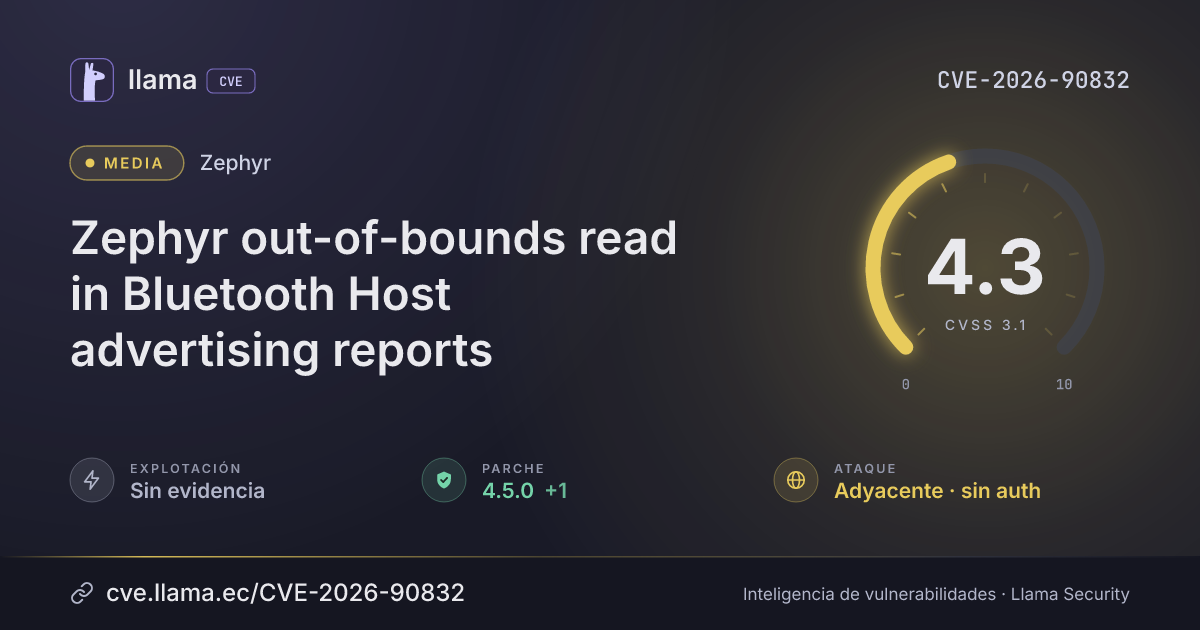
CVE-2026-90832
Zephyr out-of-bounds read in Bluetooth Host advertising reports
An adjacent attacker can read nearby memory, including stale HCI event data, and pass it off as advertising data.
CVSS:3.1/AV:A/AC:L/PR:N/UI:N/S:U/C:L/I:N/A:N
Fuente: CNA
Ciclo de vida de la vulnerabilidad
| Fecha | Fase | Evento | Detalle |
|---|---|---|---|
| Divulgación | Publicada | CVE-2026-90832 divulgada · CVSS 4.3 (CNA) | |
| Monitoreo | Detectada | Ingresó al índice | |
| Divulgación | Evaluación SSVC | CISA-ADP · explotación ninguna | |
| Divulgación | Modificada | Última actualización del registro | |
| Monitoreo | Fuente: OSV | Registro visto por primera vez en OSV | |
| Monitoreo | Verificada | Última verificación contra las fuentes |
Zephyr's Bluetooth Host stack has an out-of-bounds read in periodic advertising report handling that an attacker on an adjacent network can trigger without logging in or taking any user action. The attacker can read nearby memory, including stale contents of earlier HCI events, and have it delivered to advertising data listeners as if it were genuine advertising data.
Descripción original del registro (zephyr)
bt_hci_le_per_adv_report_common() in subsys/bluetooth/host/scan.c handles the HCI_LE_Periodic_Advertising_Report (and _v2) event. It verified that the fixed event header was present and that the controller-declared Data_Length fits the tailroom of the periodic-sync reassembly buffer, but never checked that the event actually carried as many data bytes as evt->length claims. Both reassembly paths — DATA_STATUS_PARTIAL, and DATA_STATUS_COMPLETE while a chain is already in progress — then called net_buf_simple_add_mem(&per_adv_sync->reassembly, buf->data, evt->length), copying up to 255 bytes starting past the end of the event's real payload. The Data_Length field originates in the HCI controller, so the flaw is reachable in host-only/split builds where the controller is a separate part reached over H4 UART, SPI, USB or an inter-core IPC transport: a malicious, compromised or buggy controller (or an attacker able to inject on that link) can send a report declaring a length larger than the event payload. The generic event dispatcher in subsys/bluetooth/host/hci_core.c only enforces a per-event minimum length and never cross-checks the subevent's internal length field, so nothing else catches it. Builds using Zephyr's own in-image controller are not affected, because the controller always emits a length matching the bytes it appends. Exploitation additionally requires CONFIG_BT_PER_ADV_SYNC with CONFIG_BT_PER_ADV_SYNC_BUF_SIZE > 0 (the option defaults to 0, which compiles the reassembly block out; LE Audio broadcast-sink and Public Broadcast Profile applications that reassemble fragmented periodic advertising data set it), and an established periodic advertising sync. The consequence is an out-of-bounds read of adjacent HCI RX-pool memory — including stale contents of previously received HCI events — which is copied into the reassembly buffer and then delivered to every registered bt_le_per_adv_sync_cb.recv listener as if it were received advertising data, so the disclosed memory becomes application-visible and may be forwarded off-device. The write side remains in bounds because the tailroom check uses the same length value, so there is no memory corruption; impact is limited to information disclosure and undefined behaviour on the over-read. The fix drops any report whose declared length exceeds the remaining event payload, matching the guard already present in the extended and legacy advertising report handlers.
Desglose de métricas
Rangos afectados
Estado del parche por paquete
| Paquete / producto | Estado | Corregida en | Desde divulgación | Última versión |
|---|---|---|---|---|
zephyr |
Corregida | 4.3.2, 4.5.0 | — | — |
4.3.24.5.0Arsenal público
Sin exploits, módulos ni PoC públicos conocidos a la fecha de verificación.
https://github.com/zephyrproject-rtos/zephyr/security/advisories/GHSA-2q4q-gv2c-997jhttps://github.com/zephyrproject-rtos/zephyr/commit/e9c3252c244b094b9caf6f426ffb77c509e58a9fLas referencias externas se muestran para copiar: cve.llama.ec no lo redirige a otros sitios.