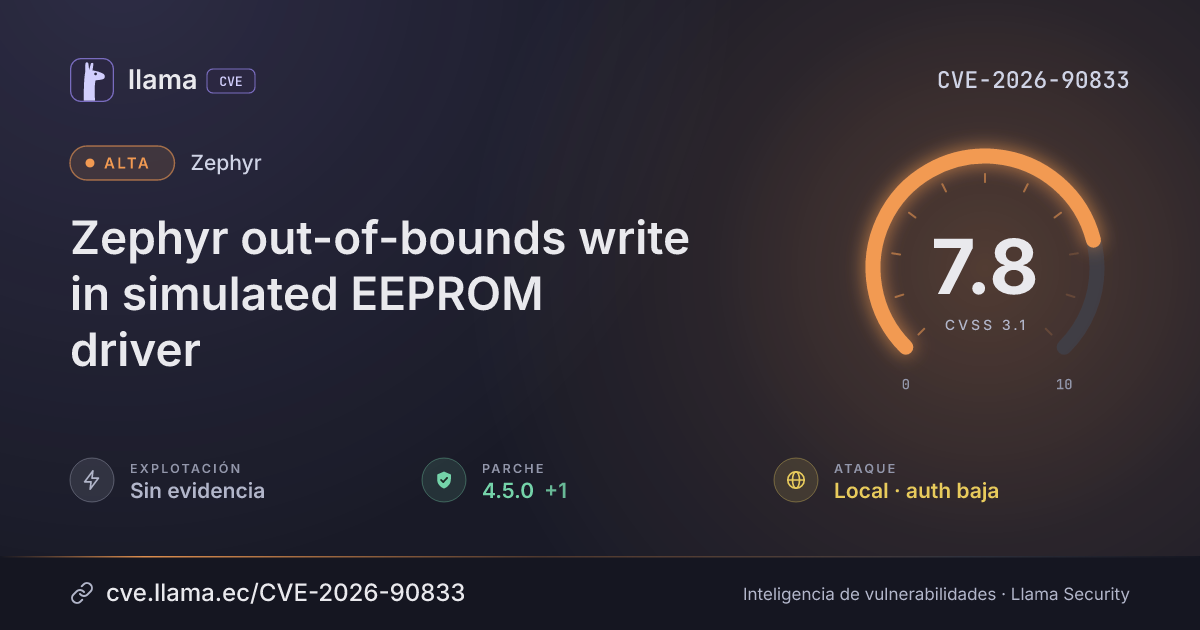
CVE-2026-90833
Zephyr out-of-bounds write in simulated EEPROM driver
A user-mode thread can read and overwrite kernel memory by passing a negative offset to the EEPROM API.
CVSS:3.1/AV:L/AC:L/PR:L/UI:N/S:U/C:H/I:H/A:H
Fuente: CNA
Ciclo de vida de la vulnerabilidad
| Fecha | Fase | Evento | Detalle |
|---|---|---|---|
| Divulgación | Publicada | CVE-2026-90833 divulgada · CVSS 7.8 (CNA) | |
| Monitoreo | Detectada | Ingresó al índice | |
| Divulgación | Evaluación SSVC | CISA-ADP · explotación ninguna | |
| Divulgación | Modificada | Última actualización del registro | |
| Monitoreo | Fuente: OSV | Registro visto por primera vez en OSV | |
| Monitoreo | Verificada | Última verificación contra las fuentes |
The simulated EEPROM driver validated access ranges in eeprom_range_is_valid() (drivers/eeprom/eeprom_simulator.c) with a single test, (offset + len) <= config->size. Because offset is a signed off_t and len an unsigned size_t of the same rank, the addition is evaluated in unsigned arithmetic: a negative offset combined with a compensating len wraps the sum back into the accepted range. eeprom_sim_read() and eeprom_sim_write() then memcpy() through the EEPROM(addr) macro, which is plain pointer arithmetic on the driver's static mock_eeprom array, so the copy addresses memory located before that array. eeprom_read() and eeprom_write() are __syscall entry points, and their verification handlers in drivers/eeprom/eeprom_handlers.c check only the device object and the caller's own data buffer (K_SYSCALL_MEMORY_READ/K_SYSCALL_MEMORY_WRITE) — the offset argument is passed to the driver unvalidated. With CONFIG_USERSPACE=y, a CONFIG_EEPROM_SIMULATOR device instance, and the device object granted to a user thread (the usage the in-tree tests/drivers/eeprom/api suite exercises from ZTEST_USER threads), an unprivileged thread could supply a negative offset and have the kernel perform the copy on its behalf. The result is an out-of-bounds read of kernel .bss returned into the caller's buffer and, via the write path, an out-of-bounds write of caller-supplied bytes over kernel memory preceding mock_eeprom. Both the start address and the length of the affected span are attacker-selected, so the primitive is sufficient to corrupt adjacent kernel state and escape the user-mode sandbox. Exposure is limited to builds that instantiate the simulated EEPROM (status = "okay" by default on qemu_x86 and native_sim, otherwise added by a devicetree overlay) together with userspace isolation. The fix rejects negative offsets and performs the remaining bound check without overflow.
Only affects Zephyr builds with CONFIG_USERSPACE enabled and a CONFIG_EEPROM_SIMULATOR device instance whose device object is granted to a user thread. Fixed in 4.3.2 and 4.5.0.
Condiciones y alcance
Desglose de métricas
Rangos afectados
Estado del parche por paquete
| Paquete / producto | Estado | Corregida en | Desde divulgación | Última versión |
|---|---|---|---|---|
zephyr |
Corregida | 4.3.2, 4.5.0 | — | — |
4.3.24.5.0Arsenal público
Sin exploits, módulos ni PoC públicos conocidos a la fecha de verificación.
https://github.com/zephyrproject-rtos/zephyr/security/advisories/GHSA-vf6j-hcx8-44vhhttps://github.com/zephyrproject-rtos/zephyr/commit/ce2ec9b3a34d71f52f5d1d7491b91393e334713eLas referencias externas se muestran para copiar: cve.llama.ec no lo redirige a otros sitios.