ExplotaciónSin evidenciaSSVC: none · no figura en CISA KEV
Exploits públicos0Ninguno conocido
Parche1 versión5.0.0-rc.14
Exposición63 dDesde la divulgación, 17 sept 2026, 10:19 a. m.
Detección60 dDesde la divulgación hasta su ingreso al índice
Decisión SSVCSeguir de cerca
Monitorear y programar la remediación
Sin explotación conocida, no automatizable e impacto técnico total. Hay versiones corregidas disponibles.
Timeline
Ciclo de vida de la vulnerabilidad
Hoy
Divulgación
Publicada +1
Modificada
Explotación
Remediación
Monitoreo
Detectada
Verificada
17 sept 26
17 nov 26
19 nov 26
17 sept 26
3 oct 26
19 oct 26
3 nov 26
19 nov 26
Fecha
Fase
Evento
Detalle
Divulgación
Publicada
CVE-2026-91039 divulgada · CVSS 9.1 (CNA)
Divulgación
Evaluación SSVC
CISA-ADP · explotación ninguna
Monitoreo
Detectada
Ingresó al índice
Divulgación
Modificada
Última actualización del registro
Monitoreo
Verificada
Última verificación contra las fuentes
Resumen
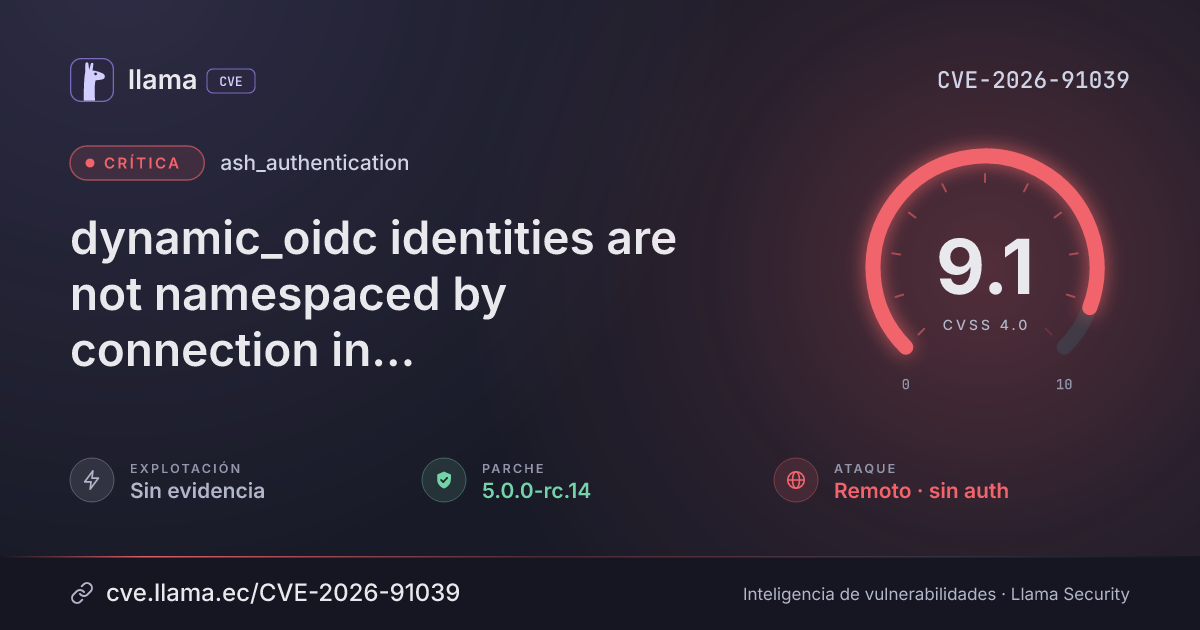
Authentication Bypass by Spoofing vulnerability in team-alembic ash_authentication allows an attacker who operates one identity-provider connection of a dynamic_oidc strategy to be signed in as a local user established through a different connection.
The strategy is meant to keep each connection in its own identity namespace by writing every UserIdentity row's strategy field as "<name>/<connection_id>", but that namespacing never takes effect. __connection_id__ is populated only on the ephemeral runtime struct built per request in dynamic_oidc/plug.ex, and DynamicOidc.IdentityChange.change/3 re-fetches the strategy from the compile-time DSL through Info.strategy_for_action, yielding the persisted struct whose __connection_id__ is its defstruct default of nil. OAuth2.identity_strategy_name/1 therefore falls back to the bare strategy name for both the identity write and the reads in oauth2/user_resolver.ex and oauth2/sign_in_preparation.ex. Since the identity resource's unique key is (uid, strategy), one row exists per sub across every connection, and the identity-match branch runs before any email check. Neither strategy handles iss, so nothing else distinguishes the issuers: OpenID Connect Core section 5.7 makes sub unique only within an issuer, so two connections numbering subjects independently share one subject space.
This issue affects ash_authentication: from 5.0.0-rc.10 before 5.0.0-rc.14.
Only affects ash_authentication from 5.0.0-rc.10 before 5.0.0-rc.14, in deployments running a dynamic_oidc strategy with more than one identity-provider connection. Fixed in 5.0.0-rc.14.
¿Qué significa?dynamic_oidc identities are not namespaced by connection, so an attacker who operates one identity-provider connection can be signed in as a local user established through a different connection, taking over that account.
¿Quién está afectado?ash_authentication from 5.0.0-rc.10 before 5.0.0-rc.14 is affected, and only where a dynamic_oidc strategy has more than one identity-provider connection. To check, look at the ash_authentication version in your dependency lock file and at how many connections your dynamic_oidc strategy is configured with.
¿Qué hacer?Upgrade ash_authentication to 5.0.0-rc.14 or later. The sources do not name vendor patch identifiers for this issue.
disagreeThe sources disagree on the attack vector. The description reads as a local attack, while the CVSS vector is marked network (AV:N), which gives a critical score of 9.1.
Contexto
Condiciones y alcance
Condiciones necesarias para que el fallo sea explotable
01
Deployment runs a dynamic_oidc strategy with more than one identity-provider connection.“Only deployments running a dynamic_oidc strategy with more than one identity-provider connection are exposed”
02
ash_authentication from 5.0.0-rc.10 before 5.0.0-rc.14.“This issue affects ash_authentication: from 5.0.0-rc.10 before 5.0.0-rc.14.”
¿Quién debe revisar?Teams running ash_authentication 5.0.0-rc.10 up to 5.0.0-rc.14 with a dynamic_oidc strategy and more than one identity-provider connection.
No protegeUpgrading alone does not fix it; existing identity rows must be relinked.
Discrepancias entre fuentesdescription-says-local-vector-says-AV:N
Vector CVSS 4.0
Desglose de métricas
Opción resaltada = valor del vector · izquierda = peor caso · CNA
Vector de ataqueAV:N
RedAdyacenteLocalFísica
ComplejidadAC:L
BajaAlta
Requisitos de ataqueAT:P
NingunoPresentes
PrivilegiosPR:N
NingunoBajosAltos
InteracciónUI:N
NingunaPasivaActiva
Confid. (sistema)VC:H
AltoBajoNinguno
Integridad (sistema)VI:H
AltoBajoNinguno
Disponib. (sistema)VA:N
AltoBajoNinguno
Confid. (posterior)SC:N
AltoBajoNinguno
Integridad (posterior)SI:N
AltoBajoNinguno
Disponib. (posterior)SA:N
AltoBajoNinguno
Versiones
Rangos afectados
AfectadaCorregida
ash_authentication≥ 5.0.0-rc.10 < 5.0.0-rc.14
5.0.0-rc.10
5.0.0-rc.14
Remediación
Estado del parche por paquete
Paquete / producto
Estado
Corregida en
Desde divulgación
Última versión
ash_authentication
Corregida
5.0.0-rc.14
—
—
Versiones corregidas5.0.0-rc.14
Explotación
Arsenal público
Sin exploits, módulos ni PoC públicos conocidos a la fecha de verificación.
Registro
EscenarioGENERALEEF
configurationOnly deployments running a dynamic_oidc strategy with more than one identity-provider connection are exposed, since a single connection has no second namespace to collide with.
Two partial mitigations exist and neither is sufficient. A confirmation add-on incidentally blocks the takeover only while the victim is unconfirmed, leaving confirmed victims and confirmation-free applications exposed. Ash multitenancy isolates only a one-connection-per-tenant topology, so non-multitenant deployments and tenants holding several connections get no isolation; connection namespacing is orthogonal to tenancy.EEF
solutionUpgrading is not sufficient on its own, for two reasons.
Namespacing changes the value the identity lookup keys on, so UserIdentity rows written before the fix, all holding the bare strategy name, no longer match. Each row's strategy must be relinked in place to "<name>/<connection_id>". Deleting the rows does not work: the block is the account match that follows, refused under the default on_untrusted_email_match :reject whether the row exists or not, and deleting also discards the stored refresh token. Where a deployment has one connection the mapping is unambiguous and the update is mechanical, but it must run in the same deployment as the upgrade and before users sign in, or a newly written namespaced row can collide with a surviving bare row on the (uid, strategy) index.
The fix also cannot separate accounts already merged, and the merge is not detectable from the database, because a collision never produced two rows to compare: the second user's identity was never created and the surviving row looks legitimate. Deployments running more than one connection must audit out of band, by exporting each connection's set of sub values from its identity provider and intersecting them. Any sub present in more than one set identifies an account that may have been merged.EEF
Usamos cookies propias estrictamente necesarias para que el sitio funcione y sea seguro. Con tu permiso, también usamos almacenamiento local para recordar tus preferencias y medir el uso del sitio de forma agregada. Puedes aceptar, rechazar o configurar cada categoría, y cambiar tu decisión cuando quieras desde el enlace “Preferencias de cookies” del pie de página. Más información
Preferencias de cookies
Elige qué permites
Solo usamos tecnologías propias de este dominio. Sin publicidad ni rastreadores de terceros. Detalle en la Política de cookies.